Financial advisors who engage with clients about their values and offer credible impact strategies can deepen their relationships and prepare for the Great Wealth Transfer.
Advisors “are the front door to this conversation,” says ImpactPHL’s Cory Donovan. “They already have the relationships, they already have the trust. They’re already managing the money.”
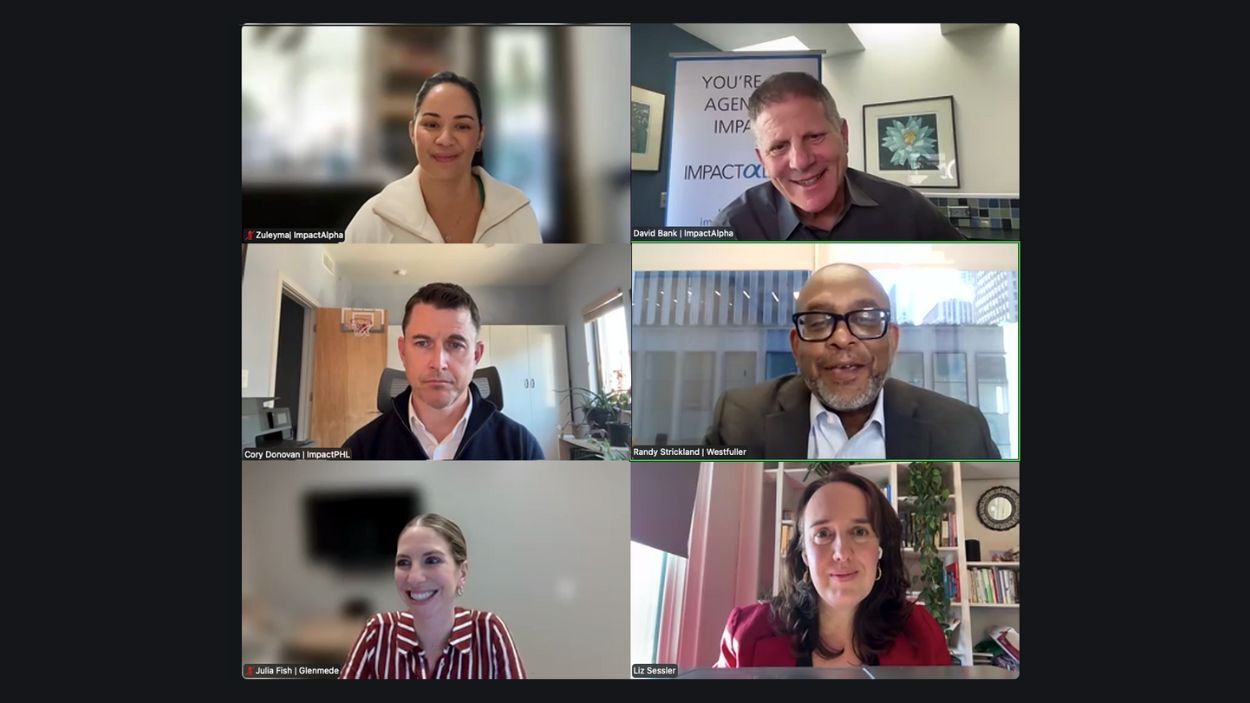
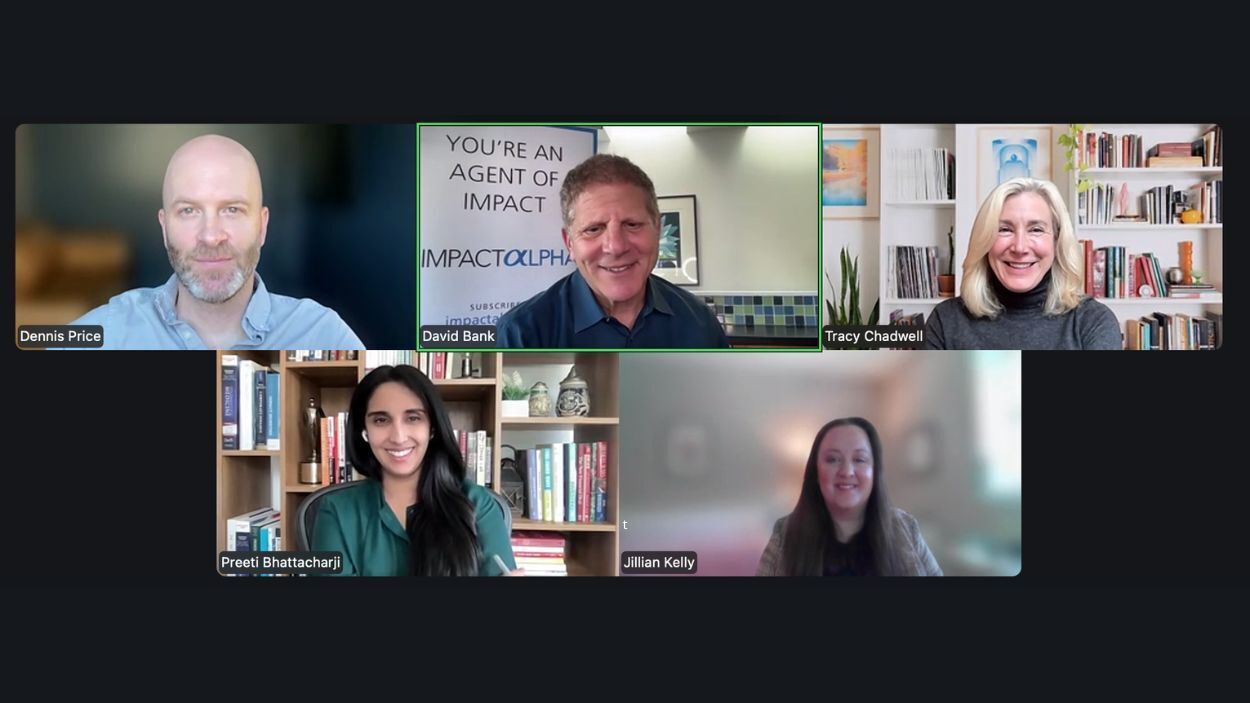
Donovan joined CapShift’s Liz Sessler, ImpactPHL’s Cory Donovan, Westfuller’s Randall Strickland, Glenmede’s Julia Fish and ImpactAlpha’s David Bank on Agents of Impact Call No. 75 to offer practical advice for advisors seeking to meet client demand for impact investment opportunities.
ImpactPHL’s Donovan has watched expectations shift in real time. When the locally-focused impact investment advocacy organization started in Philadelphia a decade ago, “what became clear to me was that most people, most asset owners, had not talked to their financial advisors about their values. They had never been asked about it.”
Fast forward, and more than a dozen foundations in the region have changed advisors in recent years as they sought deeper alignment between their portfolios and their missions.
“If you were a foundation here in Philly and you were doing this, people would probably raise an eyebrow and ask you if that was a good idea,” Donovan said. “I’m hoping that in another 10 years, if you’re not doing this, people will look at you with a you know, why not? What’s wrong?”
The foundations have also added local impact as a lens. “They’re telling the financial industry, we want you to help us find local investment opportunities and create local impact,” he said.
Wealth management firms like Westfuller and Glenmede have benefited from that shift.
Investment options, depending on the client, span public equities, private market investments, muni and social bonds, and investments in community development financial institutions.
Next gen
There are still obstacles. Liz Sessler of advisory firm CapShift identified a “chicken-and-egg” problem holding back progress.
“The client hires an advisor to be the expert, and they don’t want to be seen as foolish for asking about impact investing, for asking about values alignment,” Sessler explained. “And the advisor likes to be an expert, and so they stay focused on what they know and understand.”.
The nervousness exists on both sides. But Sessler sees opportunity in the discomfort. “This is a real opportunity for people to grow together,” she said.
Westfuller’s Strickland pointed to powerful tailwinds: a $125 trillion wealth transfer underway and a rising cohort of investors for whom purpose is not an afterthought.
“The next generation is more purpose-driven and does want to align their values with their investments” he said. “And then there are foundations that are realizing that their funds are out of step with their mission, and so are seeking to align.”
Westfuller is a B Corp certified wealth advisor that serves valued aligned individuals.
Terminology doesn’t help, Strickland adds. “This whole space is a little crazy. We’ve got, it’s a word salad, SRI, ESG, green, investing, impact, sustainable,” he said. “You can get three impact investors in a room and get five different definitions of what it means.”
But the core concept remains straightforward: “Generally speaking, it is about getting outcomes that are beneficial to people and planet, as well as getting financial returns.”
Meeting clients where they are
Glenmede’s Julia Fish offered a practical approach: skip the jargon and focus on what clients actually care about.
“Instead of focusing on ESG or sustainable or whatever words might trigger a certain response or create conflict within multi generational families, thinking about the specific themes that folks may care about,” Fish said.
“Let’s talk about how you think about your passions and your legacy and your purpose,” she suggested.
Fish recommended looking at charitable giving patterns. “You could look at someone’s charitable donation history and say, you know, there’s other ways to perhaps amplify some of the themes and the trends we see in your philanthropic giving through your portfolio.”
Glenmede, which started out managing the funds of the Pew Charitable Trust, works with clients allocating anywhere from 10% to 100% of portfolios to sustainable investing. “Most are on a journey approaching higher and higher levels of allocations,” Fish said. “We work to meet people where they are.”