
Longer lifespans, coupled with over-50 Americans’ spending power and productivity, are fueling a “longevity economy” that would rank third among the world’s largest economies. Impact investors are seizing opportunities to support adults as they age.
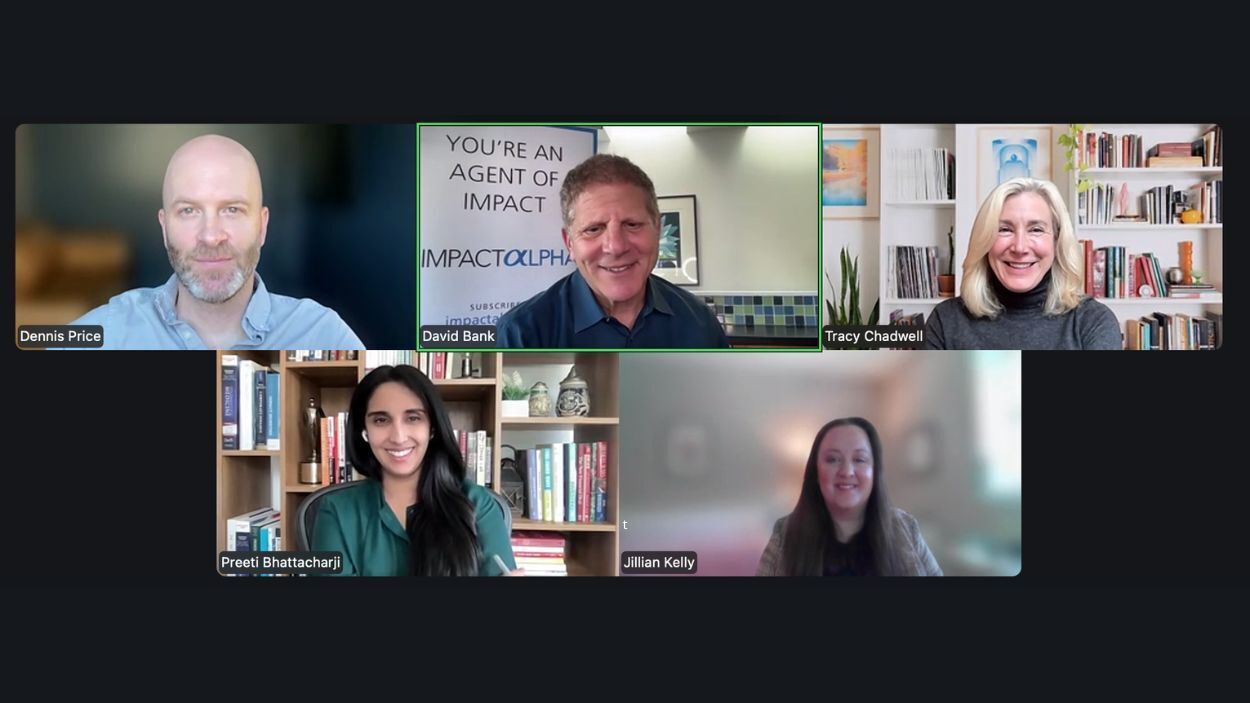
“Our focus is entirely on aging. That means older adults, the aging process, caregivers, everything that has to do with aging,” said Next50’s Jillian Kelly on this week’s Agents of Impact Call, which featured investors who are building portfolios that see aging as an economic and social asset. Next50 supports ImpactAlpha’s coverage theme, Valuing Aging.
The SCAN Foundation, a California nonprofit, is focusing on healthy aging for people of color, low-income adults, and rural residents through policy, programmatic grants and impact investments.
Colombia-based Fundación Arturo Sesana is investing to drive a more positive narrative around aging.
SE Impact Ventures, a Canadian impact venture fund, is backing businesses that are helping people age in place and access mental healthcare.
youtube.com/watch?v=K7UwyQNOw7g&feature=youtu.be
Valuing aging
Next50, a private foundation in Denver, is working to align 100% of its $265 million endowment to support healthy and dignified aging. Its portfolio is supporting access to transport and housing, health services, and economic opportunities for the fast-growing over-65 population. ImpactAlpha and Next50 are partnering to chronicle the foundation’s efforts to align its endowment with its programmatic mission.
Next50 will host a convening in Denver later this year with 150 foundations to explore how to invest in the longevity economy.
“We know that older adults need more resources, but they’re also a really powerful economic force,” said Kelly. “All of us are aging. That means so many different things for what we need as we go through that process.”
Aging-lens investing
Through a partnership with JPMorgan Chase, Next50 has developed an investment framework that analyzes public and private market investments through a lens of how they affect older adults, similar to how investors use gender-lens or climate-lens frameworks.
“It’s a lens you can use to evaluate any company, and then you can overlay that lens onto whatever universe of securities you need,” JPMorgan’s Preeti Bhattacharji explained.
The framework considers three main questions: Is this company a good employer of older adults? Does this company sell good products and services to older adults? And does the company have known violations or issues related to older adults?
“That became our starting place to say, ‘How do we build these portfolios, and how do we optimize these portfolios’,” Bhattacharji said.
The screenings have also surfaced a myriad of ways companies harm older adults, such as nursing home violations or medical malpractice.
“The thing I didn’t expect – which is rampant – is all kinds of financial engineering that has harmed and hurt older workers,” said Bhattacharji. JPMorgan identified numerous companies that failed to appropriately fund their workers’ retirement accounts. “That’s one of the clearest ways you can harm older populations.”
Longevity tech
The growing population of centenarians is projected to quadruple over the next 30 years, reaching nearly four million people by 2054. 1843 Capital, a Washington, DC-based fund manager backed by Next50, invests for the 100-plus lifespan.
“Your opportunity to get to 100, or even 105 or 120, has markedly increased,” said Tracy Chadwell of 1843. “Most people, when you ask them if they want to live past 100, will say no. But if you ask them, ‘Do you want to live a full, healthy life until your life is over? I think most people would say yes.'”
1843 Capital invests in early-stage technology ventures with solutions that are focused and designed with older adults and their caregivers. It targets businesses with “strong IPO potential”, such as Cariloop, a Texas-based company that pairs caregivers with care coaches to develop health and wellbeing plans; and Midi Health, which focuses on hormonal health support for women in menopause.
It has also invested in May Mobility, a Michigan-based startup that manages fleets of on-demand, autonomous vehicles in urban areas and rural towns in the US and Japan. It’s one of the few wheelchair accessible companies in the autonomous vehicle space. It offers free or subsidized shuttle services for people with disabilities and seniors in partnership with cities and rural municipalities. Chadwell says the company last year secured contracts with ride-hailing apps Uber and Lyft.
“Mobility is critical,” said Chadwell. “It’s critical for getting to the grocery store, getting your healthcare, getting to see friends and keeping social connections together.”