
A dozen private foundations in the greater Philadelphia area are working together to turn their endowments – not just their grants budget – toward local investment opportunities in small-business finance, inclusive homeownership strategies, affordable housing development and other community-led ventures and initiatives.
The foundations, with more than $400 million in combined assets, are working collaboratively through the Philanthropy Network Greater Philadelphia to share what’s working and working with local impact investment advisors, including Glenmede and Zenith Wealth Partners, to find local investment opportunities.
As with other elements of Philadelphia’s vibrant impact ecosystem, the foundations’ collaboration could be a model for local institutions to invest local assets in local initiatives in other places (see Margaret Bradley earlier Q&A, “Turning Philadelphia institutions into impact investors”). Aligning their endowments with their values and mission allows them to move more capital into local minority-owned small businesses, community-owned commercial real estate and local filmmakers and independent news organizations.
Foundations are usually the first movers of institutional capital in communities that are historically overlooked and underserved by traditional capital markets. They often use first-loss capital and guarantees to support early stage initiatives that need such risk-tolerant, flexible capital to catalyze additional investment from commercial investors.
Many of the foundations are small; that also makes them familiar with local challenges and opportunities. The Valentine Foundation, for example, has used grants and low-interest loans to support nonprofits and social enterprises working at the intersection of racial and gender justice. The foundation was founded in 1985 by local philanthropist Phoebe Valentine to empower women and girls.
“Mission-aligned investing is a whole new world,” said Alexandra Frazier, executive director of the foundation. Valentine is on track to align all of its $5 million endowment with its mission by the end of this year, up from 10% in 2019. It is looking to carve out 30% of the endowment for place-based investments.
Valentine’s mission-aligned portfolio includes Southwest Philly’s Girl Concrete, a Black and woman-owned commercial and residential construction company that hires female general contractors to lead its projects. Earlier this year, it backed Impax Asset Management’s Ellevate Global Women’s Leadership Fund, a global large-cap mutual fund that invests in companies working to advance gender diversity and equity in the workplace. The foundation has a gender-lens mandate to have at least 30% women in board leadership positions at its portfolio companies.
“We have a scoring matrix when we look at an investment, and it includes a gender and racial equity lens, to screen for the people that are running it and the people who are going to benefit from the investment,” Frazier told ImpactAlpha. “We use that as a guide to decide whether or not this is something that falls within our priorities.”
Agents of Impact
Few foundations had fully grasped the concept of mission-aligned investing a decade ago. Then came the region’s early adopters, Elizabeth Killough of the UnTours Foundation and Laura Kind McKenna of the Patricia Kind Foundation, who led a rallying cry to enlist other local foundations.
Both the Kind and UnTours foundations have since achieved 100% mission-alignment.
“Laura McKenna and Elizabeth Killough were really the first agitators around impact investing, and saying ‘You just need to do it,’” said Kristina Wahl, president of the Barra Foundation, which was founded in 1963 by American chemist Robert McNeil Jr., who through his family’s pharmaceutical company, McNeil Laboratories, developed Tylenol. They “kept on bullying me to do it,” Wahl joked.
Concerns about increased risk and lower returns have long kept many foundations invested in the broader public markets for stocks and bonds, rather than in local impact investments, which tend to be in private equity and private credit. Some larger foundations have pledged to move all or some of the endowments into mission-aligned investments, and have generally found that aligning their endowment dollars with their social and environmental missions can deliver competitive and risk-adjusted financial returns.
Unlike program-related investments, or PRIs, mission-aligned investments don’t count towards the 5% minimum annual grantmaking that the US Internal Revenue Service requires private foundations to deploy towards their charitable missions.
With approximately $93 million in assets, Barra has committed to use 95% of its endowment for mission-aligned, mission-related and responsible investments. Of that, an internal carveout provides catalytic capital to local projects in under-resourced Philly communities.
“It’s the ability of those dollars to unlock other dollars” that creates impact, Wahl says. “It’s the rates, but it’s also the length of time.”
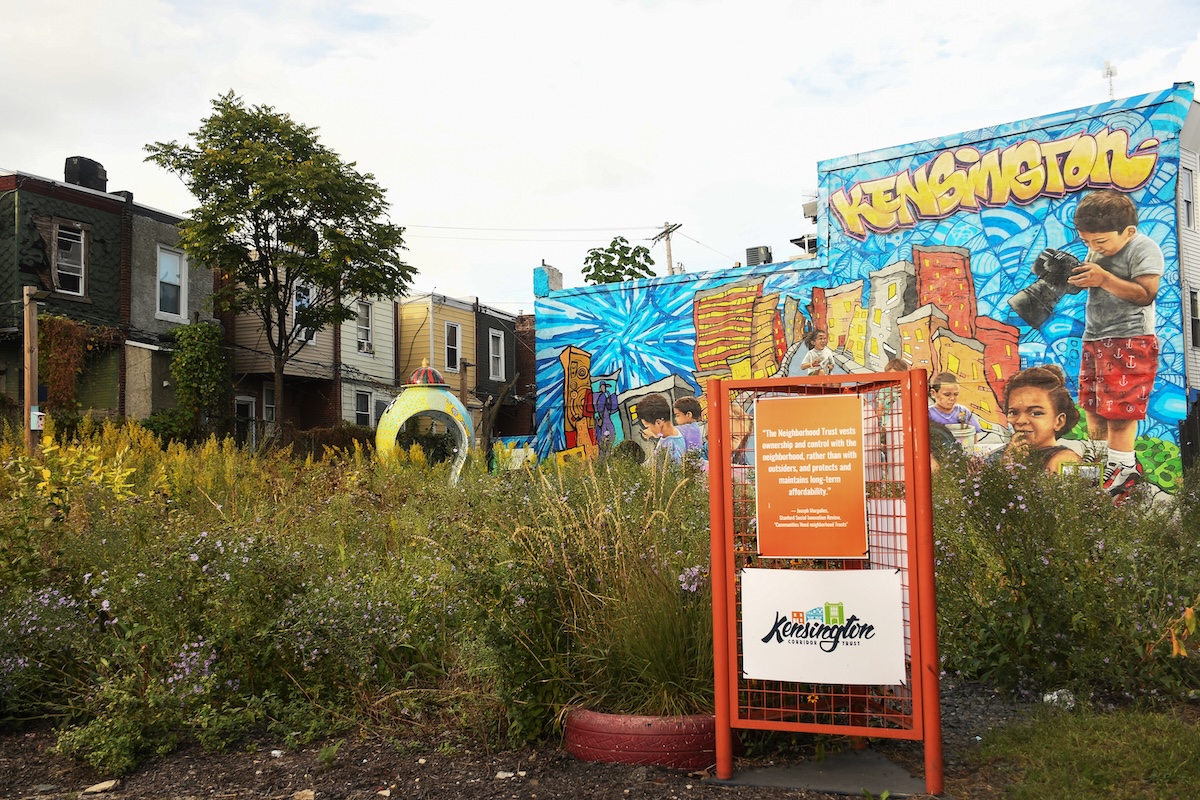
Three years ago, Barra Foundation made a 10-year million-dollar loan at 1% annual interest in 2022 to Kensington Corridor Trust, which is acquiring and redeveloping commercial and mixed-use real estate in North Philly’s Kensington Avenue commercial corridor. The woman-led nonprofit uses a neighborhood trust model to place ownership and management of the assets in the hands of local residents, most of whom are low-income people of color.
That sort of patient capital is critical, says Wahl. “Foundations have the ability to move quickly in the short term, but we also have the ability and the responsibility to think long term,” she adds. “We’re not political actors. We don’t act on election cycles.”
“We say our primary lens is innovation, but we have interest in arts and culture, health, human services and education,” says Wahl. The foundation uses grant dollars for nonprofits to test novel approaches that will result in more equitable outcomes. “We’re looking within those areas for different early stage ideas that might be de-risked through our Catalyst Fund,” she said.
Barra’s mission-aligned portfolio includes loans ranging between $300,000 and $500,000 and 0-4% interest to local nonprofits, including the Women’s Community Revitalization Project, which develops permanently affordable supportive housing for low-income Black and brown women and their families.
The portfolio also includes Jounce Partners, which through a fellowship program, recruits and supports educators of color to move into school leadership positions to gain more influence over improving student outcomes.
In Philly’s central city, the Independence Public Media Foundation, previously a former public broadcaster known locally as WYBE Channel 35, is carving out 5% of its $120 million endowment, or $6 million, for debt and equity investments in community-owned and -led media and internet projects. The carve out is meant to complement the foundation’s grantmaking portfolio of such projects.
WBYE turned into a foundation when it relinquished its broadcast license in 2017, part of the US government’s Federal Communications Commission’s Broadcast Incentive Auction, in which it received a $131.5 million one-time payment.
The foundation’s Christopher Capato told ImpactAlpha that it plans to deploy the $6 million over the next three years, with a focus on supporting local filmmakers and independent news organizations who are focused on using media as a tool for justice, sharing the complex and diverse stories of underrepresented communities that have been historically disempowered by harmful media narratives.
“We want to catalyze a movement around stories that help create a more liberatory future,” says Capato. The foundation is looking at different levers outside of media and internet to accelerate that liberatory future for greater Philly communities. Even affordable housing is not out of scope. “It’s not media, but it brings a more liberatory future to that community,” Capato says.
IPMF is an investor in The Decarceration Fund, a Philly-based impact investing fund that invests in justice tech ventures, especially those that are led by formerly-incarcerated people. The strategy is led by first-time fund managers Lawrence Williams and Christopher Bentley (see, “The De-Carceration Fund: Lifting ‘justice tech’ entrepreneurs”).
“We fund quite a bit of media and storytelling around the problems in the criminal justice system,” Capato says. “The Decarceration Fund is looking to ethically disrupt that system. So from a mission perspective, that made perfect sense for us.”
Impact advisory
When Wahl and Frazier got the go-ahead from their boards to begin aligning their endowments with their foundations’ missions, both had been working with longtime investment advisors. To move capital towards mission, Wahl says finding an advisor with fluency in impact investing was critical.
Barra found Glenmede, a Philly-based wealth and investment management firm, which had staff interested in the opportunity and worked with local groups, such as ImpactPHL, the community-based nonprofit dedicated to growing Philly’s impact investing ecosystem. “They’re present right in our local impact investing ecosystem,” Wahl said. Barra also works with Susan Hammel and Cogent Consulting, based in Minneapolis, to “balance out some of what Glenmede can’t do.”
“There is momentum among the local foundations of wanting to build a stronger regional economy,” says Wahl. “We’ve been having conversations and thinking about ways to collectively do due diligence and deploy capital, partly because we’re all small shops. I think the next 10 years could be really fruitful and exciting.”
Both Valentine and Independence Public Media foundations have selected Zenith Wealth Partners, a Black-owned firm in Philadelphia, to source place-based investment opportunities.
Capato says Jason Ray, who launched Zenith Wealth in 2019, “is very active in working with local direct investments in Philly, helping smaller foundations with both the traditional and local direct management.”
“We wouldn’t know how to do it without Jason,” Frazier adds. “We trust him and he’s been great with getting us things that are appropriate for us to invest in.”
The political crackdown on diversity, equity and inclusion has not distracted the foundations’ efforts. Through the Philanthropy Network, the foundations have adopted a racial equity-lens in their mission-aligned investing portfolios. At the recent Total Impact Summit, hosted by ImpactPHL, there was conversation among local stakeholders about changing language in their documents and online.
Valentine’s Frazier says her board of directors made a collective decision “loud and clear, not to change a thing,” she says. “I was very proud of them for doing that.”