
After two decades spent coaxing cautious capital off the sidelines with the promise of “market rate” returns, some impact fund managers are going back to the basics: impact first.
Fund managers on this week’s Agents of Impact Call transcended the time-worn debate over “concessionary” capital by focusing first on the impact side of the ledger.
They’re doing so by making problem-solving the starting point in their investment processes, structuring their capital, support and interventions – not to mention return expectations – accordingly.
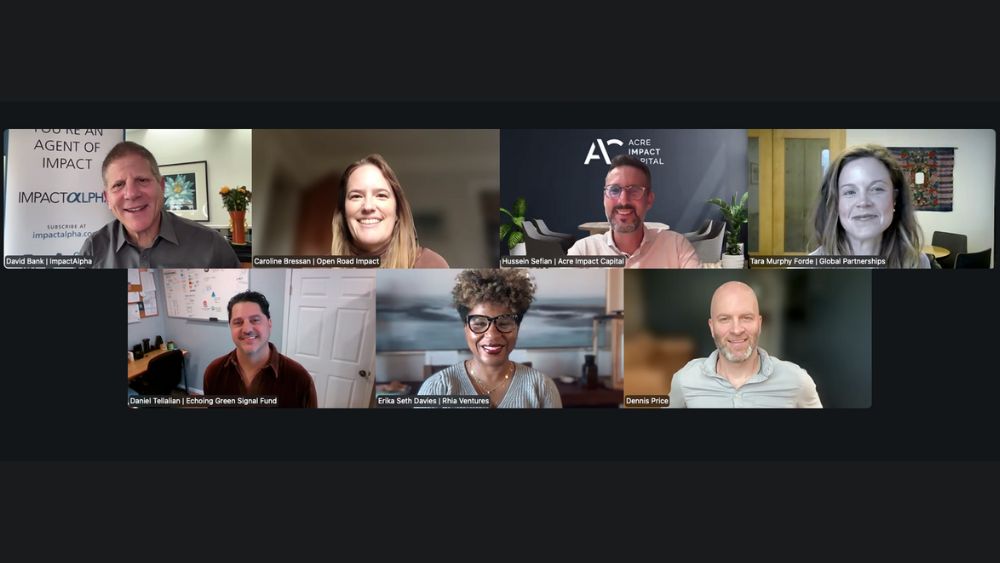
“I would posit that impact-first investing is really just impact investing,” said Caroline Bressan of Open Road Impact. “Perhaps it’s time for us to reclaim that term.”
Global Partnerships, which backs social-enterprises that serve some of the billions of people living below the World Bank’s poverty lines, seeks scale but not necessarily commercial rates of return, “where philanthropic solutions can’t achieve the level of scale alone and where the market is not yet reaching or incentivized to reach,” explained Tara Murphy Ford.
The Seattle-based firm designs its fixed-income funds to recycle their capital, pairing flexible debt with integrated impact analytics and advisory support for each entrepreneur. That allows investees to serve “the hardest segments, rather than drifting upmarket where we continue to see the same business as usual gap in terms of what the market can accomplish,” says Murphy Ford.
You might just say that these GPs are making impact first again.
“I went into this conversation thinking impact-first was a philosophy,” wrote audience member Romi Navarrete in a reflection after the Call. “I came out realizing it’s actually a discipline of sequencing.”
Order of operations
“The paradigm we thought we existed in, one, two, five years ago no longer holds,” Bressan said. “So how are we responding? We’re building a community of people that have a different vision for the world, that is maximizing for impact with every dollar disbursed.”
With different themes and geographies, and different return expectations, the speakers described a similar protocol: identify a problem, find companies building solutions, and let the returns reflect the need.
Acre Impact Capital’s Hussein Sefian made the point that an impact-first approach doesn’t require a sacrifice on returns.
“We target market rate, risk adjusted returns, while being very intentional about our impact,” said Sefian. “And we don’t rely on concessional capital or a subsidized return.”
By providing a small commercial debt tranche – often around 15% – Acre unlocks much larger pools of export credit and public financing for climate infrastructure projects in Africa that otherwise couldn’t move forward.
“We identified a structural inefficiency in the market, and innovated around that to identify a way to deliver both impact and financial returns,” he said.
Form follows function
A growing trend for impact-first investors is to house for-profit funds within nonprofit structures. Rhia Capital, which operates at the nexus of racial equity and women’s health, is a for-profit fund owned by its parent nonprofit.
“Simply staying in compliance with our structure requires an impact-first approach,” explained Rhia’s Erika Seth-Davies. The arrangement “forces impact-first decision making, since charitable resources have been used to structure and to support the fund,” she said.
Such structures can be especially appealing to LPs who themselves are mission driven. Those include foundations, development finance institutions, and a growing number of wealthy individuals and family offices. These impact-first asset owners are creating the conditions for GPs to offer what some are calling “risk adjusted impact returns.”
For Echoing Green Signal Fund, the relationship with their parent nonprofit provides a compelling pipeline of innovative founders and social entrepreneurs.
The Signal Fund was created to help Echoing Green Fellows navigate the valley of death between a proof of concept and a business that is viable for commercial investment.
“It’s really founder first,” said the Signal Fund’s Daniel Tellalian of their approach. The fund isn’t interested in “forcing the founder to pretzel themselves into a preferred product or an optimal portfolio construction or an incentivized return profile.”
Instead, Tellalian and his team tailor financing to each founders’ mission. “At the end of the day, that’s an inversion of power,” he noted.
Open Road Impact, which cut its teeth providing bridge loans for social enterprises experiencing “OMG moments,” in 2025 moved away from a for-profit structure altogether. “We had a for-profit, LLC, closed end debt fund,” said Bressan. “We just structured as an open ended evergreen nonprofit because that’s where the impact led us.”
True cost
As the panelists described their strategies, the meeting chat played host to a lively conversation over language – and the power embedded in it.
“I’d love it if we replaced the concessionary with affordable,” wrote Aunnie Patton Power of the Innovative Finance Initiative. “Concessionary to what?”
Her comment was met with a wave of agreement. For many in the room, “concessionary” implied that financial returns remained the unquestioned benchmark, and impact must take a back seat.
“The very term ‘concessionary’ suggests impact has less importance than financial returns,” said Hal Glasser of Health Impact Partnership. “No one speaks about concessionary rates of impact from most market-rate investments.”
“Commercial rate returns are also often conceding on social and environmental impacts,” added Brigit Helms of the Miller Center for Global Impact.
Several participants proposed new terms — from affordable and restorative to catalytic and enabling — as a way to reframe the debate. But as Laurie Spengler of Courageous Capital Advisors put it, the issue runs deeper than semantics: Current labels, she said, are “keeping solutions, investors and entrepreneurs trapped in narrow lanes.”
The real gap, said Daniel Waldron of Acumen, is not in language but in measurement. “The only real imperative we can solve is how to value the impact we create. That’s the variable missing in the debate around who’s conceding what.”
Tellalian challenged capital holders to really consider what they were doing with their money.
“At the end of the day, you can listen to your wealth advisor and walk a very traditional path, or you can decide to think about what is the change you’d like to see in the world.”