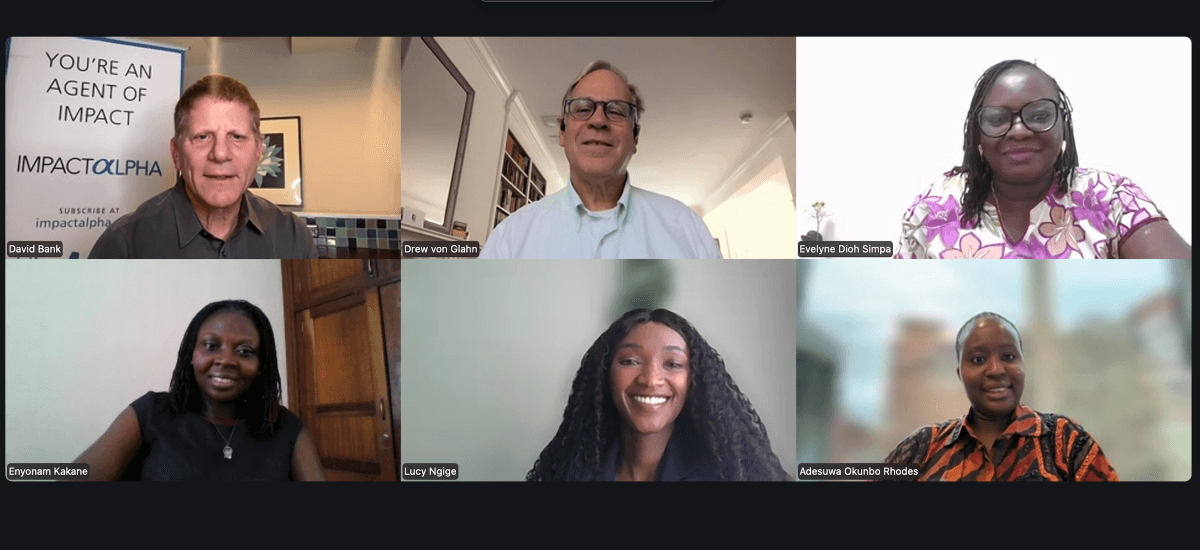
Tech-enabled ventures in healthcare, education, agriculture and financial services are driving economic growth and job creation in Africa. “This segment of the market offers the best, most attractive risk-adjusted returns across the capital stack,” Adesuwa Okunbo Rhodes of Lagos-based Aruwa Capital Management said on this week’s Agents of Impact Call on catalyzing capital for the “growth funds” financing such “growth firms.”
Fund managers from Ghana, Senegal and Nairobi also made the case for backing relatively small, local investment funds. Aruwa, which writes equity checks of $1 million to $3 million, is in the market with its second, gender-focused fund with a goal of $60 million, triple its first fund. “This segment is where we see the demand on the ground,” said Okunbo Rhodes.
Its fund and ticket sizes gives Aruwa the ability to cherry pick firms ready to scale, she said. “If someone said I should raise a $500 million fund in Africa tomorrow, I would politely decline.”
Fit for purpose
More capital is needed to support Africa’s growth firms, but in forms that go beyond what large venture capital or private equity funds can offer. WIC Capital, a gender-focused fund investing in Senegal and Cote d’Ivoire, makes investments of up to €2 million through a mix of equity and revenue-sharing agreements.
“Small business investing is very specific,” said WIC Capital’s Evelyne Dioh Simpa. “It’s different from venture capital, it’s different from private equity. It needs a specific value-creation process.”
WIC Capital’s revenue-sharing agreements provide liquidity for the fund and its investors given the long investment timelines needed to achieve equity exits in Africa’s evolving private equity market.
“One of the problems for small business investors is liquidity,” said Dioh Simpa. The ecosystem of small business investors on the continent needs to work on creative solutions for exits, she added. “That’s the only way we can keep the money flowing toward our small businesses that are the majority of our private sector.”
Technical assistance to help growth firms succeed is one way catalytic investors and philanthropic funders can help fund managers succeed.
“The value chains and the markets where we are investing are underserved markets and require some kind of managerial support,” said Victor Ndiege of Kenya Climate Ventures.
KCV backs early stage and early growth-stage businesses supporting circularity, renewable energy, water, and climate-smart forestry and agriculture by investing with a mix of debt and equity. Ndiege says technical assistance has been instrumental in helping companies establish both a financial and business track record and land follow-on funding.
Local capital
African growth fund managers are finding increasing interest from local pension funds and high net-worth investors that understand local markets and the imperative to support such economy-boosting businesses. They also have the ability to invest in local currencies.
Mirepa Investment Advisors in Ghana raised the entirety of its first fund, a Ghanaian cedi denominated fund, from local investors.
“At the time we were raising the fund, there were a number of economic issues going on in the country,” said Mirepa’s Enyonam Kakane. The country was in an economic crisis; it defaulted on its sovereign debt, and the cedi was rapidly depreciating. “None of the development finance institutions or foreign investors wanted to touch any fund coming from Ghana.”
Bringing local investors on board required an intensive education process, Kakane noted. “We realized there was an understanding gap – that the way you assess government bonds is not the same way you assess private equity.” But ultimately raising a local currency fund in local currency, rather than in hard currencies, has better served the businesses in Mirepa’s portfolio and pipeline, she added. “Most of our companies here are doing business and earning revenues in the local currency.”
Mirepa is now in the market with its second fund, which will be a dollar-denominated fund to support its existing portfolio and other local businesses that are growing into new markets in the region and internationally – “businesses that have the capability to earn in hard currency because they are exporting or have customers paying in foreign currency,” shared Kakane.
Hourglass dilemma
Technical assistance, small and patient equity checks and creative liquidity plans are all necessary tools to ensure that Africa’s small business can grow into large businesses.
“There is an inherent problem of moving big capital to small deals,” said Drew von Glahn of the Collaborative for Frontier Finance, ImpactAlpha’s partner on The Call. CFF surveyed nearly 100 capital providers for its recent “state of play” report and found large pools of capital can be a poor fit with what’s needed in most African markets.
“[Local] capital managers are playing that incredibly important role in the middle of the hourglass. They can take large pools of capital and disperse it,” von Glahn said.
“This is just where the African private equity landscape is,” Okunbo Rhodes added. “We have a number of large funds looking for large transaction sizes, but there are not a lot of companies that can absorb a $20 million or $30 million or $40 million check… we don’t have the right fund sizes [for] the majority of the market today.”