If you’re starting an impact fund, chances are you’ve got a bold investment thesis, a strong desire to create positive change in the world, and possibly a few investors.
What often comes later are the less glamorous tasks of fund administration, middle-office modeling, compliance and investor reporting.
That “boring” work, as more than one speaker jokingly acknowledged on this week’s Agents of Impact Call, can be the difference between ambition and execution for emerging funds.
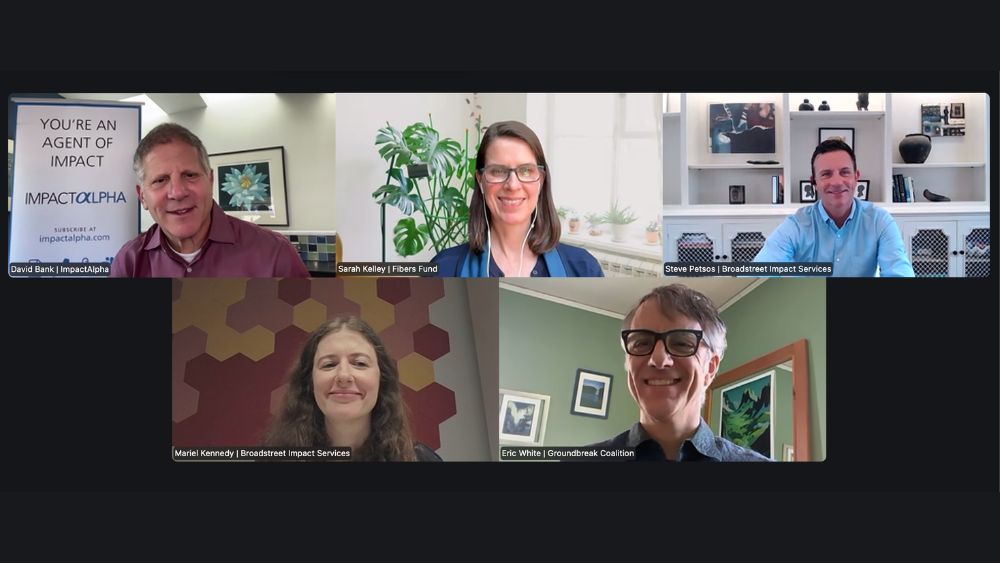
“It’s just hard to launch and manage a community investment fund,” explained Broadstreet Impact Services’ Steve Petsos. The Chicago-based financial services firm, which co-hosted the Call, has spent two decades building infrastructure for such vehicles.
“The front office — you’re good at raising capital, you know what types of investments are necessary,” he explained. “But that operational side is just as important in many ways if you want to thrive.”
A new generation of impact funds are being designed with governance, capital structures and operational systems explicitly in service of their values. For these emerging managers, translating their impact mission into a vehicle that can withstand the scrutiny of institutional investors can be the key hurdle for success.
And increasingly, that back-end structure is being recognized as a lever for impact itself.
Designed for values
At the Fibers Fund, which backs US producers of natural fibers, operational design is inseparable from mission. The fund was designed to fund farmers and entrepreneurs who have been largely excluded from both traditional agricultural finance and newer impact vehicles.
“We just heard very strongly from these farmers and ranchers that ‘we want to be able to access the same kinds of patient and flexible and creative capital that are becoming available for food producers,’” said Fibers’ Sarah Kelley.
Rather than retrofit a conventional structure, Fibers built its governance from the ground up. Decision-making authority sits with an advisory council composed of stakeholders with lived experience in the sector.
“They hold the values of the fund, they set our portfolio targets and make those high level decisions on the investment policy statement,” Kelley explained.
The structure allows the fund to blend grants and loans, pairing capital with technical assistance for entrepreneurs who have historically lacked access to both. But that flexibility comes at a cost: multiple capital pools, different compliance requirements and more complex reporting.
“The idea that your infrastructure is really such an important piece of how you put values to work on the ground has been huge for us,” Kelley said.
Small yet mighty
In Minneapolis–St. Paul, the six person team at GroundBreak Coalition is taking a similarly infrastructure-first approach to closing the racial wealth gap. The initiative focuses on homeownership, small business and neighborhood development.
With a goal of mobilizing $1 billion over a decade, back-office support has been critical.
“A concerted effort in the design of this program was to build that first, because we recognized that was going to give the funders comfort that this could get to the scale that we intended,” said Groundbreak’s Eric White.
GroundBreak blends grants, program-related investments and a guarantee facility that encourages banks to lend into underserved markets. The guarantees, backed by philanthropic pledges, reduce perceived risk while testing whether those risks are overstated.
“What we’re seeking to do is to demonstrate that these are not as risky as the narrative,” White said.
Bespoke back-end
Such structures require careful modeling and ongoing management. They also illustrate how the “middle office” can shape outcomes as much as the investment thesis itself.
For service providers like Broadstreet, that means moving beyond standardized templates. Each fund’s infrastructure must reflect its mission, its stakeholders and the realities of the markets it serves.
“Using launch templates for funds doesn’t always work,” said Broadstreet’s Mariel Kennedy. “When you’re launching funds that haven’t been done in the past, being a service provider that’s willing to try different ideas has been something that I’ve really liked.”
That flexibility extends to how funds decide what to build internally versus outsource. For many emerging managers, the choice comes down to where they can add the most value.
“It’s all a question of risk, resources and leverage,” Kennedy said. “Having someone who has done it before can introduce best practices and work with you.”
LP driven
The focus on administrative design is also being driven by investors in emerging managers. These limited partners are increasingly scrutinizing not just what funds invest in, but how they operate.
“We’ve seen a lot of investors actually come to us and say, we were looking at these funds, can you work with them on that middle and back office,” said Petsos.
As managers seek to move capital closer to communities, they must reconcile with the institutional requirements that govern large pools of capital. The back office is where that reconciliation happens.
“Once things get formalized into funds, you can’t easily exit them, and mistakes can become super costly and long lasting,” Kennedy warned.
Getting the structure right from the start can unlock growth later. It can also free managers to focus on what they do best: building relationships, sourcing deals and delivering impact.
For a field often defined by bold ideas and ambitious goals, the lesson from the call was somewhat more down to earth: Impact doesn’t just depend on where capital flows, but how it does so.