Philanthropic guarantees and bond banks can level the playing field for rural communities seeking low-cost capital for climate-resilient infrastructure.
The issuances of municipal bonds hit record levels this year, but many smaller cities and rural areas remain boxed out of the market due to perceived risk and lack of top-tier credit ratings.
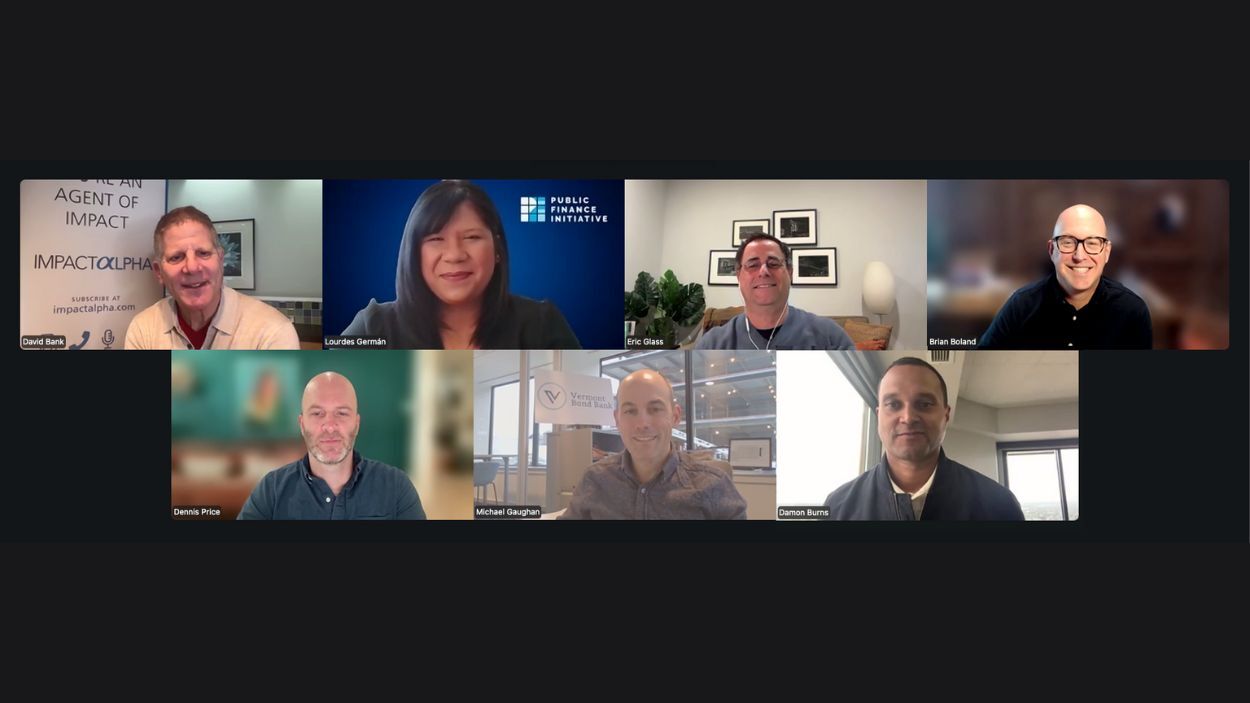
Michael Gaughan of the Vermont Bond Bank, Lourdes Germán of the Public Finance Initiative, Damon Burns of Munivestor, Eric Glass of Clarion Call Capital and Brian Boland of Delta Fund joined ImpactAlpha’s David Bank on Agents of Impact Call No. 76 to discuss how credit enhancement tools can expand access to efficient capital.
Bond banks, for example, pool borrowers to help smaller issuers access the municipal bond market. The Vermont Bond Bank has nearly $700 million in outstanding bonds across public infrastructure projects including roads, schools, water systems, community facilities, and energy projects.
“Our median sized community in Vermont is 1,800 people, and they all have about one and a half (full time employees) or so, but they have needs that are the same as other larger cities across the country,” Gaughan said in explaining Vermont’s state-chartered organization. “A bond bank is, in my view, the most effective way to level the playing field and provide equitable access to capital,”
Philanthropic guarantees
The Public Finance Initiative is testing whether foundations with AAA credit ratings can open doors for municipalities that traditional markets have shut out. The Public Finance Initiative is working with a half-dozen state and county-level, rural-serving organizations to test the approach.
“The theory of change of this program is, can a guarantee be a meaningful tool when it comes from a philanthropy that believes in your mission, that believes in healthy communities, and that also can provide a credit enhancement that is currently not available on the open market,” Germán said.
“It could bring your credit rating to a AAA at a moment when, if you look under the hood, you are facing significant fiscal weaknesses.”
Damon Burns of Finance New Orleans, sees lower borrowing costs as directly improving residents’ quality of life.
“We have an old housing stock. We have a lot of historic homes. They’re beautiful, but they cost a lot of money to operate,” he said. The city is deploying community solar projects and microgrids financed through bonds, tax abatements and renewable energy tax credits.
“All of those are going toward helping the lower cost for families, so that it can improve their quality of life,” Burns said. “So it’s really critical that we get the best cost of money from the municipal bond market, and that’s where those guarantees can come in.”
After Hurricane Katrina devastated the agency’s $400 million single family mortgage portfolio, Finance New Orleans has rebuilt with climate resilience at the center.
Market response
Clarion Call Capital’s Eric Glass, who previously ran a $1.5 billion municipal bond portfolio at AllianceBernstein, sees investor interest as a catalyst for market transformation. As more money flows into the impact space, both market participants and municipalities will change their approach, he added.
“There’s a tail wagging the dog. If investors are really interested — whether foundations, high net worth individuals, family offices or multi-family offices — the market is going to respond,” Glass said. “Municipalities themselves will become open to more of these types of financing.”
Glass launched Clarion Call to direct fixed-income investments toward municipal infrastructure “that delivers real value, without extraction or exploitation.”
Delta Fund, the family office of Katie and Brian Boland, is among the investors backing Clarion Call’s strategy. Brian Boland challenged allocators to examine their existing bond strategies. His call to action: Ask you advisors what you’re doing with your bonds and bond strategy.
“How many of the investors and foundations on this call have had board level meetings about their bond strategy?” Boland said. “Just starting by looking at the existing strategy and allocating it, first towards muni bonds and then towards truly impactful muni bonds and muni bond partners. You’d see just a massive shift.”