For at least some wealthy families, it’s impact on.
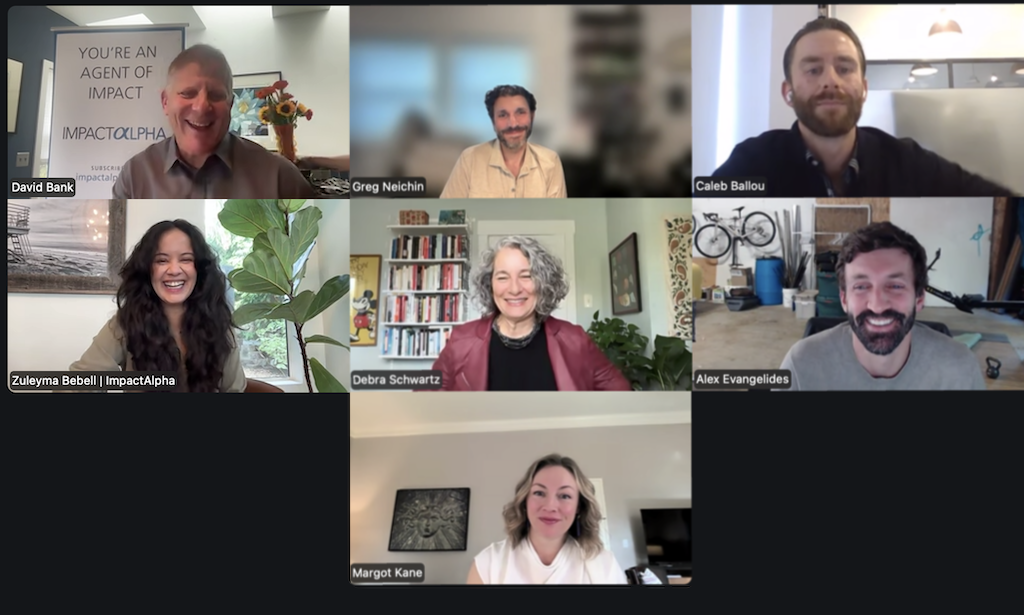
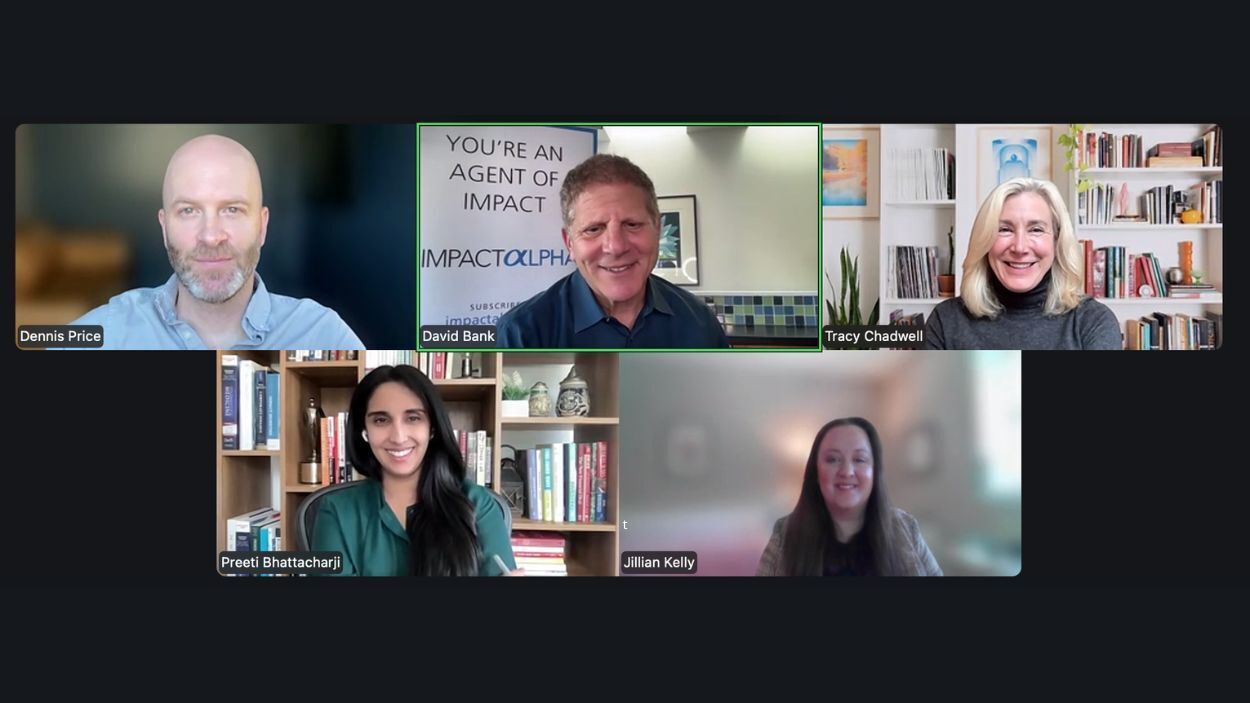
Hundreds of Agents of Impact showed up for Agents of Impact Call No. 73, featuring Trimtab Impact’s Caleb Ballou, Spring Point Partners’ Margot Kane, Ceniarth’s Greg Neichin and A to Z Impact’s Alex Evangelides and MacArthur Foundation’s Debra Schwartz.
“Family offices have flexibility. They can be patient, they can be risk-tolerant,” Schwartz said. “That’s the essence of catalytic capital. The whole point of impact-first investing is recognizing that markets don’t always meet all the needs for capital that deliver the goods and services, the projects, the resources to the people and the places that we care about.” (Disclosure: Through the Catalytic Capital Consortium, MacArthur supports ImpactAlpha’s coverage of catalytic capital).
Purpose before convention
Spring Point Partners’ Margot Kane described her fifth-generation Philadelphia family office as “built for purpose —purpose over convention or over tool.” Spring Point blends grants, investments, and other forms of support to champion community-driven change and promote economic justice and ownership.
“Impact-first doesn’t mean concessionary,” said Kane. “It means aligned values and smarter risk-taking.”
Market rate, after all, is a subjective construct. “We are trying to back the next generation of managers who are going to make decisions differently, who are going to back overlooked founders and solutions, who are going to envision a different way in which early-stage risk taking capital shows up in society,” she added.
Kane urged peers to think in portfolio terms: balancing risk, liquidity and purpose rather than chasing a single return profile. “When people are pulling back, have that conversation in a portfolio sense,” she said. “How much risk are you actually taking when you take an impact-first approach, relative to the rest of your assets under management?”
Impact-first made easy
Along with The ImPact’s Trace Welch, Caleb Ballou launched Trimtab Impact to make catalytic investing accessible for more families. As a holding company owned by a perpetual purpose trust, Trimtab is has a fiduciary duty to maximize risk-adjusted impact and operational flexibility to deploy a range of products.
Trimtab invests in intermediaries that are building markets and making capital access easier and cheaper. “Capital additionality is a huge part of it as well, simply investing where others are not,” says Ballou.
“We look for low single digits in our pilot portfolio as a blended return, but we underwrite for impact. We come with capital that is patient, flexible, and tailored to the needs of promising fund managers.”
Ballou called for more transparency and shared learning among practitioners. “Be as collaborative as you possibly can,” he said. “Share pipeline, share diligence. There’s so much opportunity for collaboration at the practitioner level.”
Getting money to the right places
Ceniarth’s Greg Neichin brought a straight-talking realism honed over a decade of deploying more than $400 million in impact-first capital.
“The ultimate beneficiaries – small farmers, shop owners, low-income workers – they don’t care why we do this,” he said. “They just care that money gets into communities that actually help vulnerable and marginalized people.”
For Ceniarth, “impact-first” means focusing less on market-rate debates and more on execution. “None of this is confusing if you think like a philanthropist,” Neichin said. “We’re just using capital to have measurable, demonstrable impact on sectors that matter.”
His practical advice to fellow funders: get to faster no’s. “Be clear about what you fund and what you don’t,” he said. “Clarity and honesty make the whole ecosystem work better.”
Cutting the pie differently
A to Z Impact’s Alex Evangelides traced his family office’s shift from “greed-only investments” and separate philanthropy to an integrated approach.
“A to Z was born to bring those worlds together so we could do one unified thing: make a return and make the world better,” he said.
Evangelides defined impact-first capital as a willingness to accept lower returns in exchange for greater social outcomes — and to recycle that capital sustainably. “So much of this is just about how we cut the pie differently,” he said. “If you, as the investor, are willing to take a smaller piece of the pie, it can go somewhere else — and a lot of good things can happen if you do.”
“Hard problems are hard to solve,” Schwartz reminded the group. “We will always need the full continuum of capital, including the resources you’re putting to work every day in an impact-first, tool-second mode.”