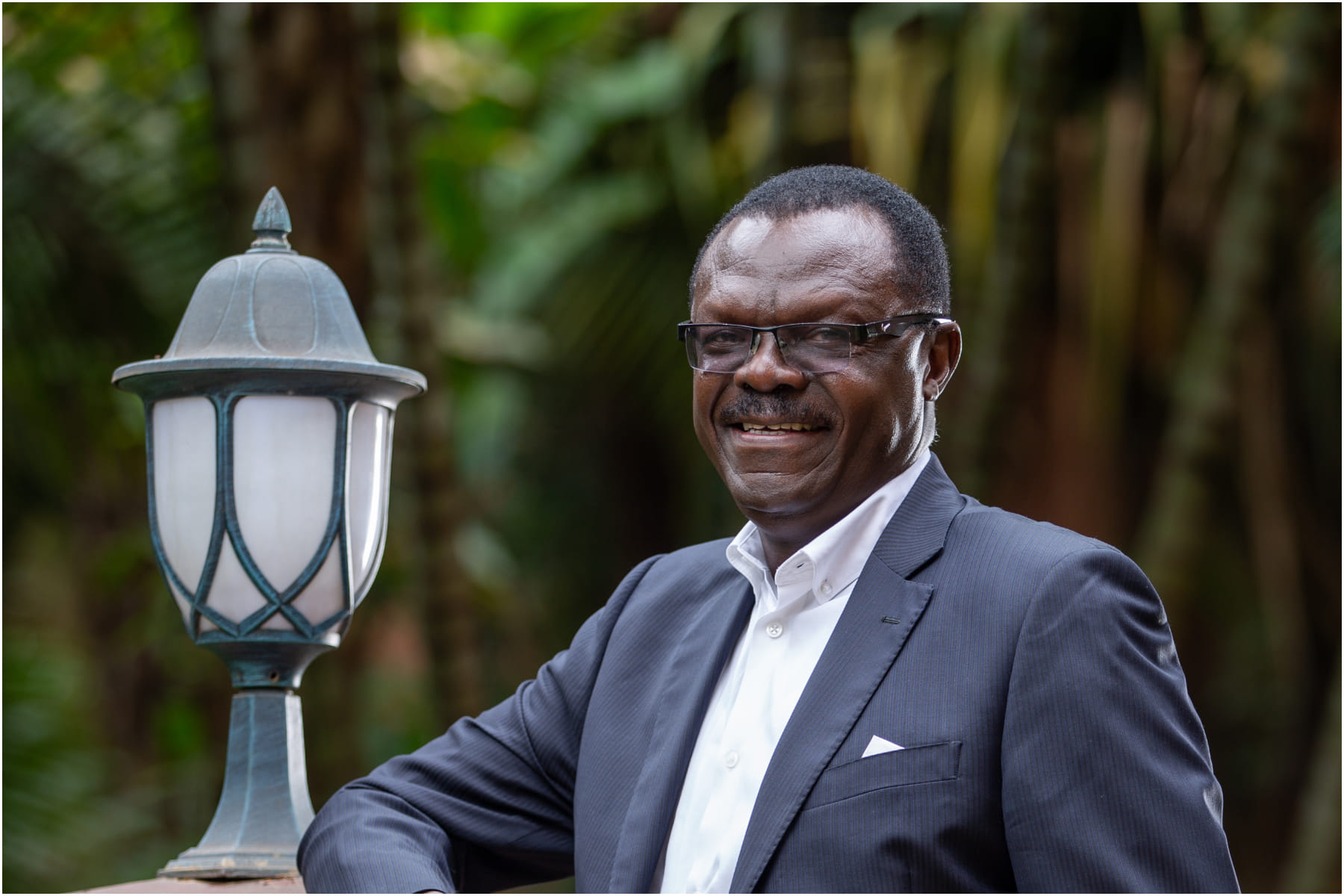

Patrick Ayota serves 2.2 million members as head of the National Social Security Fund, a $6.5 billion provident fund in Uganda. He wants to have 15 million members a decade from now.
To “create” them, he is reshaping the pension fund’s investment policies and asset allocations in order to back local growth funds for small businesses, which generate the bulk of the new jobs in Uganda, as in many other countries. He is also helping broker export deals to raise incomes for Uganda’s farmers.
“Now they’re making a little more money, and they’ll save a bit of that money with the fund,” Ayota told ImpactAlpha on the sidelines of the Collaborative for Frontier Finance gathering in Naivasha, Kenya earlier this year.
NSSF’s five-year partnership with Mastercard Foundation to invest in local small businesses was so successful in creating new pension fund members that it is being expanded and extended for another five years.
The NSSF’s allocations to local fund managers makes it a leader of a promising trend among Africa’s pension funds: investing locally, in local currency, to grow the economy by growing small businesses, the engines of both development and employment.
“We said, as a fund, we cannot be passive or bystanders in the economy,” Ayota says in a video interview, part of ImpactAlpha’s series, Pathways to Growth, produced in partnership with the Collaborative for Frontier Finance, or CFF.
African pension funds collectively manage close to $2 trillion in assets. Yet they invest a mere 3% of their portfolios in “alternative” assets, including private equity, private debt and infrastructure, instead favoring listed equities and government bonds. Last month, a pool of investors in Ghana came together to sign a compact, advocating for insurance and pensions to allocate 5% of their capital to alternative assets. The Bank of Zambia is setting up a $200 million facility to backstop lending to small and medium-sized enterprises.
NSSF is hosting a convening in Kampala in November to encourage other pension funds to take on the challenge of spurring local economies and being active investors. That will require changes in investment policies, asset allocations and staffing and structure of the investment teams.
“By creating more jobs and more resilient businesses, he’s able to get people to be in a place where they can put money aside for their pensions,” said CFF’s Drew von Glahn. “ And secondly, they’re reinvesting back into their own economy. It creates a virtuous circle of positive benefits.”
Unlimited upside
More money is being withdrawn from the pension fund than is being deposited, largely driven by low employment rates. Pension funds primarily cover formal workers, though nearly 90% of employment in Africa is in the informal sector. Net contributions, the difference between member contributions and benefits paid out, dropped from 73% in 2015 to 27% as of 2025.
“If we don’t do this, we are dead by 2045,” Ayota says.
The NSSF’s Hi-Innovator program, in partnership with Mastercard Foundation in 2020, has invested in more than 400 startups over the last four years. That’s already generated 14,000 new members for the pension fund. Together, they’ve saved around $430,000, exceeding the program’s goals.
The five year program, seeded with $5 million from each entity, aimed to equip youth, women, refugees and persons living with disabilities with entrepreneurship skills and seed funding to get their ventures up and running.
The program will be extended to 2030 with a substantial ramp up in investment from both NSF and the Toronto-based Mastercard Foundation, one of the world’s largest philanthropies. The new goal: reach 1000 startups.
“A pension fund can afford to be a bit patient,” Ayota says. “I can wait for four, five or six years, but the upside is unlimited.”
But Ayota says he knows he cannot reach his goal of 15 million members just by funding startups. Nearly 70% of Uganda’s population earn a living through agriculture.
NSSF has committed another $8 million to a $40 million entity to provide market linkages for farmers, stabilizing and increasing their incomes – and spurring them to contribute to the pension fund. It has already secured commitments from buyers in Croatia, Serbia, the US and North Africa for coffee, soya beans, sesame seeds, maize and other crops, at set prices.
By doubling the prices farmers receive and doubling or even quadrupling their yield with targeted technical assistance, NSSF figures it can help farmers dramatically increase their incomes, and begin to save for their future.
“What we are creating is a national holding company,” Ayota said. This initiative will also bring in commercial banks, which often shy away from lending to farmers, to offer short term loans (for background see, “Proof points from Uganda for unlocking capital for women and refugees”).
“What it does is it derisks the entire value chain,” he said. “The entire sector is working to help that farmer produce the crop that the market requires.”
Setting a precedent
Ayota is a staunch advocate for leveraging Africa’s own capital and productive sectors like agriculture first, then having international capital supplement these efforts.
Funding that traditionally supported sectors like agriculture on the continent is being cut back, as international lenders reprioritize their financing.
“We as Africans forget one thing,” he says. “The American doesn’t have your self interest. He has his self-interest. The European doesn’t have your self interest. He has his self-interest.
“We Africa, need to think of ourselves first, do things for ourselves first. Then let the European come and supplement what I’m doing. That becomes a more sustainable partnership.”
“A local entity with credibility derisks it for the international investor,” he said. “I think there will be even more inflow of the resources into Africa.”
His message to other African pension funds: “You can do something in your local economy. It doesn’t require a lot of outlay. You become the catalyst that other investors can look at, because you are a local entity with credibility.”