
A trio of initiatives in Uganda are successfully unlocking financing for women, refugees and other vulnerable communities long overlooked by the continent’s biggest lenders. The models, on display at the Gender-Inclusive Financing Innovation Expo in Kampala last week, aim to expand the customer bases of commercial banks and other lenders to improve financial inclusion on the continent.
First up: Concessional capital from nonprofit Aceli Africa that is designed to get more banks and financial institutions to lend to businesses in agriculture, where women make up 77% of the sector’s labor force in Uganda. Aceli has provided first-loss capital to more than 45 financiers in East Africa.
“For every dollar that we give to the lenders, they deploy $10 of their capital,” Aceli’s John Robert Okware told ImpactAlpha.
In Uganda, it has provided gender-focused fellowships and technical assistance to eight lenders to address systemic biases against women in their lending practices. Recognizing that women lead smaller businesses, Aceli has encouraged lenders to reduce their revenue thresholds from $50,000 to $20,000 and minimum loan size from $25,000 to $10,000 to get more female entrepreneurs into their pipeline.
“We’ve also adjusted our incentives to encourage lenders to identify more women and onboard them to their portfolios so that when they bring in a woman, they earn more,” Okware shared.
Its work with the Ugandan lenders has so far supported more than 1,000 small businesses and 200,000 smallholder farmers, 60% of whom are women.
“We are already demonstrating that we can change the narrative using incentives and capacity building, and most of our partners are seeing their money generate impact,” Okware said.
Helping businesses grow
The World Bank-funded Generating Growth Opportunities and Productivity for Women Enterprises, or GROW, initiative is providing loans and grants to women-and refugee-owned businesses via a network of local banks.
The partner banks, PostBank, Equity Bank, Finance Trust Bank, DFCU Bank, Centenary Bank and Stanbic, lend anywhere from four million Ugandan shillings to 100 million shillings ($1,100 to $27,300) to small retailers to wholesalers of fast moving consumer goods, poultry and vegetable farmers, agricultural produce exporters, and pre-schools, at interest rates of 10% annually. Female borrowers in the program note that the rates are more than 15 percentage points lower than alternative sources of credit.
The initiative is overseen by Uganda’s Ministry of Gender, Labor and Social Development and the Private Sector Foundation Uganda.
Refugee-lens investing
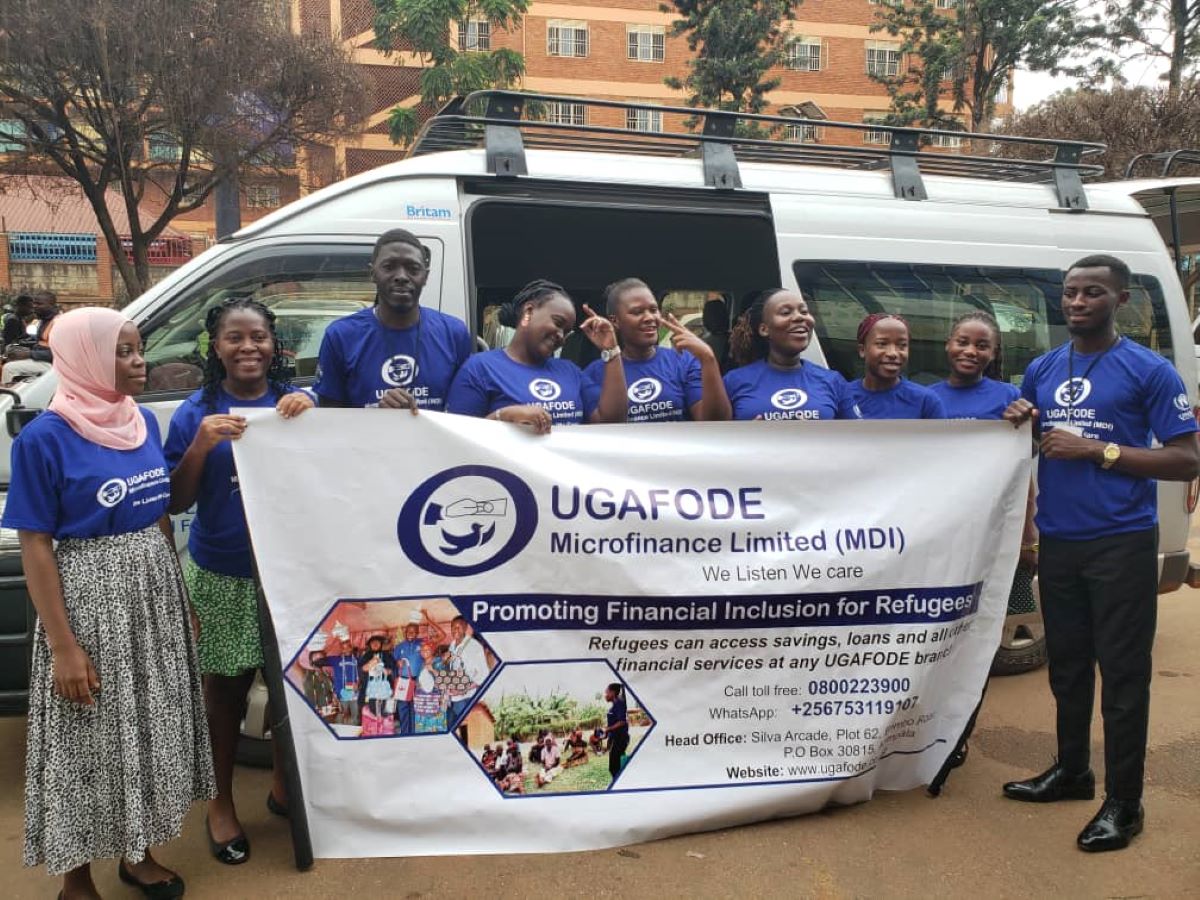
UGAFODE Microfinance developed a new product line that directly caters to women’s and refugees’ financial realities. It provides collateral-free loans starting at 100,000 Ugandan shillings ($30) to put women- and refugee-owned businesses on a path to unlocking larger loans as they grow.
The microfinance institution has a 30-year track record working toward women’s financial inclusion in the country, having started as a group credit provider before pivoting to microfinance in 2011. Today it operates 20 branches in the country, mostly in rural and peri-urban areas.
“When you go into the market, you will find that men have security. They can walk into an institution and get a loan. But a woman who wants to start a business doesn’t have that security,” noted UGAFODE’s Florence Mutonerwa.
Its female customers, who make up about 30% of UGAFODE’s borrowers, are offered lower interest rates than male customers.
UGAFODE has over the years secured financing from Oikocredit, Accion, Opportunity International and Habitat for Humanity Uganda. In 2019, UGAFODE expanded its inclusivity lens to refugees, many of whom are undocumented and therefore ineligible for most bank services. It runs a branch in the Nakivale refugee settlement, one of Africa’s oldest refugee camps.
“The main aim is to build resilience for them because for how long will they depend on aid?” Mutonerwa says.
To extend capital to undocumented customers, UGAFODE had to secure special permission from Uganda’s central bank to allow for the use of refugee ID numbers as credit bureau reference. About 15% of its workforce is from refugee communities to better reach and engage with this population of borrowers.
It currently serves about 10,000 economically active refugees, who are engaged in retail, carpentry, food services and farming. Mutonerwa says lenders’ risk perceptions are overblown; UGAFODE’s default rates from refugee clients is about 6%.
“There is a risk in lending refugees, but it is also a business that you can shield with guarantees,” she says.
The non-profit KIVA, offered a partial guarantee for UGAFODE refugee loans on its crowdfunding platform.
Shifting lender behavior
To incentivize a wider range of financiers to lend to female and rural borrowers, Aceli is piloting a new initiative: interest rate rebates to make loan repayment more manageable for agribusinesses. Aceli promises to cover up to half of the interest owed by a business instead of letting it default, providing risk mitigation to lenders.
Other initiatives in the works: expanding its network to include savings and credit cooperatives or SACCOs, which largely serve rural and female farmers, and working directly with policymakers to tackle biases in the broader financial system.
In the latter effort, Aceli has presented three policy papers to the Central Bank of Uganda to address policies that contribute to the perception that agriculture is underfinanced and carries greater risk — issues that disproportionately impact female borrowers.