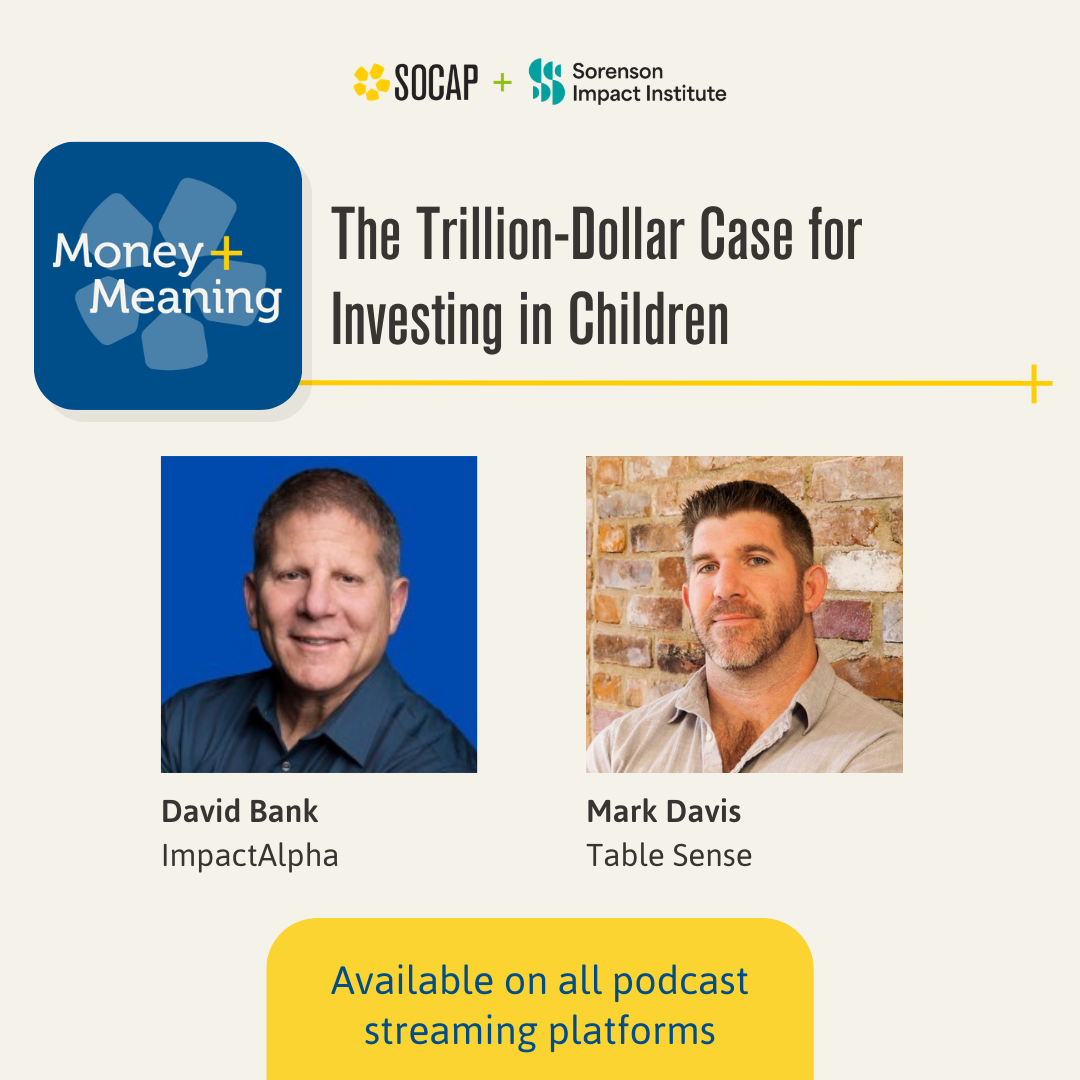
When Mark Davis tried to explain impact investing to his five-year-old son, he reached for the language of finance: resource allocation, strategy and the “double bottom line.”
It didn’t land.
The next day, the boy summarized it in simpler terms.
“Out of the blue, he’s like, ‘Hey Dad… you help kids, right?’” Davis recalled. “And that was it.”
For Davis, that moment crystallized the purpose of his work. “I literally kind of melted a little bit,” he tells ImpactAlpha’s David Bank in a special interview for the Money + Meaning podcast, a production of SOCAP Global. “Sometimes you have to ground yourself in what a privilege it is to be able to do that every day.”
Davis is the founder of TableSense, an organization that invests in research, innovation and advocacy for child welfare.
“Our mission is to help kids,” Davis said. “We’re trying to bring together the tools of impact investing with research and policy work. When those things come together, that’s how we can create systematic, lasting change.”
Trillion-dollar case
The moral argument for investing in children is obvious. The economic argument may be just as compelling: Davis says that eradicating child poverty could increase US GDP by five percent, or nearly a trillion dollars.
“This is a problem that’s worth solving,” says Davis. “It’s a big market, and we’ve got to get more people coming to the table.”
Child-focused investing has received relatively little attention compared with other impact themes such as climate or fintech.
“There’s not a lot of people talking about this yet,” Davis said. “It’s like a hidden population.”
His goal with TableSense is to help build the investment ecosystem around youth outcomes—from financial instruments to policy frameworks and data systems.
Pay-for-success
One of the most promising tools, Davis argues, is outcomes-based financing, where governments or institutions pay service providers based on measurable outcomes. Investors can fund the interventions upfront and earn returns if positive results are achieved.
The model aligns incentives across the system. Governments can justify higher spending if programs demonstrably reduce long-term costs — for example, by preventing homelessness, incarceration or health crises.
Those dynamics are particularly acute for young people leaving state systems.
Much of TableSense’s work focuses on teenagers and young adults, a group sometimes called “transition-age youth.”
“These youth from disadvantaged backgrounds hit a literal cliff,” Davis says.
The most striking example is foster care. Research suggests that up to 20% of former foster youth become homeless when they turn eighteen, as subsidies and support services suddenly end. Resources often exist to support these young adults—but the system fails to deliver them effectively.
“There are federal programs and funding for that population,” he said. “But due to miscommunication and other issues, those resources don’t always reach the people who need them.”
One of the biggest opportunities lies in connecting disadvantaged youth to employment pathways. Programs focused on apprenticeships, micro-credentials and workforce pipelines can deliver both social and economic returns.
“You’ve got employers that are desperate,” Davis said, particularly in skilled trades and other industries facing labor shortages. At the same time, many young people lack access to the training or networks required to enter those fields.
“If we do everything else but ignore earning a living wage, we will not be successful long term,” he said. Early studies suggest strong returns on these workforce programs—sometimes double the social value of the initial investment.
Building systems
TableSense often acts as a direct investor, but the organization also works at the systems level, mapping the flows of capital and incentives that shape youth services.
Innovation in social services requires engagement with public policy and funding structures, which differ dramatically from typical venture capital markets.
“Launching a new solution in a government-funded human service system is very different from launching a tech startup and praying for the best,” Davis says.
One challenge is what economists call the “wrong pocket problem”: the entity that pays for a preventive intervention may not be the one that benefits from the savings.
“If the payer is bearing the responsibility of the investment but doesn’t reap the rewards, they don’t have an incentive to cut a deal,” Davis said.
TableSense is commissioning research to map these cost flows and identify where financial incentives could be better aligned.
In housing, for example, programs such as the federal Foster Youth to Independence housing vouchers provide steady funding streams that could help finance new housing developments. But many states struggle to access those resources because of logistical barriers.
“Most states haven’t been able to tap into those dollars,” Davis says.
TableSense is working to bridge gaps between developers, service providers and public agencies to unlock those funds and expand housing options.
For Davis, the case ultimately returns to the same simple insight his son captured.
“You help kids.”