

TGIF, Agents of Impact!
- Roundup: Virtuous circles
- Podcasts: Hear from Ashley Bell, Bryan Goh, Roy Swan and Christine Looney
- The Call: Investment portfolios that value aging
- Pop Impact: Ownership stakes for creatives at the Oscars
🗣 Virtuous circles. Impact investing can sometimes feel strangely insulated from the swirling vortex of events. Private credit meltdown? Not here. Software stocks swallowed by AI? Not in our portfolios. There is no escape from the war spiraling out of control in Iran and the Middle East. The human toll is staggering. In just short of two weeks, the war has displaced more than 3 million people in Iran, and more than 700,000 in Lebanon. That’s on top of some 122 million people displaced by violent conflict globally. Organizations such as iGravity, UNICEF, Save the Children and Mercy Corps are testing financing solutions to create durable funding streams for refugees and other displaced people, writes ImpactAlpha’s Lucy Ngige. Such investment is all the more needed as global aid withers for people affected by conflict and climate change.
Farmers, consumers and investors will soon pay a price. The effective closure of the Strait of Hormuz has pushed oil above $100 a barrel, “the largest supply disruption in the history of the global oil market,” according to the International Energy Agency. Just ahead of planting season, prices for fertilizer, another key commodity transported through the strait, have also surged. Amazon data centers in the United Arab Emirates and Bahrain were hit earlier this week, and the Iranian regime has vowed to target tech firms that have supported the US or Israeli military, including Google, Microsoft, Palantir, IBM, Nvidia and Oracle, dual use be damned. Along with power stations and desalination plants, banks are also fair game, the regime declared after a Tehran branch that processes payments for the Revolutionary Guards was bombed this week.
Betting markets suggest the war will drag on. In the world as it is, solutions like solar + storage, bio-based fertilizer, and access to finance for the growing number of people forcibly on the move are all the more needed. Call it the resilience trade. Agents of Impact surely prefer virtuous circles to vicious cycles. It may be hard now to envision that self-reinforcing, positive feedback loops of beneficial events will create an accelerating cycle of improvement. But when the missiles stop flying, the rebuilding begins, again. – Amy Cortese
Also on ImpactAlpha this week:
- “Why Bridges is ‘spinning in’ HSBC AM’s climate investment team,” by Danielle Rossingh
- “Responsible AI should be a top priority for impact investors. Climate investing offers lessons,” by Daniel Firger
- “Profit and punishment: The portfolio risks lurking inside private prisons,” by Andrew Behar
- “Beth Bafford to leave Climate United as ‘green bank’ legal battle drags on,” by Amy Cortese
The Week’s Podcasts
🎧 This Week in Impact. Host Brian Walsh takes up ImpactAlpha’s top stories with editor David Bank. Up this week: Conflict in the Middle East creates (even more) refugees in need of livelihoods, services and impact investment; how to build investment portfolios that values and supports aging; and, the risks to investors lurking inside private prisons.
- Listen to the new episode of This Week in Impact. Get the podcast in your feed by subscribing on Apple, Spotify, or YouTube.
🦸Agents of Impact. Redemption Bank’s Ashley Bell joined David Bank to talk about the newest Black-owned bank in the US. Redemption Bank is in an affluent, mostly white suburb at the base of the Wasatch mountains just north of Salt Lake City. “What separates us from every other African American-owned bank in history is that all of the previous banks have operated out of, and were birthed out of, low to moderate-income areas, and they were surrounded by a lot of economic challenges that made it really hard for those banks to succeed,” Bell says. “We flipped that on its head. We think the sky’s the limit for what’s possible.” Tune in.
- Tsao Family Office’s theory of change. Who would be funding this, if not us? That’s the question Bryan Goh, CEO and chief investment officer of the Tsao Family Office in Singapore, asks all the time. “We’re very careful where we fund that we don’t distort things,” Goh says in this podcast conversation. “We’re always thinking, are we displacing purely financial capital? Are we replacing capital that would invest in any case?” Learn more.
💬 Impact Investing Musings: Ford Foundation, and the mission related investment movement. The newest addition to the ImpactAlpha Podcast Network is Impact Investing Musings, produced by AVPN and hosted by Vikas Arora. Arora speaks with the Ford Foundation’s Roy Swan and Christine Looney about aligning a slice of the foundation’s endowment with its philanthropic mission (disclosure: Ford Foundation is an investor in ImpactAlpha).
The Week’s Call
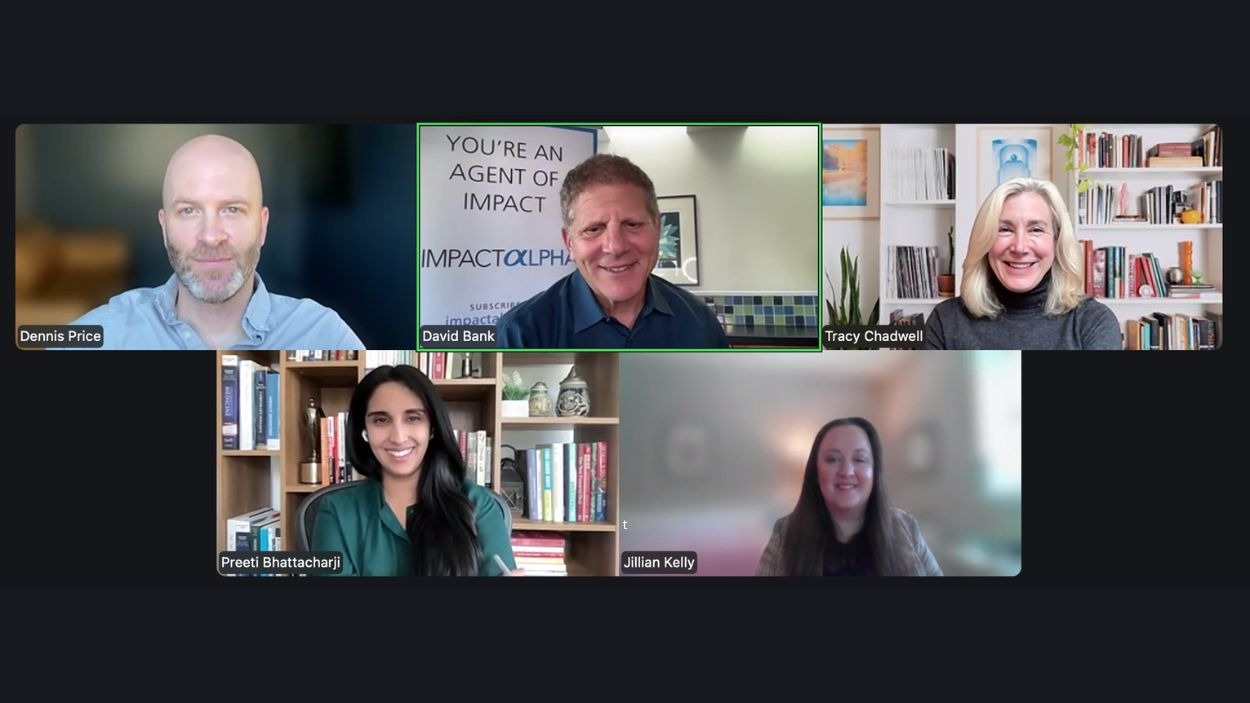
How impact investors are building portfolios for the ‘longevity economy’ (video). Longer lifespans, coupled with the spending power and productivity of the 50+ crowd, are fueling a “longevity economy.” Impact investors can seize opportunities to support older adults on their journey. “Our focus is entirely on aging. That means older adults, the aging process, caregivers – everything that has to do with aging,” said Next50’s Jillian Kelly on this week’s Agents of Impact Call. The Call featured investors building portfolios that view aging as an economic and social asset. Denver-based Next50 is aligning 100% of its $265 million endowment to support healthy and dignified aging and economic opportunities for seniors. “All of us are aging,” said Kelly. “We know that older adults need more resources, but they’re also a really powerful economic force.”
- Aging-lens investing. ImpactAlpha and Next50 are partnering on a Valuing Aging beat to expand coverage of investment opportunities in healthy aging. Next50 worked with JPMorgan Chase to develop an investment framework that supports aging, similar to gender-lens or climate-lens frameworks. “It’s a lens you can use to evaluate any company, and then you can overlay that lens onto whatever universe of securities you need,” JPMorgan Chase’s Preeti Bhattacharji explained. 1843 Capital, a Washington, DC-based fund manager, sees an investment opportunity in the social infrastructure needed for 100-year lifespans. “Most people, when you ask them if they want to live past 100, will say no,” says 1843’s Tracy Chadwell. But if you ask them, ‘Do you want to live a full, healthy life until your life is over? I think most people would say yes.'”
- Keep reading and watch the replay.
Weekend Watching: Ownership at the Oscars
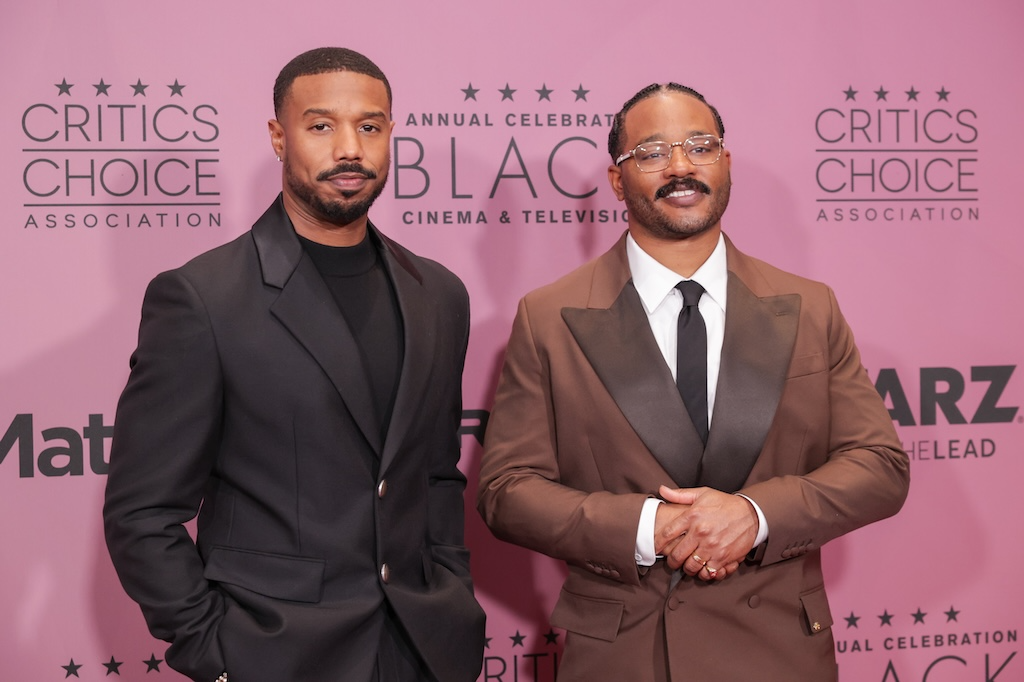
Michael B. Jordan and Ryan Coogler
With ‘Sinners,’ Ryan Coogler demonstrates the power of creative ownership. One of the central themes in the Oscar-nominated film, “Sinners,” is the demand for cultural experiences that are both for us and by us. For director Ryan Coogler, that also means owned by us, ImpactAlpha contributing editor Dmitriy Ioselevich writes in his latest Pop Impact column. Coogler, together with his manager, Charles D. King, negotiated a groundbreaking deal with Warner Bros. for the rights to distribute “Sinners.” Coogler reportedly received “first-dollar gross” that gives him a percentage of all ticket sales. He will also take back the rights to the film starting in 2050, which will allow him to control future licensing deals, sequels, and streaming revenue. It’s the type of deal that made “Hollywood lose its mind.”
- Oscar record. Both King’s MACRO and Coogler’s Proximity Media “demonstrate that when diverse creatives have control, capital, and autonomy, the market responds,” says Cynthia Muller of the Kellogg Foundation, an investor in MACRO. “Sinners” has earned approximately $330 million worldwide, putting the Southern vampire movie in elite territory among horror films and in 2025’s top 10 overall. “Sinners” also scored a record 16 Oscar nominations for Sunday’s Academy Awards ceremony. “For too long, many creatives — especially women and people of color — have generated extraordinary cultural and financial value without sharing proportionally in the wealth created,” says Muller. “Compensation has to move beyond fees to participation. Equity stakes, profit-sharing and revenue participation models matter because they turn talent into long-term stakeholders.”
- Keep reading, “With Sinners, Ryan Coogler demonstrates the power of creative ownership,” by Dmitriy Ioselevich. With the W.K. Kellogg Foundation, ImpactAlpha is lifting up investment strategies that expand economic opportunity.
The Week’s Talent and Jobs
💼 See and share more than a dozen new impact jobs posted this week on ImpactAlpha’s Career Hub and view hundreds of more jobs in impact investing and sustainable finance. Have a job listing to post? Submit it here. And catch up on all of this week’s dealflow reporting.
Ford Foundation anchors a Collaboration Fund to support consolidation of impact field builders. The urge to merge is often stymied by legal expenses and organizational complexity. Sorenson Impact Institute seeks proposals from impact and inclusion-focused nonprofits that are pursuing mergers, acquisitions and other forms of collaboration to reduce fragmentation and financial stress. “Our goal is to increase collaboration, make best use of available resources, and ultimately accelerate our collective impact,” Sorenson’s Katie Macc said in a statement. The institute is managing the $1 million Collaboration Fund, anchored by the Ford Foundation with support from the MacArthur Foundation, to cover the direct costs of consolidation, along with communications to “destigmatize and celebrate these forms of collaboration for the field.” Letters of intent are due by June 11.
Hela Fourati-Triki, formerly at BloomScale, joined Bpifrance as vice president of private equity, focusing on Africa… Zaki Raheem, previously at DAI Global, joined the Miller Center for Global Impact as senior director of programs… David Schuppan and Phil Alphonse were named co-presidents of Vistria Group’s flagship funds, while Nick Potter was appointed head of strategic initiatives… Faiza Ali departed the Maple Leaf Sports & Entertainment Partnership foundation to join Acumen as grant manager for the Green Rise Africa program.
Kenneth Owera was promoted to chief investment officer at NSSF Uganda… Verónica López de la Lama, formerly at Solidaridad Network, joined Amazonia Impact Ventures as impact and ESG lead… Green Impact Exchange appointed Kevin Buckley, previously with Prudential Financial, as chief financial officer… Sekai Chiwandamira joined Mastercard Foundation to lead the foundation’s Innovation Labs… The Quadrature Climate Foundation hired Sonny Bardhan as chief impact and insights officer.
Flourish Ventures promoted Charlee Brady to people operations manager… John Arzinos, former economic inclusion officer at IFC, joined Triple Jump as an ESG and impact officer… Iliya Krutko was promoted to senior director of impact investments at Building Hope… Gridworks, an Africa-focused energy access company, promoted Amol Pinge and Shaun Githuku to co-heads of business development… Symbiotics tapped Yvan Renaud to become CEO… New Majority Capital Foundation added Aisha Weeks of Gary Community Ventures as a board member.
The Builders Fund promoted Ani Ajith to principal… Sue Dorsey returned to Gates Family Foundation as chief operating officer and chief financial officer… Maria Gil Mendoza was promoted to senior associate at FMO… Ownership Works welcomed Jane Schumacher, previously with High Lantern Group, as a senior associate of networks and partnerships… The National Association for Latino Community Asset Builders appointed Elizabeth Nimmons, previously with the National Association of Hispanic Real Estate Professionals, as public policy director.
That’s a wrap. Have a wonderful weekend.
– March 13, 2026