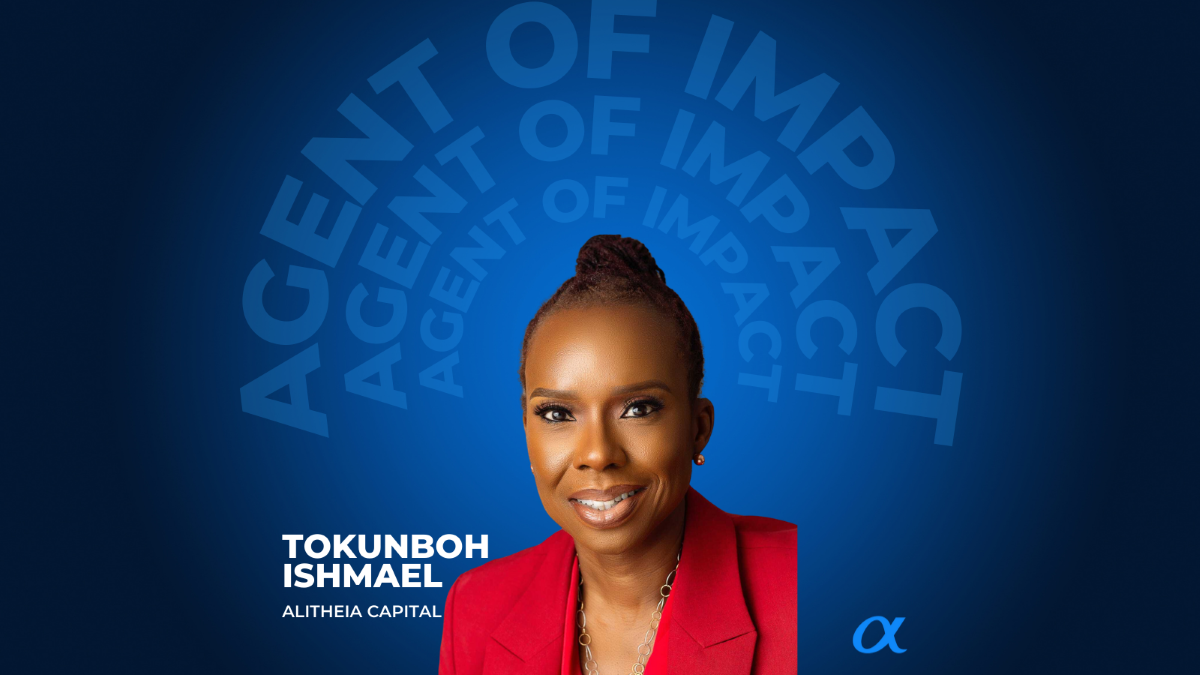


Tokunboh Ishmael isn’t dispirited by the forecasts of private equity fundraising. Market volatility is compounding an already difficult environment for private equity and venture capital fund managers. But Ishmael, who spent more than five years trying to raise one of Africa’s first gender-lens private equity funds, is accustomed to “difficult.” Her firm, Alitheia Capital, is working toward the launch of its second fund and a goal of $200 million—double its first fund.
To make the case for why investors should be putting money in women in Africa, she’s focused on proving they can also get their money back. “We’re growing assets in a very hostile environment,” Ishmael tells ImpactAlpha. Many African markets are nascent, undercapitalized and often underresourced. A retreat of foreign development finance means capital is more scarce. “You have to have innovative instruments to have a broader pool of strategic and financial buyers.”
Alitheia recently notched an exit from Baobab Nigeria, a small business lender that the firm backed through its partnership with Netherlands-based Goodwell Investments. The investment partners sold their stake at a 3x return to Baobab’s French parent company. Alitheia has more portfolio exits in the works. Exits are on Ishmael’s mind a lot these days, recognizing that a number of private equity and impact investment firms in Africa are nearing the end of their first funds’ investment cycles. In addition to finding strategic acquirers, she’s looking at ways fund managers like Alitheia can invest though self-liquidating or redeemable instruments, or sell equity stakes back to founders. “We need to think about new ways in which our stock exchanges accommodate smaller businesses,” she adds (see, “Early growth-stage companies are going public in Africa”).
As Alitheia prepares to launch its second fund, it’s expanding its gender-lens strategy beyond financial inclusion and small businesses into climate opportunities – namely energy efficiency – and digital infrastructure, “which broadens access to essential goods, services and markets,” Ishmael says.
Being an African woman raising a gender-lens fund is an uphill climb, particularly in today’s geopolitical environment, but investors also have greater comfort and familiarity with the lens than they did when Alitheia launched its first fund a decade ago (see, “The fundamentals of gender-lens investing are still ‘smart’“). “One of the biggest [developments] has been the mainstreaming of gender-lens investing, because 10 years ago, it wasn’t a thing,” Ishmael says. “There has been a widening of the gates, and there has been a spotlight on the strategy.”
Challenges abound still. Ishmael observes that the available money doesn’t come anywhere close to matching the opportunity, or the need. That female fund managers are over-mentored and underfunded. And that LPs are too focused on pushing gender-lens adoption by mainstream private equity firms, rather than backing new fund managers. She believes this leads to superficial, box-ticking investment approaches. “It ranges from complete pinkwashing to genuine interest, but you need to have that range for any kind of action to happen,” she says.
Ishmael was heartened by this year’s International Women’s Day theme of ‘accelerating action.’ “That can only be done with intentionality, with a large tent that is inclusive and makes it possible for ordinary people to have access to basic necessities, and for founders that dream to realize their dreams, particularly female founders,” she says. It takes all hands on deck. “If I’m going to be here, by Jove, I want to play a role in lifting up [their] prospects.”