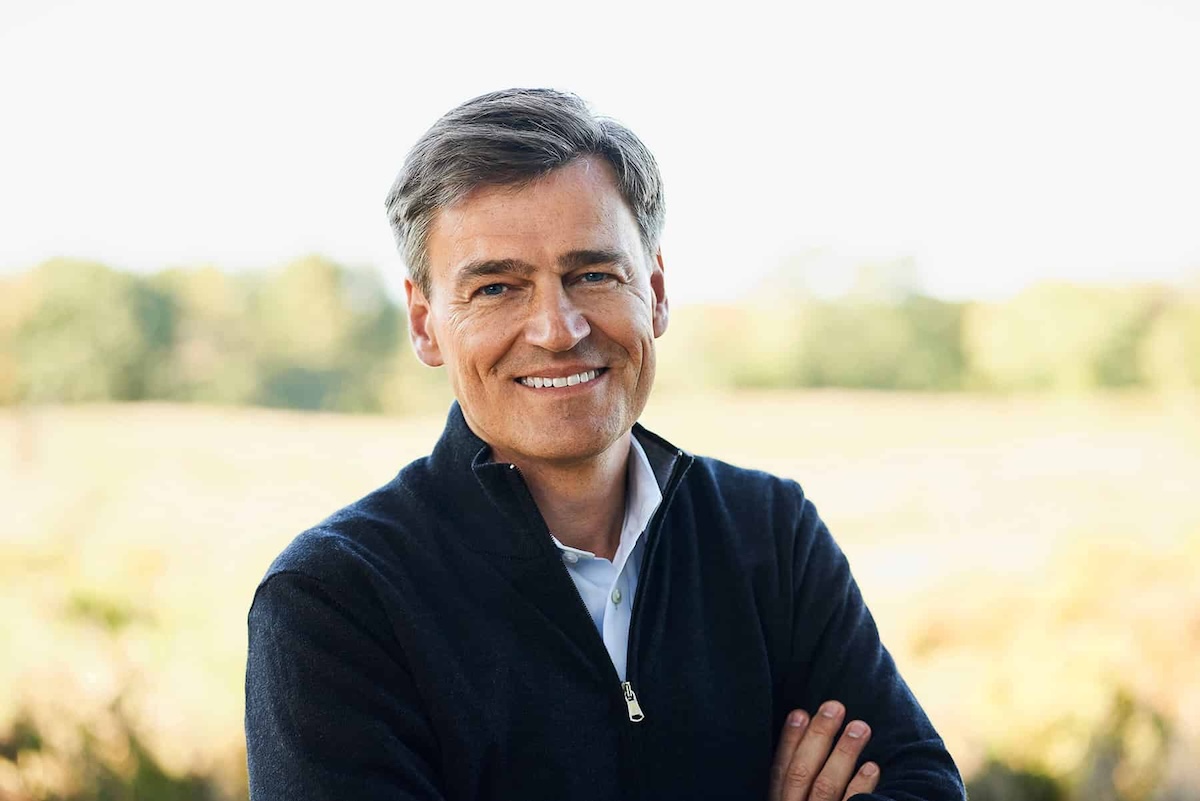


Carsten Stendevad has spent his career in institutional finance with one eye on impact investors. Well, one investor specifically: Acumen. The Dane was first introduced to Acumen’s founder Jacqueline Novogratz more than 20 years ago while working for McKinsey & Co.
“I heard about this team whose central idea is using the power of investing to solve pressing challenges. I was very intrigued,” Stendevad tells ImpactAlpha.
As Acumen’s new president and chief investment officer, Stendevad is now at the helm of putting that idea into action at a pivotal moment of growth for the impact accelerator and fund manager.
Acumen, with just about $300 million in assets under management, is growing and adding onto its thematic funds, which include: a second fund for its African energy and climate-focused KawiSafi Fund; its $250 million Hardest-to-Reach initiative for energy access in Africa’s frontier markets; and a $300 million climate-smart agriculture initiative; as well as its dedicated fund manager for Latin America, ALIVE Ventures.
“Acumen is at a fascinating inflection point,” Stendevad says. Its collective funds and initiatives are trying to raise more than $750 million, much of it in patient and blended finance. “It has picked the hardest goals,” he says. “With the types and amount of capital Acumen will have to deploy—it’s an exciting expansion of its capability to have an impact.”
Stendevad brings with him to the job what he calls “a toolkit of how to think about investing.” It’s a modest choice of words. Stendevad joins the impact firm from an eight-year stint as co-chief investment officer at Bridgewater Associates, Ray Dalio’s $92 billion hedge fund, where he led its sustainability strategy. Before that he served as CEO of Denmark’s largest pension fund, ATP, and as global head of Citi’s financial strategy group. He’s an investment strategy board advisor for GIC, Singapore’s sovereign wealth fund.
“My resume has always been mostly with established financial institutions, but I’ve always tried to bend my work and the work of those institutions to having a broader role,” he says. “We need the entire financial system to bend toward impact.”
Separate spheres of finance
Stendevad has worked up close on the social and environmental issues Acumen is trying to address. He chairs the board of directors for the Danish Refugee Council and served on the boards of UNICEF Denmark and Denmark’s Covid Recovery Fund.
But the financial and social-humanitarian spheres are still largely separate and at odds with one another, Stendevad observes. “The traditional capital markets often bypass the markets and countries where the needs are the greatest.”
He recalls living in Mumbai two decades ago, where he would return home at the end of each day from work in corporate finance, while his wife returned from field research on the informal economy in the city’s slums.
“We were in the same city and seeing the contrast between where the financial markets were really working for certain parts of the economy, and the parts where the most vulnerable were that the financial markets were not reaching,” he says. “It is necessary for everyone to think more broadly about what the society needs.”
Critical cause
His concern that the world could be moving in the opposite direction led him to join Acumen.
“At a time when the world seems to be pulling inwards, I felt compelled to lean in,” Stendevad says. “The cause is critical. Around the world we have fiscal pressures, aid programs being reduced, slowing in the economy, and a long list of challenges. The problems are not getting smaller.”
Acumen, and impact investing more generally, is focused on the pipeline of solutions and creative ways to seed and finance them.
Reflecting on his prior career experience, he says, impact investing’s approach “is not that different from other investors. When you have a clear goal with a lot of constraints, you have to be creative.”
What’s different is putting impact at the center of the risk-return calculation. “You think differently about financial models, types of risk capital. You’re patient,” he says. “And you commit to being present where others are not.”