
As singer-entrepreneur-cultural icon Rihanna turns her attention to Africa, her Nairobi-based investment fund is deploying a new set of tools to invest in women-led and women-focused enterprises.
The Clara Lionel Foundation, which Rihanna launched in 2012, has provided mostly grants for education and climate initiatives across the Caribbean. In 2022, the foundation launched Gather Ventures to meet the needs of entrepreneurs across Africa. That means debt, equity, convertible notes and bridge financing on top of grants, across Africa.
Charitable organizations responding to cutbacks in official development assistance are showing increased willingness to deploy such flexible capital. More broadly, the disruption in foreign aid is causing a rethinking of capital structures to emphasize women’s ownership and bottom-up wealth-building.
“We want to figure out ways where, as Africans, we can distribute the assets that are being made from all these investments,” Gather Ventures’ Jo Opot, a former partnerships lead at Acumen, told ImpactAlpha in one of her first interviews since the pop billionaire’s foundation established the $20 million fund.
“As this portfolio grows, we want to have templates of what it looks like to do things differently, run by African women who are based here,” she said. “To have a Black LP, to change the power dynamics that I know exist, is something that needs to happen.”
Entrepreneur-centered
Opot said she often interacts with African entrepreneurs who face mismatches of capital. Founders may have to accept, for example, dilutive equity capital when what they might really need is a working capital loan.
Evolving fund models can help enterprises break out of extractive systems, where communities and especially women, provide raw materials and labor, but are excluded from value creation and asset ownership, she said.
“Our market is not robust enough to give (entrepreneurs) access to all the different players,” said Opot, who at age 13 ran a roadside food shack in Nairobi. “If we’re still doing grants 20 years from now, we’re not really getting to a place where we’re actually building companies at the tertiary level. In the center, we’re still primarily extractive.”
Gather Ventures offers debt, equity, convertible notes and bridge financing when needed on top of grants. It has so far invested in six enterprises that work in the nexus of climate and gender.
“We start with what is the opportunity, and then what is the capital needed to unlock this.”
Other funders also are finding that standard capital structures may not be a good fit and are adding flexible capital structures to their toolkits.
“The need to focus on solutions with a sustainable business model and diversifying funding sources is felt to be imperative,” the UBS Optimus Foundation said in its latest impact report.
“While we see a continued stress on development aid budgets, strong impact opportunities remain. Engaging with these strong opportunities requires catalytic capital, time, expertise and networks,” the foundation said.
The UBS Optimus foundation launched its Accelerate the Future impact investment strategy in mid-2023 and has so far invested $15 million in a dozen enterprises and two emerging market funds in health, education and climate. The pivot from grantmaking has accelerated in the face of funding cuts for development finance by the UK, US and Switzerland.
UBS Optimus now deploys capital in SAFE notes, direct equity and debt, convertible notes and equity investments with structured exits. The foundation also provided outcomes-linked debt for Tanzania’s Village Climate Solutions, which pays out carbon credit revenues to incentivize rural communities to protect forests.
Celebrity impact
The emergence of Gather Ventures comes as the growth in other parts of Robyn Rihanna Fenty’s global portfolio, and celebrity brands more broadly, have slowed. Still, she ranked No. 35 on this year’s Forbes list of self-made women, with an estimated net worth of $1 billion.
Most of her wealth comes from Fenty Beauty, the cosmetics company she co-owns with the French retail giant LVMH. She also owns a stake in the lingerie line Savage x Fenty. Launched in 2018, the brand has gained massive popularity for its body-positive ethos and diverse size range. Its former CEO, Hilary Super, departed for Victoria’s Secret last year.
Rihanna named the Clara Lionel Foundation after her grandparents. Fenty Beauty collects donations for the foundation, and commits the proceeds from some products. The foundation has backing from global companies including Amazon, American Express, Facebook, Puma North America, and the Universal Music Group, among others. Prominent figures like Twitter co-founder Jack Dorsey and rapper Cardi B have also donated to the foundation.
Non-extractive
The firm’s focus on women is centered on the fact that investing in women produces more favourable social outcomes. Non-grant funding like debt and equity help to position women as owners or value creators. Gather wants to use them to design systems that pass value down to women in the supply chain. Kenya’s Giraffe Bioenergy, for example, sources cassava from female farmers for use as feedstock in bioethanol manufacturing.
Giraffe Bioenergy received both a grant and a convertible note to process cassava from female farmers. If the company becomes profitable, part of Gather’s future stake will be shared to the female farmers in the cassava supply chain.
“If Giraffe is successful, we want a stake in the company. But what we’re also doing is figuring out how in that stake, we can have a carve-out that then becomes quantum shares for the female farmers,” she said.
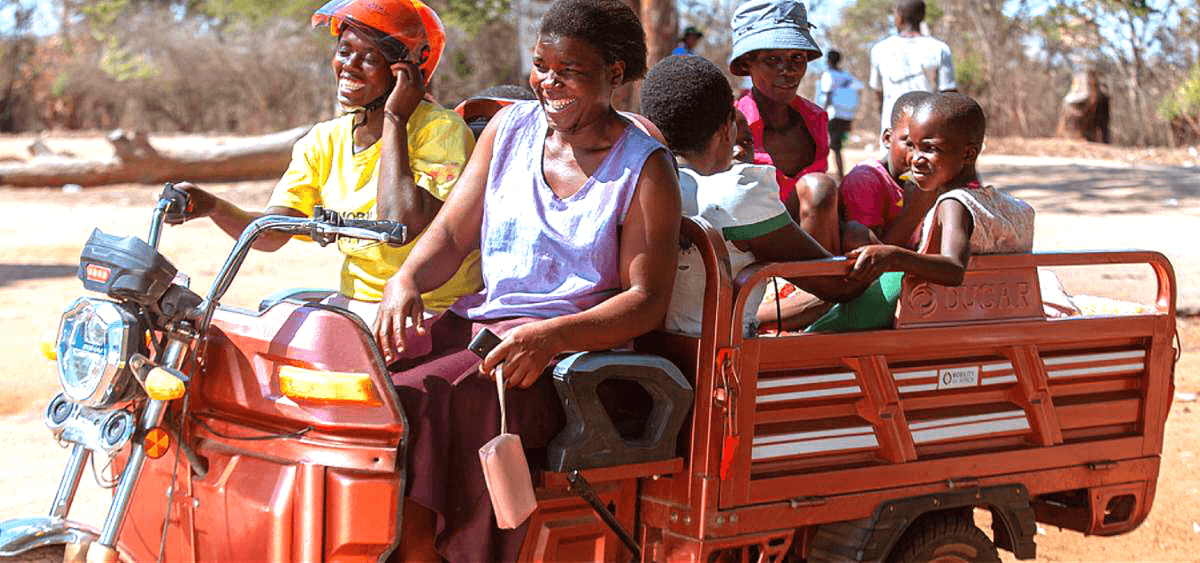
Other companies in Gather’s portfolio include Loropio Girls, a high school in Northern Kenya, Mobility for Africa which provides electric tricycles in rural Zimbabwe. Kenya’s Women-Owned Microprocessors provides microprocessing services in the mango value chain. In Ethiopia, Kubik recycles plastic waste.
Training and entrepreneurial support, often supported by grants, is a first step. Gather is taking the next step to provide women with pathways to asset ownership.
Ownership of assets, like drying equipment to cut food loss in agriculture, small-batch processing equipment and delivery trucks requires different pools of capital. The flexible-capital instruments give Gather more influence over how ventures operate.
Beyond ownership in shares, Gather wants to use alternative instruments to create ownership in payments, supply chains and governance models. That includes encouraging its portfolio companies to prioritize sourcing from women, and to structure payments to ensure money actually gets to the female suppliers and employees.
Gather is working on designs for workplaces that account for caregiving and other domestic responsibilities.
“In agriculture, if you actually give them [women] goals for a week and tell them what they need to hit by the end of the week, as opposed to the end of the day, you actually get higher returns,” she said.
Gather also wants to back construction and technology ventures, to help women shift into other fast-growing and high value sectors that can put them on a path to asset accumulation.
“Education is not enough, income is not enough,” Opot said. “Women still hit a wall, unless we back ideas that have a pathway to assets in a woman’s name.”