
A push to mobilize local institutional capital in Africa could open much-needed financing channels for the kind of local businesses that power job creation.
But before pension funds, insurance companies and high net-worth individuals can lean into such opportunities, they need to be able to allocate assets to “alternatives” more broadly.
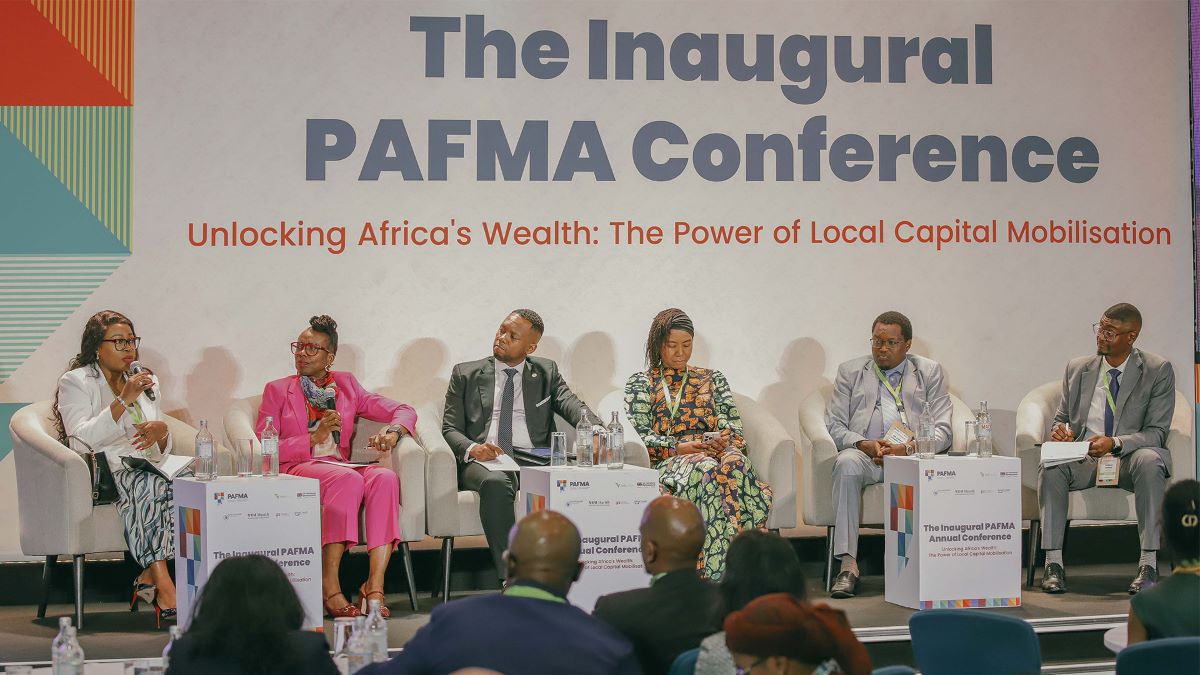
National regulators, in the name of reduced risk, have become a major bottleneck to the deployment of local institutional capital outside of government paper and global stock markets. Regulations need to evolve in response to transactions happening on the continent, argued Paul Frankish of African Infrastructure Investment Managers on the sidelines of the Pan-African Fund Managers’ Alliance convening of institutional fund administrators, board members, trustees, regulators and fund managers in Nairobi last week.
“It’s something that will start moving,” Frankish told ImpactAlpha. “What I think is important is how we shorten the period it takes for pension funds to develop into this asset allocation.”
Capital continuum
Africa’s institutional investors collectively have about $2 trillion in assets. Just a sliver is invested in alternative assets like private equity, venture capital, critical infrastructure and small business finance.
The pension fund market is especially young, compared to pension markets in the US or Europe, but its growth is following a familiar trajectory. An early preference for risk-averse bond investing is starting to give way to a preference for more diversified portfolios, which includes allocations to alternatives.
“Capital is starting to go from government bonds into infrastructure debt, and then in time, we’ll move into infrastructure equity and the broader private equity market,” Frankish said.
African Infrastructure Investment Managers, a private equity infrastructure fund manager, raised almost $1 billion in 2024. About half came from African institutional investors; the rest was from development finance institutions, sovereign wealth funds and other global investors.
Frankish said AIIM spoke with more than 800 investors as it was raising. “What the pension funds were looking for was a traditional infrastructure-type return, including long-term stable growth, inflation protection and foreign exchange hedging.”
Aware of institutional investors’ interest in infrastructure, some private fund managers are pushing for investors to broaden their definition beyond energy, roads and ports.
“Digital infrastructure is particularly pertinent at a time when everyone’s saying AI is going to enhance productivity,” argued Tokunboh Ishmael of gender-focused fund manager Alitheia Capital.
The firm is in the market with a fund for energy and digital infrastructure that supports efficiency, productivity, customer relations and financial management for small businesses. It is aiming to raise $150 million.
Mandating alternative investment
The Ghana Venture Capital and Private Equity Association, in partnership with fund managers like Oasis Capital and Savannah Impact Advisory, as well as private investment industry players, proposed a minimum 5% allocation of institutional assets to venture capital and private equity. In November, the Ghanaian government approved the mandate, which is set to go into effect this year.
The topic stoked debate among attendees at the PAFMA convening.
“To get the depth that we want for our markets, there are certain things that just have to be done, like minimums,” argued Ishmael. “You’re not allocating a minimum so that people can just play the lottery with it. It’s to allow that allocation to be patient capital.”
Omolola Oloworaran of Nigeria’s National Pension Commission disagreed. “I do not think that putting in place a minimum investment criteria would be good for contributors. It sounds like an easy way out, but what that essentially leads to is poor allocation of capital and pricing issues.”
She argued instead for the development of a stronger pipeline of bankable projects by alternative fund managers that institutional investors can back.
“The capital should be looking to address the needs of the pension fund,” agreed Frankish. The deep need for capital shouldn’t be solved through mandates,” he added. “We need to increase the efficiency and decrease the barriers to free markets.”
Proof points
With nearly all investors’ emphasis on track records, Africa’s private fund managers are focusing on pathways to liquidity and performance proof points.
Alitheia notched one exit last year and is lining up more for this year. Ishmael said the portfolio companies are averaging 200% top-line growth, but in local currency. She’s concerned about the impact of foreign exchange conversions on investor returns.
“It’s great progress, but it’s also revealing how much we need to have local currency products,” she said. “And who better to bring that than domestic institutional investors.”
UK-government backed FSDA, which supported the PAFMA convening, sees better data as a way to get more institutional capital flowing for economic development. FSDA and PAFMA jointly launched the Africa Pensions and Asset Management Data Hub, to illuminate trends in pension systems and the asset management industry.
Perhaps the stickiest obstacle is perception of alternative asset risk, argued AIIM’s Frankish. “It’s about educating and building familiarity and building a base that people can compare you to, which is easier in traditional asset classes than alternatives in many instances.”
AIIM’s approach is blending different types of capital, including a first-loss layer, to buffer institutional investors’ risk exposure.
“There is a level of misperception on the risk. I don’t necessarily think it’s a wholesale misperception,” he said. “A lot of African strategies have fewer levers to drive return than you see in some developed markets.”
“We also have the ability to drive stronger impact than we see in other markets,” he continued. “That allows us to [better] match the supply of capital with investor needs for adequate risk-adjusted returns and impact.”