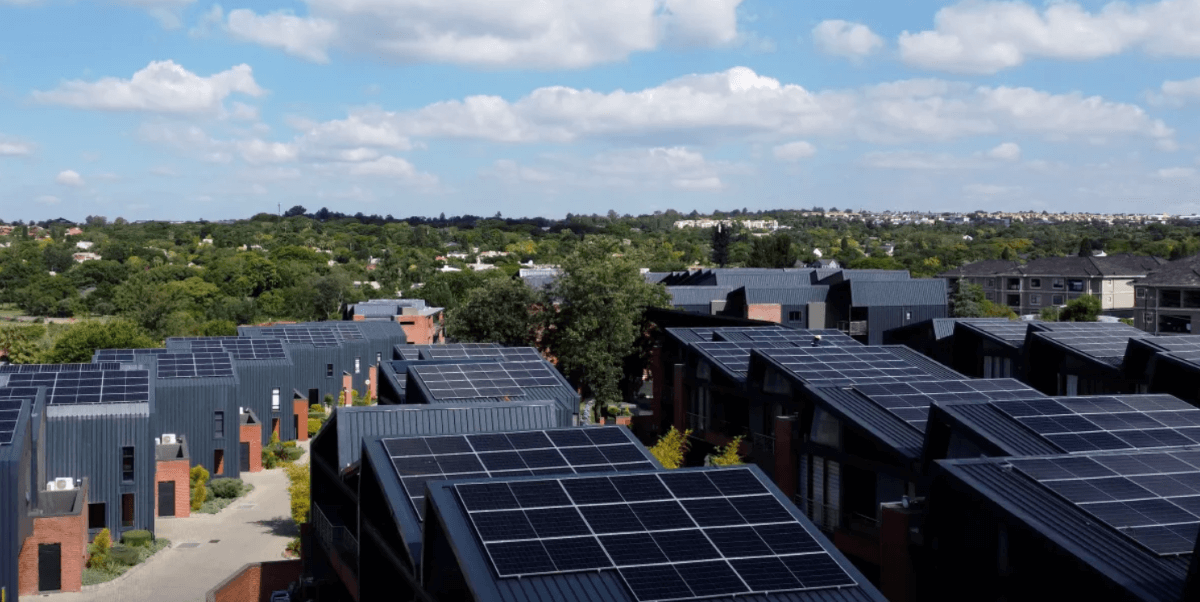

In South Africa, a solar microgrid serves a 101-unit residential complex in Sandton, an upscale suburb north of Johannesburg.
In Brazil, more than two dozen community solar projects lower the cost of electricity for households and small businesses.
And in Colombia, a pilot project for solar and storage systems is bringing electricity to Indigenous communities that have never had access to electricity.
The projects are being financed, in part, by 4,000 non-accredited US retail investors, who have put down as little as $100 in one of several private energy infrastructure funds offered by Energea, a Connecticut-based sustainable infrastructure investor that launched its online investing portal in 2020.
The crowdfunding platform says it has deployed $463 million since its first offering in 2019, delivering realized returns, net of fees, of more than 12%.
For retail investors, who have had too few opportunities to make a direct impact with their investments, Energea brings together energy infrastructure financing with private credit. The company’s exposure in emerging markets, according to Energea’s Chris Sattler, can “provide broader diversification and potentially higher long-term return profiles.”
Rather than developing projects from scratch, Energea acquires equity stakes in fully operational solar assets and generates revenues from electricity sales. At the end of 2024, the company owned more than 50 megawatts of generating capacity across 65 projects. The steady cash flows from electricity customers replay customers in the form of dividends.
“We pay the bills every month,” Sattler tells ImpactAlpha. “We collect the money from the offtakers, we pay the bills every month, and we distribute the rest to the investors. Whether that’s retail investors, wealth channel investors, they all get their pro rata share every month on monthly dividends.”
Retail crowdfunding
Energea isn’t the only clean-energy financing play that has turned to retail investors online.
California-based company Climatize Earth allows retailers to invest in projects in the US with as little as $10, offering fixed returns over a set time and repayment schedule. Climatize secured $1.75 million in 2024 in a pre-seed round from Myriad Venture Partners, Climate Capital and others and says it has invested over $12 million in nearly 30 projects.
BBoxx the now Kigali-based solar systems provider turned to crowdfunding in 2018 and raised €6 million ($7.2 million) in debt the following year via Trine, a Swedish crowdfunding platform for solar energy. Trine claims to have crowdfunded €112.7 million ($135.3 million) in debt to date, for projects in Africa, Latin America and Asia.
Energea’s returns are pegged on a project’s performance, unlike Climatize’s fixed-return model. Investors receive shares with identical economic terms. Energea offers four share classes for wealth professionals to accommodate different advisor fee structures. Sattler said retail investors represent a steady stream of capital.
“What retail does provide is broad participation and democratization, which results in a more predictable and smoother capital raise and liquidity cadence,” Sattler says. Institutional investors, including high-net worth families, can come into Energea’s deals for as little as $100,000.
“We view the retail and wealth channels as complementary,” he says. “Retail provides a stable foundation for predictable, compounding growth, while wealth channels enable larger-scale deployments.”
Up and downmarket
This month’s $462,000 acquisition of the Sandton project is the first microgrid in Energea’s Solarize Africa portfolio, which includes utility-scale and rooftop solar for schools, healthcare facilities, small businesses and residential clients. The company says the projects provide “economic security” in a country with an ongoing energy crisis and frequent outages.
Energea says the Solarize Africa portfolio has returns of 9.8% annually (vs. 13.9% for the Community Solar portfolio in Brazil and 7.2% for Energea’s projects in the US).
In Colombia, Energea is working with the government on a rural electrification program in communities that have never been connected to the grid. Under an agreement with the government, Energea will install solar and battery systems with meters that can be read remotely in homes and schools. The government will cover the electrical bills. A pilot project successfully tested the model, and the government has started disbursing payments to Energea.
“It’s a very good program as far as financial returns and impact go, because you have the low to no carbon energy, but you are electrifying communities that never have been on the grid and never connected to the internet. It’s a very impactful program,” Sattler says.
The company is now raising $150 million to scale the program to other parts of the country and fund other opportunities in Latin America. The open-ended fund seeks checks of $100 from retail investors and at least $100,000 from institutional investors and will provide loans and project financing to renewable energy companies in the region that operate their own assets. Energea says it has nearly 100 megawatts of projects in its pipeline.
Circular solar
The company deploys local operational teams and has offices in the markets where it’s active: within each market it’s active in: the US, South Africa, Brazil and Colombia.
Running these assets comes with its own risks like theft, policy changes, grid outages, interconnection delays, and counterparty failures. Energea says the regional and project diversification helps mitigate those risks and losses incurred in operating these assets. Energea’s “core” fund
Today, Energea operates 28 projects in Brazil through its community solar portfolio which serves small businesses and households. One of its earlier investments was reviving a hydroelectric plant in Rio de Janeiro, Brazil two years after Energea’s launch, using money secured from friends and family.
“We do a community solar model,” he says. “Local subscribers get discounts on their electric bill when they subscribe to our project.”
Energea recently turned to electrifying Enkaji School in Kajiado, just outside Kenya’s capital of Nairobi, aligning with its energy access initiatives. The school will be the first test of Energea’s initiative to recycle and repurpose solar panels and batteries from its projects.
By 2040, the International Renewable Energy Agency forecasts around 50 million tons of waste from solar projects will be generated globally.