Our road trip through North Carolina this month traveled both back in history and forward on the road to renewal.
We flew into Charlotte for Re:Construction NC, our daylong gathering of Agents of Impact at the University of North Carolina in Chapel Hill. We were there to start assembling a playbook for shared prosperity, a roster of what works in making less wealthy people more wealthy. The goal: Share the wealth. Contribute to the playbook.
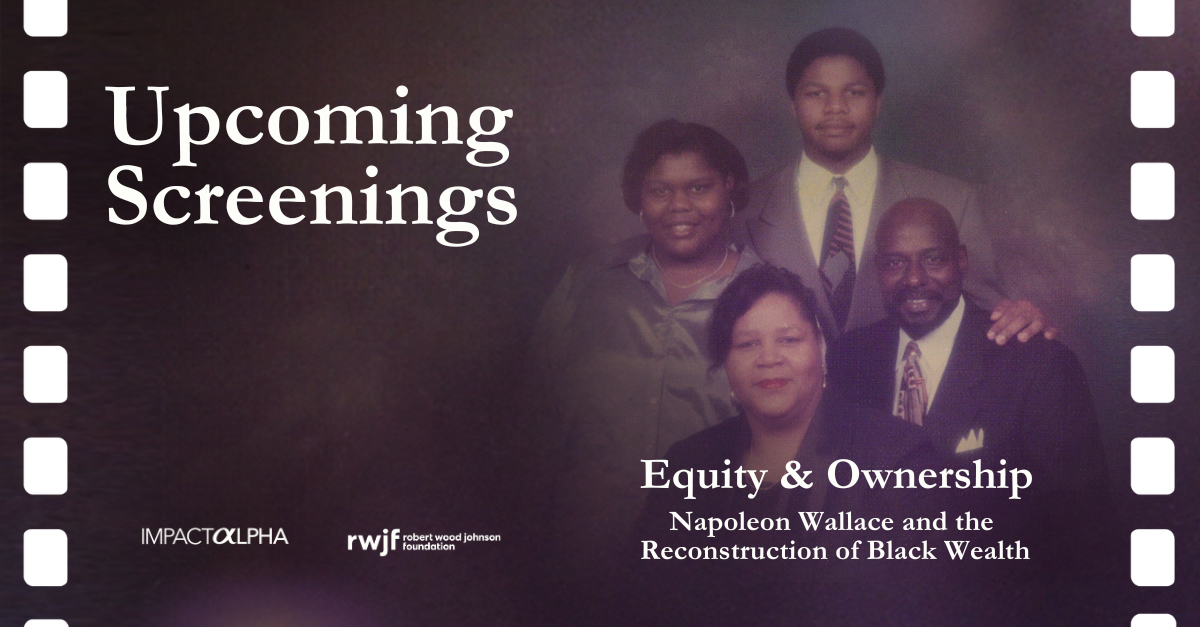
And we were there to show ImpactAlpha’s mini-documentary on such a wealth-building strategy in the place where it is centered. In just 20 minutes, “Equity and Ownership: Napoleon Wallace and the Reconstruction of Black Wealth” sketches elements of what’s needed that are already taking shape in North Carolina.
As the name suggests, Re:Construction is about constructing a new economy, building companies and communities, moving forward, abundance.
Five entries in the playbook are detailed below. Among the plays: Rebuilding whole blocks of devastated urban neighborhoods and sell them back to legacy residents to restore once-thriving Black neighborhoods without displacement. Helping owners of manufactured homes form co-ops to buy the mobile home parks where they live. And with shared equity, helping business owners build assets and intergenerational wealth by buying the commercial properties in which they operate.
Other shared-prosperity strategies: A real estate investment trust for the care economy that helps childcare providers secure a stable location and a share of the appreciation in the property’s value. And a turnkey solution for entrepreneurial operators seeking to launch their own high-margin businesses, with the aim of creating dozens, if not hundreds of millionaires.
Our event at the Kenan-Flagler Business School was co-hosted by Good Trbl, which describes itself as a North Carolina “coalition of investors, builders, and truth-tellers.” It’s the latest effort of Napoleon Wallace, who is building out a network of wealth-building strategies while living with late-stage ALS.
“We’re challenging our state’s wealthiest to double down on investments that address the health, wealth, workforce, and housing needs of their fellow North Carolinians,” Wallace said. “While Wall Street plays its game, we’re building a different one. A local one. A just one. We don’t need permission—we only need our convictions, our capital, and a little courage.”
The playbook’s tie-back to the historical Reconstruction is intentional. Just as the promise and progress of the historical Reconstruction after the Civil War gave way to a backlash and retrenchment in the 1870s, so too has the progress toward inclusion in recent decades triggered reaction and retreat.
The southern US has a legacy of slavery and Jim Crow, but also of shared prosperity and multiracial democracy based on broad ownership, self-determination and collective power. Multiracial prosperity was so successful that even after the end of Reconstruction, it persisted in pockets like Greenwood and Rosewood and Wilmington and Durham.
150 years later, successful models can survive and even thrive. Rather than ignore, or rewrite the past, Re:Construction seeks to learn from the past, help to repair it and build on its successes.
Neighborhood economics
First stop: Asheville.
Just six months after Hurricane Helene delivered an unexpected wallop to the lowlands around Swannanoa and the city’s River Arts District, unseasonable wildfires threatened to detour our drive up from Charlotte.
The fires had again tested the community resilience of western North Carolina. A providential downpour helped douse the fires on the day we arrived.
Such resilience was the theme of Neighborhood Economics, the roving annual gathering of community finance practitioners that had been planned for Asheville even before Helene, and now was more salient than ever.
“Having one of the largest national disasters come to your doorstep, you learn real quick,” said Rev. Amy Cantrell of BeLoved Asheville, a street ministry that builds solutions to homelessness, poverty and racism through what it calls “the art of neighboring.”
For years, Cantrell had organized street medics, teams of homeless and formerly homeless residents who reach out to those still living on the streets. When many Asheville residents found themselves in similarly dire straits, community resources materialized from all directions.
“I looked up and I was like, ‘We are in a sharing economy. Holy geez,’” Cantrell told the Neighborhood Economic gathering. “I was so excited. I was so excited because suddenly we had left capitalism. Everybody here had left capitalism. Whether they knew it or not, they were in a different economy. They were in a neighborhood economy. They were in a sharing economy.”
“And we got to experience it. And I want to tell you, it’s traumatic and devastating, and we saw death and we saw great tragedy in our community and destruction,” she said. “But I’m also going to tell you, we saw something that not many people have gotten to experience. We saw how alternative economies can work. And it was glorious.”
On the way to Chapel Hill, we detoured to South Carolina, to check in on my husband’s family home in Spartanburg, where he grew up. My in-laws’ house had suffered its own storm damage last year when a neighbor’s two giant trees crashed through the roof and let the rain pour in, ruining the carpeting and drywall. Emptied of decades of memories and stripped to the studs, the old house was getting its own kind of renewal.
Unlike for many residents of Asheville, insurance was covering most of the damage.
Local investment ecosystems
In Chapel Hill, I had the pleasure of having an on-stage conversation with Bill Spruill, who sold his startup, Global Data Consortium, to the London Stock Exchange in 2022. Spruill, who grew up in Greensboro, is proud that the sale minted more than two dozen millionaires in the Research Triangle area of North Carolina.
“But my biggest lament in creating that wealth opportunity for people was the fact that there was zero minority participation in that – zero,” Spruill told me. To help more Black and brown entrepreneurs realize the wealth creation opportunity in tech, Spruill established 2ndF, short for foundation, as his family office and investment vehicle.
“I believe that my focus in life is meant to help aspiring Black founders from across the country achieve eight- and nine-figure outcomes,” Spruill said.
The foundation runs several networking and mentorship programs and has also invested in early stage startups like Charger Help, which trains repair technicians for EV chargers, and Solideon, a mobile robotics company founded by Oluseun Taiwo, a first-generation Nigerian-American.
North Carolina is well-suited to nurture an inclusive entrepreneurial ecosystem in large part because of its wealth of historically black colleges and universities, including North Carolina Central University in Durham. Boston, for example, lacks such legacy and has struggled to build an inclusive ecosystem, despite its concentration of tech startups, Ed Gaskin, a local writer who also heads Greater Grove Hall Main Streets, a community economic development effort.
“On paper, Boston should be a Black tech founder’s dream city,” Gaskin writes in “How Boston Lost Big on Black Tech.” Black founders received just 0.4 percent of Massachusetts’ $34.8 billion in venture capital investments in 2021, compared to 8.9 percent in Atlanta.
Atlanta has created 11,000 Black millionaires and several billionaires. Despite its tech prowess, Boston has yet to launch a single Black billionaire. Sorting for the key variables, the presence of vibrant HBCUs stood out as determinative, Gaskin told ImpactAlpha.
ImpactAlpha’s 20-minute film, “Equity and Ownership,” won an award for “Best Documentary” at the Boston International Film Festival.
In the documentary, Activest’s Micah Gilmer describes his intellectual “marriage” to Napoleon Wallace, a co-founder of the firm. Gilmer’s work had been working with foundations and civic leaders to confront the way white supremacy continues to show up in structures and institutions.
“And what Napoleon was about was, ‘Yeah, I know they’re doing that, but let’s focus on building economic opportunity for Black communities,’” Gilmer says in the film.
Pages in the playbook
When we moved on to Re:Construction DC, we found an appetite for the themes of “people, purpose and perseverance,” which served as a welcome counterpoint to the chaotic and divisive news coming out of the nation’s capital.
“We needed this,” more than a few people said at our event with the Robert Wood Johnson Foundation, hosted at the Aspen Institute. The institute’s Financial Security Program has developed a “New Wealth Agenda” with a bold target: to 10x the wealth of low-income and households of color.
Among the levers: Positive cash flow, debt resolution, wealth-building career pathways and homeownership.
Many guests wore purple to reflect that solutions to “kitchen table” challenges like high housing costs, lending for small businesses and upgrading community infrastructure are not that different for “blue” urban areas and “red” rural regions. For example:
Rebuild whole blocks of devastated urban neighborhoods and sell them back to legacy residents. Parity Homes’ Bree Jones is working to revive abandoned blocks of West Baltimore. Thriving Black neighborhoods were destroyed through urban renewal, redlining, blockbusting and a lack of capital for investment. Parity is looking to renovate the houses and sell them, cheap, to people who share Jones’ goal of generating community wealth and creating thriving neighborhoods once more.
“This model only works if you are purchasing at scale and if you’re purchasing in concentration,” Jones says.
Parity sells the renovated homes to its legacy resident buyers for $280,000 — or, $100,000 less than the typical appraised value – giving the new homeowners an immediate equity boost.
“We’re attempting to bring back community, bring back home ownership by acquiring vacant properties in bulk by the block,” Jones said at the event. Wealth-building requires more than home ownership, she said, citing entrepreneurial business ownership and employee ownership of the companies where they work.
“But at least in our little lane, our home buyers are rebuilding wealth upwards of over $100,000 just in equity in their homes. They’re building multi generational wealth,” she said.
Jones spoke of vibrant Black economies that persisted long after formal Reconstruction was over, in Tulsa, Oklahoma; Rosewood, Florida; Wilmington, North Carolina and many other places. “These neighborhoods were thriving, and black folks were just fine,” Jones said. “And you have racist white folks come and burn it down and massacre people and destroy that joy that was built.”
“And so my theory of change is that when we can restore Black folks’ connection to land,” she said, “then we can potentially change the world together through collective action, through political action, through collective engagement.”
Help owners of manufactured homes form co-ops to buy the mobile home parks where they live. In the Carolinas, manufactured or mobile homes make up some 15% of the housing stock, compared to 6% nationally.
“We’ve been helping homeowners form limited equity cooperatives to buy the land beneath their homes and to operate as owners of their homes with one share in the cooperative that owns the land,” says Paul Bradley, who until recently led ROC USA, which has helped form 332 such co-ops with a total of 23,000 homes sites in 21 states.
As more mobile home parks are rolled into chains by private equity investors, ROC USA has spun off Integrity Community Solutions to raise an equity fund to be able to move fast to purchase portfolios, own them on an interim basis and then sell them back to the homeowners.
“You need the capital in advance in order to belly up to the bar and negotiate on bulk or portfolio purchases,” says Bradley, who is leading the spinoff effort. “We’ve got to step up and deconsolidate and remove these properties from the speculative real estate market, and get them in the hands of the local community.”
Help low-wealth business owners purchase the commercial property where they operate. Wallace, along with Talib Graves-Manns and Wilson Lester, is building Partners in Equity to help Black business owners buy the commercial properties in which they operate. The appreciating asset can then be leveraged for growth capital, building generational wealth.
The shared equity model helps the business owners come up with the needed down payment to begin to build equity.
“Partners in equity is essentially that rich uncle fund for those entrepreneurs,” Lester said during the Chapel Hill event. “We come in and we absorb a portion of that gap, that 20% down payment to help them realize the actuality of owning property.”
Lester and Graves-Manns will be guests of ImpactAlpha’s Sherrell Dorsey on the next PluggedIn call on Tuesday, May 6.
Enable ownership and operation of turn-key high margin businesses. Zarû is piloting the model with high-tech vertical farms built inside of shipping containers. One shipping container can produce the equivalent of two acres of farmland.
Zarû provides entrepreneurs with the financing to buy a real asset, as well as training, support and services. They then collect recurring royalties as the entrepreneur builds personal wealth and equity in the business.
The company has the ambitious goal of building a billion dollars in Black wealth – in the form of 1,000 businesses worth at least $1 million each (listen to the podcast, “Franchising indoor farms to build a billion dollars in Black wealth”).
New CEO Alexis White is moving the company’s operations to North Carolina from Oakland. For Loren Taylor, the former CEO, the chance to run again for mayor of Oakland was hard to resist, after he lost an extremely tight race in 2022. This time, Taylor ran a surprisingly strong race against longtime Rep. Barbara Lee, only to fall slightly short again. Taylor conceded the race to Lee this weekend.
Lease houses and centers to child care operators with an opportunity to purchase. Mission Driven Finance has created Care Access Real Estate to purchase, renovate and lease commercial and residential properties specifically designed for child care.
The fund helps child care providers build wealth through buy-out options and profit-sharing in most leases. The fund is anchored by the Annie E. Casey and W.K. Kellogg foundations, which cited the model’s dual benefits of addressing a broken child care market and driving economic opportunity for early care and education providers.
CARE has a portfolio of nearly two dozen child care homes in Nevada, California, and Colorado.
ImpactAlpha is assembling a playbook for shared prosperity, a roster of what works in making less wealthy people more wealthy. The goal: Share the wealth. Contribute to the playbook.
Join Agents of Impact Call No. 70 to meet Agents of Impact who are building the playbook. We’ll showcase specific examples to start to construct an innovative agenda for moving forward – together. Wednesday, April 30 at 10am PT / 1pm ET / 6pm London. RSVP.