
Equity and ownership for small businesses. Lower cost of capital for majority-minority cities and colleges. Startup capital for underestimated founders. Place-based investment ecosystems.
At least in North Carolina, even as President Trump’s tariffs tanked markets and roiled global trade, Agents of Impact stayed focused on mobilizing capital for local entrepreneurs and building wealth for families of all kinds. Together, they are assembling a “playbook for shared prosperity.”
“The priority for making sure our economy is inclusive, that everybody is welcome at the table – the data is overwhelming in support of that,” Thom Ruhe, head of the entrepreneurship accelerator and investor NCIdea said at the Kenan-Flagler School of Business at the University of North Carolina in Chapel Hill. “It’s not just the right thing to do. It’s economically the smart thing to do.”
Ruhe kicked off Re:Construction NC, produced by ImpactAlpha with GOOD TRBL, a collaboration of North Carolina fund managers and ecosystem builders, which NCIdea is supporting. In the last nine years NCIdea has moved from making 90% of its grants to white male founders in the state’s major metro areas to backing women, minority and rural founders with 70% of its funding.
ImpactAlpha will continue to build out the playbook for shared prosperity on Tuesday, April 8, at Re:Construction DC, produced with Robert Wood Johnson Foundation and hosted by Aspen Institute (RSVP). With the theme “People, purpose and perseverance,” many guests will wear purple to reflect that solutions to “kitchen table” challenges like high housing costs, lending for small businesses and upgrading community infrastructure are not that different for “blue” urban areas and “red” rural regions.
The Purple Party also aims to rally business, community and global development staffers and other public servants whose work and lives have been disrupted in what is being euphemistically called “the current environment.” Protests around the country on Saturday demanded the Trump administration keep its “hands off” vital programs; there’s also a need for hands-on strategies to strengthen what works.
“My challenge to you all now is that this is not the time to pull back. This is actually the time to get involved, to get loud, to get in trouble,” Ruhe told the UNC gathering. “And those of us who make moves now can find that courage, and understand that this too shall pass. When it does, we won’t be making up for lost ground. We’ll pick up from where we left off.”
Good trouble
There was another part to the late Rep. John Lewis’s admonition to get into “good trouble,” Karen LeVert of LeVert Ventures reminded the gathering: “Necessary trouble.”
The GOOD TRBL network of a half-dozen impact fund managers in North Carolina is seeking to mobilize additional capital, in part by enlisting the state’s 50 wealthiest families to allocate 2% of their investments to impact. The state “has become a national hotbed of impact investing activity and funds,” the group says on its website.
“We want to think differently about investing so that we can check the box on social good,” said LeVert, an agritech investor based in Asheville. “We want to check the box on environmental good, and at the same time, we want to generate market rate returns, and we want to do that right here in North Carolina.”
The GOOD TRBL grouping is another brainchild of Napoleon Wallace, the indefatigable entrepreneur living with ALS who is the subject of ImpactAlpha’s mini-documentary, “Equity and Ownership,” which had its North Carolina premiere last week. “Those of you that know Napoleon, if he’s heading a certain direction, you might as well just get on the bandwagon with him,” LeVert said. On the eve of the gathering, the television station WRAL featured Wallace on its evening news.
Participants in the gathering called the Trump administration’s weaponization of DEI a distraction from the “necessary” work of redressing generations of compounding wealth inequality. Wallace told ImpactAlpha that the shift in the national political discourse “from calls for equity to cries of reverse discrimination, isn’t just dishonest. It’s dangerous.”
“It ignores how deeply history has stacked the deck. Generations of violence and exclusion built today’s wealth gap. Pretending everyone’s now suddenly on equal footing now isn’t fairness—it’s fiction.”
In the film, Wallace takes impact investing to task for failing to fulfill its promise of improving outcomes in low- and moderate-income communities.
“Impact investing is at a crossroads,” he said. “It’s up to us to fight, scrap and demand that the broader market internalize the impact of their investments,” Wallace said. “That type of wholesale conversion is the next leap forward and the highest and best use of impact investing, especially in this moment.”
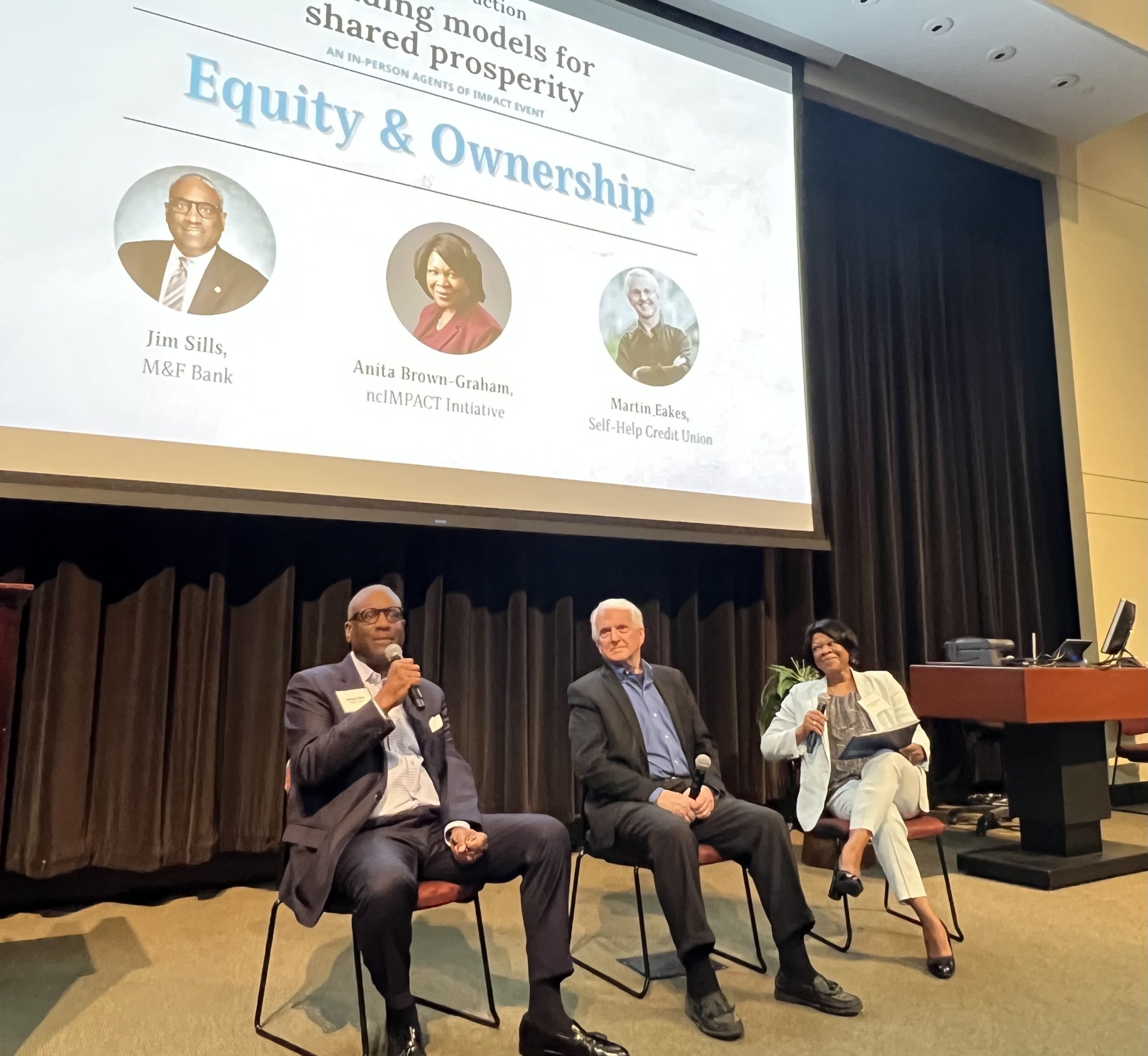
James Sills, CEO of M&F Bank, the second-oldest Black-owned bank in the US, said the film’s title, “Equity and Ownership,” resonated. “That’s something been a mission of the bank and a personal mission of mine for over 30 years – how to provide access to capital to small- and medium-sized businesses and consumers all across the southeast.”
Sills said that while the wealth gap between Black families and the majority population is as much as 12:1, for business owners, its 3:1. The bank focuses on businesses with less than $5 million in gross revenue.
“That’s where we think we can make the biggest difference and continue to make the difference here in North Carolina.”
Playbook of what works
“Re:Construction DC” will take place on the eve of the Aspen Institute’s annual Employee Ownership Forum, a two-day event that aims to highlight how the experience of ownership changes the reality of work for workers.
Ownership – of homes, commercial real estate, financial assets as well as of the companies that employees have helped to build – is a key theme in any playbook for shared prosperity. The Aspen Institute estimates that such an investment ecosystem could, in rough numbers, 10x the wealth of households of color and those in the bottom half of US wealth distribution, which now own less than 2% of US household wealth.
Wallace, along with Talib Graves-Manns and Wilson Lester, is building Partners in Equity to help Black business owners buy the commercial properties in which they operate. The appreciating asset can then be leveraged for growth capital and generational wealth. The firm is close to closing its second fund.
“Partners in equity is essentially that rich uncle fund for those entrepreneurs,” Lester said during the event’s GP Showcase. “We come in and we absorb a portion of that gap, that 20% down payment to help them realize the actuality of owning property.”
Another North Carolina fund manager, Symphonic Capital, set out to invest in founders targeting solutions for underserved communities, and quickly found that gaps in health and wealth often intersected with climate change. The pre-seed venture firm has found a pipeline that includes companies in insurance tech, data and analytics for detecting disasters, or products and services that help employees adapt to extreme heat.
Symphonic’s Shruti Shah said the firm invests nationally, but has a special focus on North Carolina because the partners are graduates of Duke and UNC, and is a member of GOOD TRBL. Shah said the firm has attracted interest from limited partners, who are assessing risks across their portfolios of real estate, insurance, bonds and more.
“All of these things are going to be impacted by climate change,” Shah told ImpactAlpha on last week’s Plugged In Live. So investing in products and services that allow them to mitigate that risk is actually extremely important.”
https://stg.impactalpha.com/how-symphonic-capital-is-setting-up-pre-seed-founders-for-success-video/
Activest, an investment research and analytics firm, made its reputation by calling out credit risks in cities that, for example, are reliant on excessive fees and fines on their own residents of color. To help finance solutions, Activest has launched its own investment advisory, Next World Partners.
With a $50 million mandate from Kataly Foundation, its first deployment was in a $58 million bond issued by North Carolina Agricultural and Technical State University, a historically black land grant university, which is building new student housing to serve its growing enrollment.
“We’re trying to reduce the cost of capital for Black and brown cities and institutions, and show that the ways that investors invest in the fixed-income side of the portfolio can be as impactful, if not more, than across other areas,” said Activest’s Ellen Ward.
With federal money likely to be scarce, the bond market will become an increasingly important way to raise capital for cities and universities. Ward said Activest is seeking to build a coalition of bond investors big enough to influence issuers to prioritize, for example, affordable housing in the financing of a sports arena.
“What we’re trying to do, within the constraints of the current capital market system, is show that there are ways to shift how capital flows, and shift the power of who’s making decisions,” Ward said.
To add a play to ImpactAlpha’s “Playbook for Shared Prosperity” – your own or one you are familiar with – please complete this short form. To schedule a showing of “Equity and Ownership: Napoleon Wallace and the Reconstruction of Black Wealth” drop a note to [email protected].