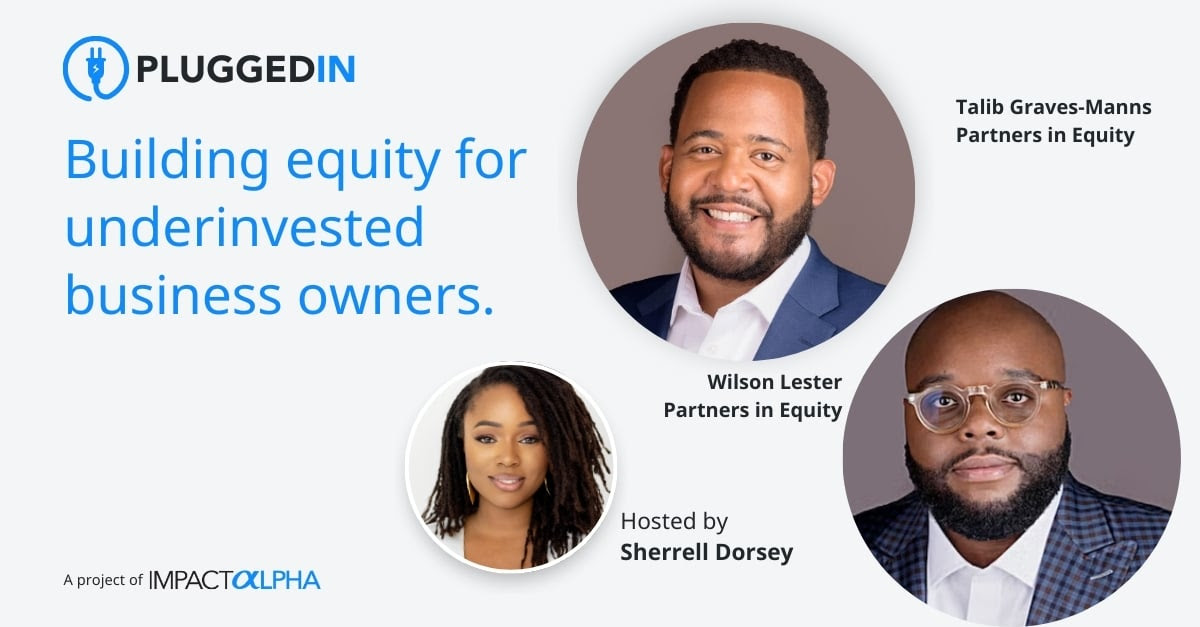

Many investors overlook Main Street mom-and-pop shops in their pursuit of returns. Partners in Equity sees potential to unlock financial and social value in these community assets. The North Carolina-based commercial real estate firm partners with small business owners in underserved communities to help them acquire the property they operate out of. “We’re thinking about commercial real estate ownership as a vehicle to fight displacement and create wealth for those business owners,” says the firm’s Talib Graves-Manns.
In the latest Plugged In episode, host Sherrell Dorsey talks with Partners in Equity managing partners Graves-Manns and his partner Wilson Lester about their equity downpayment assistance model and how they are fostering wealth creation pathways in communities.
PluggedIn: Building equity for underinvested business owners
Downpayment assistance
Local businesses such as health clinics, daycare centers, coffee shops and grocery stores are often anchors in their communities and offer vital services. But if they lease their properties, as most do, these local businesses are vulnerable to dislocation when rents get pushed up.
Partners in Equity, or PIE, helps business owners with the biggest obstacle to real estate ownership: a downpayment. “We are a down payment equity partner for the business owner,” says Graves-Mann.
Banks will typically require a 20% cash downpayment. On a $2 million dollar property, that means a business owner must come up with $400,000.
PIE comes in with 15% of the downpayment, and creates an at LLC that owns the real estate. “When it’s time to refinance the loan, the idea is that the property has appreciated or the building sells and a wealth event is created through equity within the property,” explains Lester.
Upskilling and Partnership
In addition to providing capital, PIE educates and supports entrepreneurs to prepare them for the complexities of commercial property ownership. That includes guidance on maintenance, taxes, energy efficiency and general property management.
“We don’t look at our business owners as targets that we’re investing in. We look at them as our business partners,”’says Lester. “And where they don’t have the skills or the understanding of how to do certain things, we want to partner with them to ensure they understand how to do it, and that they have the support and resources to really bring the property to its highest and best use through the relationship.”
Righting Historical Underinvestment and Displacement
The historical impact of discriminatory policies like redlining, which took hold in the 1930s, resulted in significant devaluation within communities of color. This vulnerability often compounded as urban gentrification led to rising rents and the displacement of both residents and the small businesses that served them.
PIE adopts an intentional investment strategy to prevent such negative consequences. Its focus is on established businesses that provide crucial value to their communities. “We prioritize businesses that are already rooted in the community and contribute positively,” Wilson Lester elaborated,. This means we actively avoid funding ventures like vape shops and instead invest in essential services such as mechanic shops, last-mile delivery services, doctor’s offices, retail stores, and local manufacturers.”
A Model for a Sustainable Future
The equity-based downpayment assistance model is already delivering tangible results. In a recent column for ImpactAlpha, PIE founding partner and senior advisor, Napoleon Wallace, highlighted the story of Kenya T, a business owner operating a mental health clinic in her community.
Rising rents threatened to displace her business and her ability to continue supporting her clients navigating trauma and domestic violence. Kenya T partnered with PIE to acquire her building. With the newfound stability, she is now planning to expand the services she offers to the community at the site.
Partners in Equity’s model generates a ripple effect of economic empowerment. As Talib Graves-Manns notes, the firm’s approach yields both near-term growth and the promise of lasting generational wealth.
The business owners they invest in now will, 10 years from now, be in a position to send their kids to college or give them seed capital to start their own businesses or buy their first home. “That’s going to transform the trajectory of the wealth of their family for generations to come, which is something that we care deeply about,” said Lester. “That’s a part of the mission and being a partner.”