Editor’s note: ImpactAlpha contributing editor Napoleon Wallace is a co-founder of GOOD TRBL, Partners in Equity, Activest and other companies and organizations. He is the subject of ImpactAlpha’s award-winning mini-documentary, “Equity and Ownership: Napoleon Wallace and the Reconstruction of Black Wealth.”
The invisible contract
Every nation is built on a set of stories.
America’s most enduring myth is that capitalism and freedom go hand in hand, that the same markets that empower individuals also protect their liberty.
Beneath that myth lies an invisible contract — one that bound liberty not to equality, but to property. In America, property was never neutral. John Locke’s famous formulation — “life, liberty, and property” — wasn’t just philosophy. It was a framework for exclusion.
Nearly 250 years ago, Thomas Jefferson swapped “property” out for “the pursuit of happiness.” The substitution didn’t erase the underlying assumption: that the protection of property, not the distribution of power, would be government’s highest calling.
The U.S. Constitution institutionalized this logic. Enslaved people counted as three-fifths of a person, even as their unpaid labor built the economic foundations of the South. Indigenous lands were seized, parceled, and sold. The “free market” was anything but free — it was underwritten by conquest, subsidized by the state, and designed to reinforce ownership, not opportunity.
This is no historical footnote. Matthew Desmond, in “Poverty, by America,” argues that poverty in the United States isn’t an unfortunate byproduct of capitalism — it’s the result of deliberate choices that allow some to accumulate by ensuring others are excluded.
The myth of the free market endures. It’s a good story, but markets are neither neutral nor efficient. They reflect the powers they were built to promote. In America, it was the power to capture, control and commodify the property rights of “others” is what our market was built to provide.
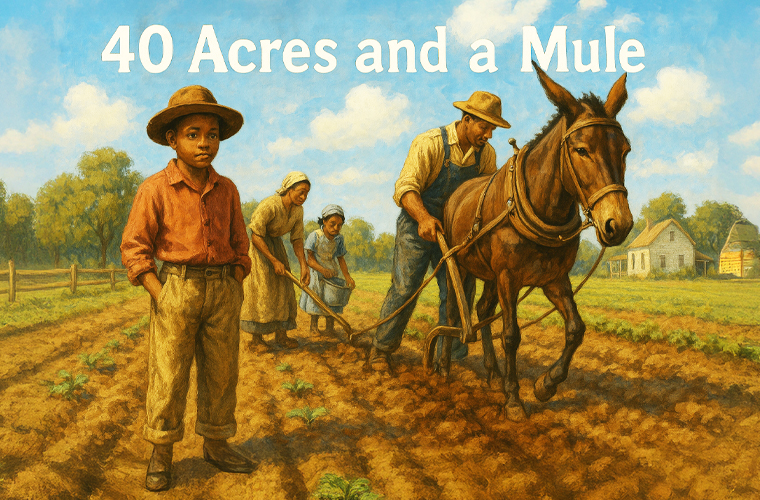
40 acres and a mule
The story of modern American capitalism is often told as one of innovation and entrepreneurial grit. But its origins are in extraction — of land, labor, and lives.
The Homestead Act of 1862 handed out 270 million acres of public land — nearly 10% of the continental U.S. — to white settlers. These land grants became multigenerational wealth for millions. But the same America that gave away the frontier was waging war against Native nations to seize it in the first place. Just a few years later, in 1865, emancipated Americans were promised “40 acres” of the same lands their enslaved ancestors cultivated for free for generations.
By 1877, that promise was abandoned along with the idea of Reconstruction. Instead, Black Americans got sharecropping, racial terror, and exclusion from nearly every federal wealth-building program that followed.
The GI Bill. FHA loans. New Deal labor protections. Each carved out exceptions — often explicitly — to exclude Black and brown Americans.
Exclusion hasn’t been a bug of our economy. It’s a feature. As Richard Rothstein documents in “The Color of Law,” redlining maps drawn by the Home Owners’ Loan Corporation codified racial exclusion. Banks denied mortgages in Black neighborhoods; some families accumulated equity. Predatory practices like “contract buying” in Chicago extracted wealth from low-wealth communities already denied access to traditional financing.
The results persist today.
In sector after sector, a few firms dominate. As The Guardian found, over 80% of food product categories are controlled by just four companies. In banking, Big Four consolidation puts massive influence in the hands of a few. Agriculture. Tech. Healthcare. Media. It’s monopolies in products, monopsonies in labor, and a dwindling number of paths to ownership.
Between 1940 and today, economic mobility collapsed. In 1940, 90% of children earned more than their parents. Today, fewer than 50% do. The top 1% owns over 30% of U.S. wealth; the bottom half, less than 3%. Native communities face poverty rates more than double the national average, and Black households—which have about one-sixth the wealth of white households—are literally trying to make a dollar outta 15 cents.
By dismantling wealth engines, America forfeited trillions in unrealized prosperity and innovation—$16 trillion in lost GDP over the last 20 years according to Citigroup. That’s not just a loss for Black America—it’s a loss for ALL America.
Playbook for shared prosperity
If exclusion was engineered, inclusion can be, too.
Across the country, communities are reimagining the building blocks of ownership and prosperity. In Boston, Community Land Trusts are taking housing off the speculative market and placing it into community control. In North Carolina, the Self-Help Credit Union — a cooperatively-owned Community Development Financial Institution — has lent over $9 billion to families and entrepreneurs who traditional banks ignored.
Public banking is gaining steam. The Bank of North Dakota, the country’s only state-owned bank, has helped insulate local economies from global shocks. California is exploring its own public banking system, and cities from Philadelphia to San Francisco are following suit.
Worker-owner models like those championed by Apis & Heritage, and even mainstream financiers like KKR’s Pete Stavros, are actively building on-ramps to ownership that turn the business of buyouts on its head. Apis & Heritage targets essential industries with workforces of color, using buyouts to build equity for employees who’ve traditionally been excluded. Stavros frames employee ownership as a competitive edge in private equity, showing it boosts productivity, morale, and retention.
By converting businesses into employee-owned enterprises, these transactions don’t just offer fair exits for founders — they democratize wealth, profits and power.
As we work to evolve capitalism, it’s worth acknowledging the myths that gird the extractive and exclusionary parts of our economy: America’s market economy was never a natural phenomenon. It was a political invention, shaped by laws, backed by violence, and justified by myth. The myth that freedom and capitalism are synonymous. That markets are self-correcting. That wealth reflects virtue. The system we have rewards capital more than contribution. Socializes risk, privatizes gains, and cloaks itself in the language of liberty. It works exactly as designed — for those it was designed for.
The Re:Construction is underway. From scarcity to solidarity. From privatization to participation. From market myth to shared mission.
That’s an economy worth celebrating: Not the myth we were sold, but the future we are building.