
Stream on Disney+ (trailer)
Spoiler level: Low
Total score: 15 (Accuracy: 5, Entertainment: 5, Impact: 5)
David Attenborough is a name known to even casual nature lovers. He is the voice and driving force behind many of the most celebrated nature documentaries, from A Life on Our Planet to the Planet Earth series.
I’ve seen many if not all of these documentaries, so it is no small statement to say that Ocean may be his masterpiece.
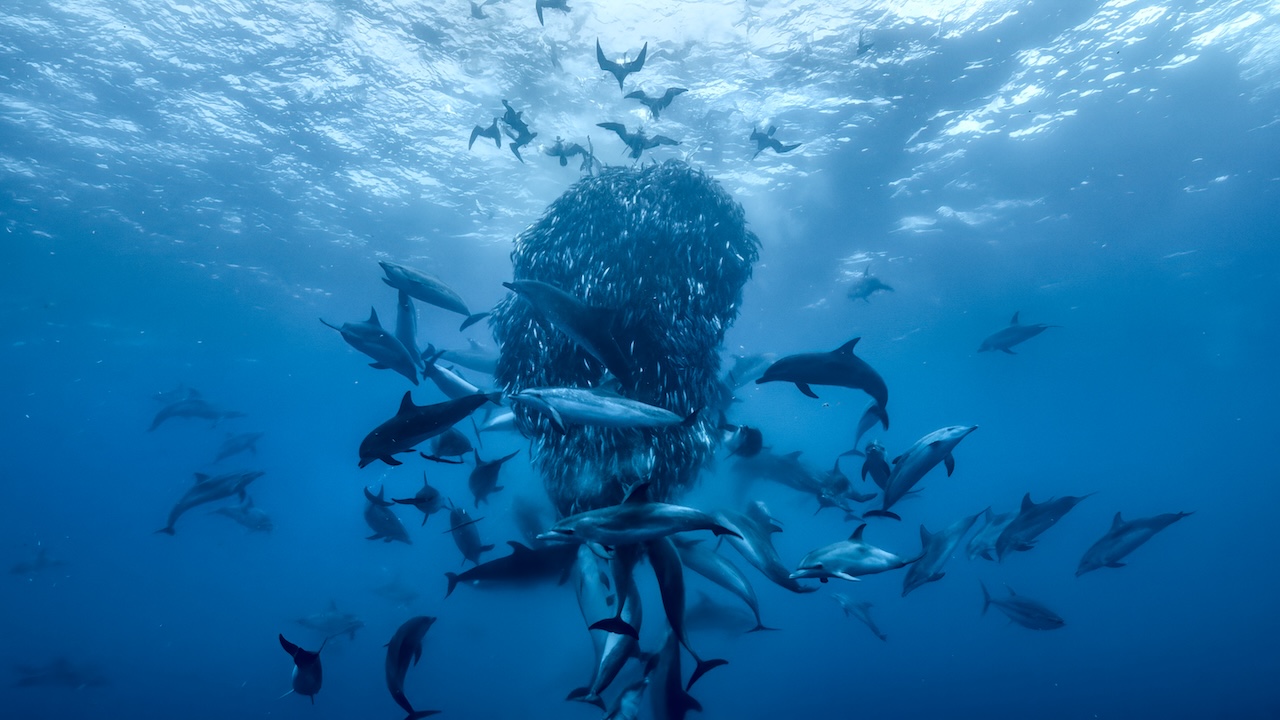
The feature-length documentary, produced in partnership with National Geographic and now streaming on Disney+, tells a captivating story about the importance of the world’s oceans and the interconnected links between life underwater and life on land.
Quite simply, much of the animal kingdom (including humans) depends on the continued vitality of the oceans and so we all need to do a much better job of protecting marine ecosystems. These ecosystems aren’t just the foundation of our global food chain – they also play a crucial role in the fight against climate change. According to one UN study, oceans generate 50% of the oxygen we need, absorb 30% of all carbon dioxide emissions and capture 90% of the excess heat generated by those emissions.
Unfortunately, the documentary makes it clear that we are treating our oceans much as we do other shared resources – as something to exploit for our own benefit, without much thought to the long-term consequences.
The clip from Ocean that best illustrates this point is exclusive footage of the process of bottom trawling, which involves tying a net to some iron chains and then dragging it across the seabed, destroying everything in its path – usually in search of just a single species. As much as three-quarters of the total haul ends up as “bycatch” (i.e., the incidental capture of non-target species when fishing) that is then thrown overboard, often either already dead or soon to be dead. As Attenborough says in his narration, “it’s hard to imagine a more wasteful way to catch fish.” And it’s all completely legal.
When I first saw this clip start to fill up my LinkedIn feed in the weeks before the Ocean premiere, I was horrified. How could we allow this much destruction to our natural habitats? Especially to innocent animals that just happened to be at the wrong place at the wrong time?
The industrial fishing companies may argue that bottom trawling is a cheaper and more efficient way to catch fish than what humans have been doing for millennia. But that obviously doesn’t account for any negative externalities like disrupting delicate ecosystems or indiscriminately killing millions of marine animals. There are plenty of ways to fish sustainability that don’t require giant, floating killing machines. It’s just that the machines are a convenient shortcut to huge profits.
As Attenborough writes in Ocean: Earth’s Last Wilderness, the companion book to the Ocean documentary that he published with Colin Butfield, “there is a tendency in conservation these days to focus on the language of economics in order to show a value to the natural world that business and markets respect.”
Attenborough proposes a different path forward for the conservation movement – one that emphasizes the power of marine ecosystems to recover naturally if left alone. What the oceans of the world need most is “time and space to rebound,” which means establishing protected areas and strictly enforcing bans against commercial fishing or dumping of waste.
At the 2022 UN Biodiversity Conference (COP 15), nearly 200 countries signed an agreement to protect 30% of land and oceans by 2030 (30 by 30). This is an incredibly ambitious goal – especially considering only about 3% of our oceans are currently considered protected – but it is well within our capabilities given recent technological advances in the monitoring and scientific study of our oceans.
Perhaps the key ingredient we’re missing is a story powerful enough to show people that we all benefit from a healthy marine ecosystem, and to convince world leaders to take the necessary action to protect our future. Could Ocean be that story? Attenborough certainly hopes so.
“If we can reset our perspective and recognize that we are a species that, despite wondrous inventions, remains entirely dependent upon a stable biosphere. If we can recognize that we are a species that is a part of nature, not somehow removed from the natural world by dint of our great intelligence. If we can acknowledge that we now have the capacity to alter and damage the biosphere; then we can also recognize that the only way out of this situation is to cooperate and solve our shared problems as a truly global species,” he writes.
“We have done such a good job of telling the stories of demise and collapse… Going forward, our stories of innovation, hope and heroes are of equal importance, as they will both show us who we are and inspire what we still have time to become. They are not tales of some far-off future but of a reality that is within reach for many alive right now.”