
Directed by Jeff Orlowski-Yang and Sarah Keo
Entertainment: 3.5, Impact: 4
Audience Award runner-up for Short Documentary
If a picture can tell a thousand words, then imagine what thousands of images captured over several years can tell us.
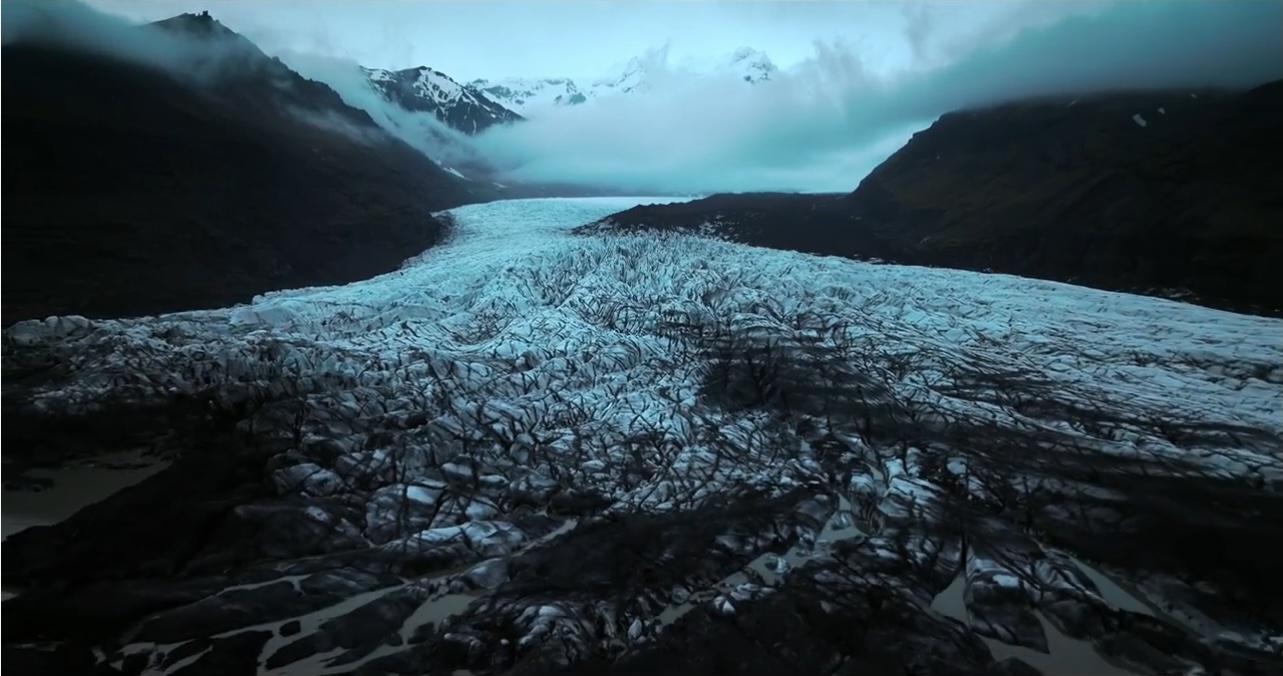
Nature photographer James Balog took this idiom literally when, in 2007, he founded the Extreme Ice Survey, or EIS, a project to catalog the melting of many of the world’s glaciers. Over several years, Balog and his team traveled to many of the most remote parts of the world – Greenland, Iceland, Alaska – and installed special time-lapse cameras capable of taking approximately 8,000 images per year.
These efforts were commemorated in a 2012 feature-length film called Chasing Ice, which made international headlines for depicting the largest calving event that had ever been caught on tape. For a sense of scale, imagine a 3,000-foot-high block of ice the size of lower Manhattan breaking apart from the rest of the island. The footage is hard to put into words – for Balog, “it’s a magical, miraculous, horrible, scary thing.” For everyone else, it should have served as irrefutable evidence of the effects of climate change, and a warning of the changes to come.
Balog and his team are now back with a new documentary called Chasing Time, which captures the end of the 15-year EIS project and reflects on the power of images to tell a story about our changing environment.
After all, it’s one thing to read news reports and scientific studies about melting glaciers and rising sea levels. It’s quite another to see visual evidence of just how much icy landscapes around Earth have been transformed by climate change over a relatively short time period.
Even Balog was initially skeptical of the science of climate change, but he couldn’t deny the story told by more than 1.5 million images from 72 cameras. Nor could the academics or policymakers that Balog shared his images with in hopes of inspiring climate action.
Much of the footage in Chasing Time relies heavily on time-lapse technology, which Balog and his team have used to produce surreal slideshows that show the same phenomenon recurring all over the world. These images are a haunting reminder that these natural wonders aren’t just static amalgamations of rock and ice, but are in fact as alive as anything else on Earth. Viewed through a geologic timescale, glaciers constantly shift and change and move, not unlike a forest constantly searching for nutrients. What we see in a single moment as the breaking of a piece of ice is to a long-term observer more like seeing “the crumbling ruins of a lost city.”
While most glaciers are found in remote regions that are sparsely populated, every once in a while we see the human impact as well. In May 2025, the collapse of the Birch Glacier in Switzerland completely flattened a town under more than 300 feet of debris. There’s also the risk of glacial lakes overflowing, as we’ve seen with the recent catastrophic floods in Juneau, Alaska. More such disasters are sure to follow, with experts pointing to the accelerating rate of glacial melting over the last few years as evidence that the worst is still to come.
Chasing Time doesn’t offer much new evidence for the encyclopedia of knowledge on the effects of climate change. But it does offer a new way of communicating about climate change, not just for today’s humans but also for people in the future.
One of the closing moments of the film features Balog and his team installing a monument near a glacier in Antarctica that will make it easy for visitors to take pictures of the surrounding landscape. These pictures will tell the story of whether or not humanity was successful in confronting climate change.
These types of monuments and mementos form a rather pessimistic ‘mea culpa’ – a way for modern-day humans to apologize to their descendants about the future state of the world.
For instance, in 2019, Iceland held a funeral for the Okjokull glacier, which attracted dignitaries from around the world. As part of the ceremony, the organizers unveiled a plaque with ‘A Letter to the Future’ engraved in both English and Icelandic.
Ok is the first Icelandic glacier to lose its status as a glacier.
In the next 200 years all our glaciers are expected to follow the same path.
This monument is to acknowledge that we know what is happening and what needs to be done.
Only you know if we did it.
Whether it’s plaques, images or videos, there are many ways for people to communicate across vast timescales. That’s part of why Balog thinks of climate action as less of a “sprint or a marathon” and more of a “relay race” where each subsequent generation does the best it can. Time will judge us all.