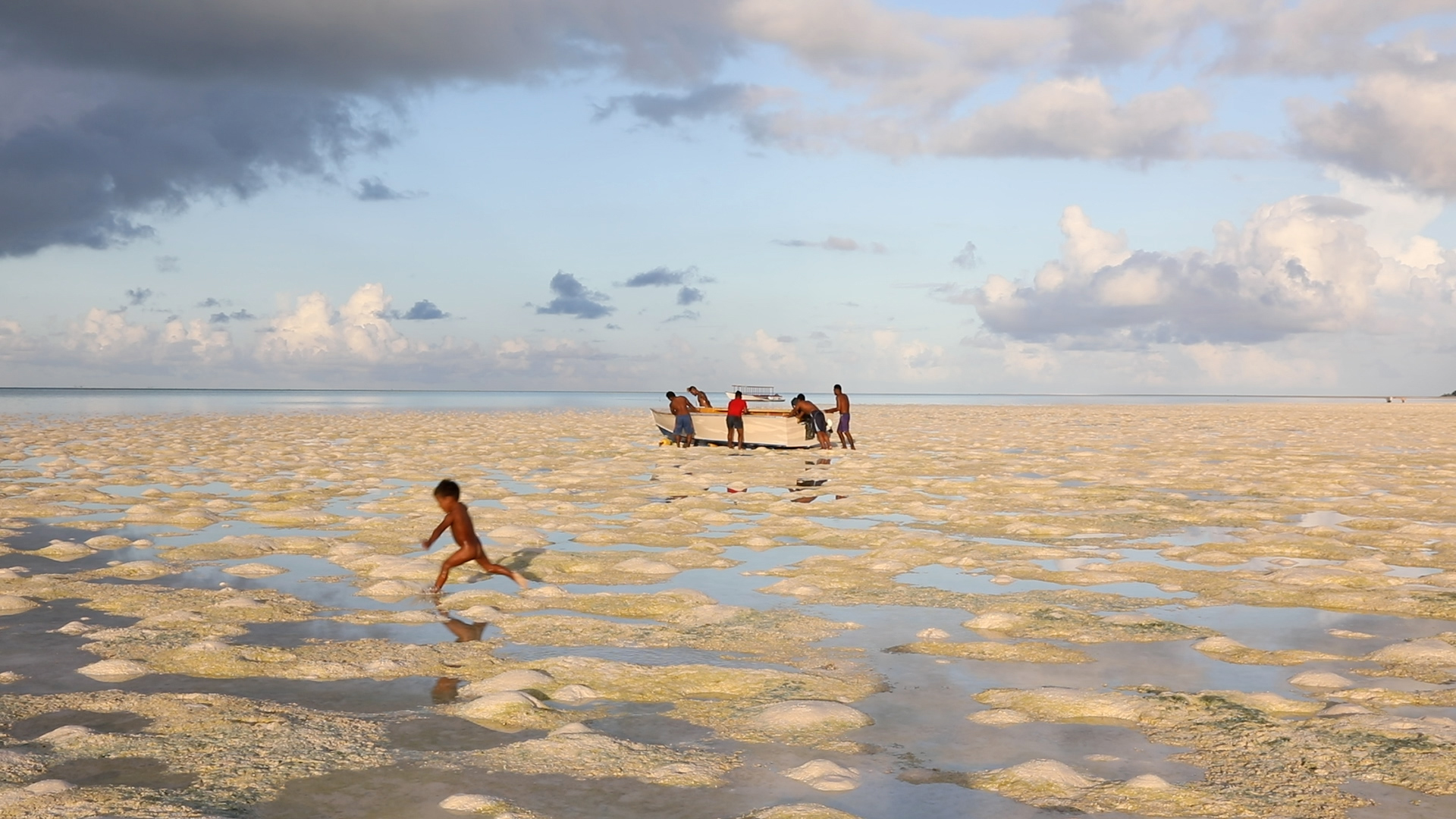

Directed by Natalie Zimmerman
Entertainment: 3, Impact: 3
Many people still think of climate change as an abstract problem or challenge that they or their children will one day have to face.
But for the people of Kiribati (pronounced ‘Kiribass’), climate change is literally on their doorstep.
The Republic of Kiribati is an island nation comprised of 32 atolls and one raised coral island spread out across a patch of the Pacific Ocean about 2,500 miles southeast of Hawaii. Most of the islands are just six feet or so above sea level, with experts predicting that much of Kirabati will be uninhabitable in 10-15 years due to rising sea levels. This makes Kirabati and its approximately 130,000 people a compelling test case for how the world will deal with the expected surge in climate refugees, which could number more than 1 billion people by 2050.
A new documentary called Oceania: Journey to the Center tells the story of the people of Kiribati and their efforts to maintain their culture, freedom and independence in the face of climate change.
Filmmaker Natalie Zimmerman spent more than 10 years visiting and learning about the people of Kiribati. Those years of relationship-building shine through on the screen in a way that encourages viewers to see the inhabitants as people with hopes and dreams, rather than victims in need of a savior. The two central characters are Tekinati (a warm and caring woman with deep pride in Indigenous traditions) and her adult son Charles (an ambitious young man who appears more sanguine than angry about the future plight of his people.)
I appreciate that Oceania, unlike many documentaries about climate change or the threat of rising sea levels, doesn’t get bogged down by scientific explanations or geopolitical debates. (Those are readily available for anyone interested in such things.) The film is first and foremost character-driven, exploring what it feels like to be forced from one’s home through one-on-one interviews and footage of local customs and traditions.
These perspectives transform Oceania into a powerful story about the importance of finding balance with each other and with nature — themes that are also a big part of Kiribati culture and mythology. For instance, one creation myth features Nareau, an ancient spider lord that weaved together sand, water and sky to create the world.
Now, through no fault of their own, the web that the people of Kiribati have grown accustomed to is coming undone.
What do you do when your home is underwater?
These are the sorts of impossible questions that many people around the world are now being forced to confront. I’m sure there’s a temptation among some government leaders to treat climate refugees as a math problem. If XX people need a new home, then YY acres of land will need to be acquired or repurposed. Then it’s just a matter of identifying the most cost-efficient options and negotiating terms. Simple right?
(The Kiribati government purchased more than 5,000 acres of land in Fiji in 2014, ostensibly as a future site for its population but currently being developed into a farm with assistance from China. There is no current plan for full-scale relocation, with the government in 2021 abandoning its ‘Migration with Dignity’ scheme in favor of a strategy that prioritizes economic prosperity, climate change adaptation and mitigation.)
But this kind of brutalist pragmatism ignores that what climate refugees are losing is more than just land. It’s their way of life.
What Oceania makes crystal clear is that most people have no interest in abandoning their home, even for a potentially higher quality of life or more economic opportunity elsewhere.
As Charles says, “you know how to survive in your place.” Generations of Kirabatians have learned to fish in the local waters, climb trees to pick coconuts and build shelters that can withstand storms. They have their own songs, dances and other customs. It’s the loss of these skills and traditions that is the bigger tragedy because it portends the loss of a culture – of a proud people who have withstood decades of colonial encounters only to face a foe in climate change that they can’t hope to defeat.
Treating relocation as a solution is a little like saying that out-of-work coal miners should just learn how to code. It’s the kind of solution that sounds good in a speech or a pamphlet but ignores the lived experiences of people with very specific wants and needs.
The film doesn’t spend much time pointing fingers or accusing anyone of culpability. But the inhabitants of Kiribati are well aware of what’s causing increased coastal erosion and severe storms.
“Foreign countries messed up the world,” says Charles, who compares the loss of Kiribati to the seas to a shark biting off a chunk of a person, the kind of loss that can never be undone.
World leaders may see the loss of a finger or toe as an unfortunate but ultimately minor sacrifice in service of the unassailable altar of economic growth. But at the pace that climate change is accelerating, planet Earth may face critical organ failure sooner rather than later.