
Score: 11 (Accuracy – 3; Entertainment – 4; Impact – 4)
Stream on Amazon Prime (trailer)
Spoiler level: Medium
Bong Joon Ho is one of the most celebrated writers and directors of our time. With 3 Oscars to date, the South Korean filmmaker has made a name for himself as an innovative and incisive storyteller. From exploring the desperation of inequality in Parasite to imagining a scenario where humanity’s last survivors are stuck on a train in Snowpiercer, Bong seems to always have his finger on the pulse of a modern society that is in freefall towards dystopia.
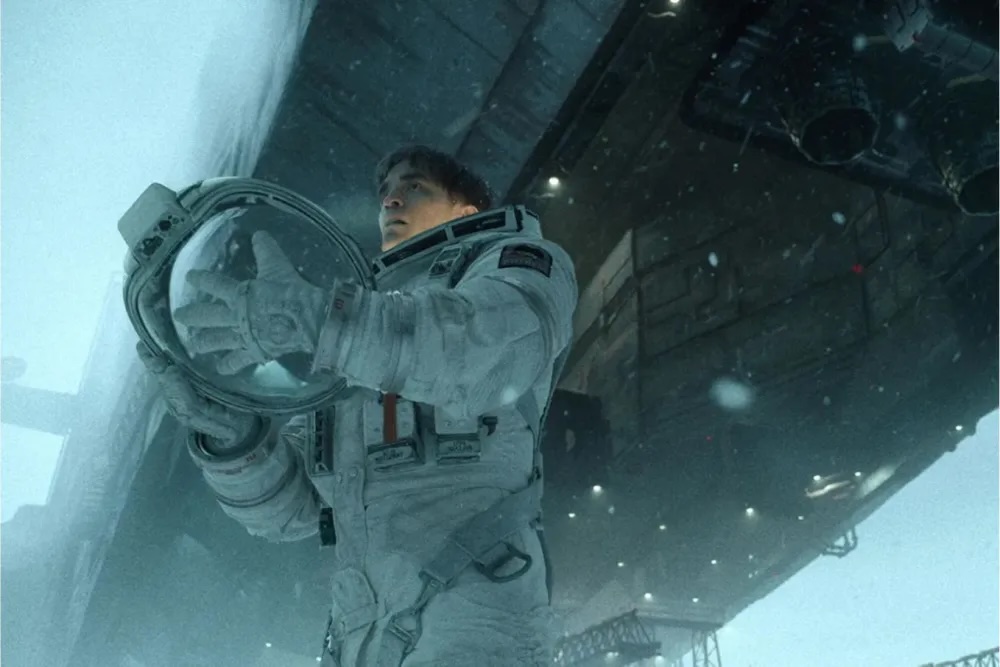
His newest film is Mickey 17 – and no, the 17 is not for the SDGs. The film is actually an adaptation of Edward Ashton’s 2022 novel, Mickey7, and it’s about a down-on-his-luck worker named Mickey Barnes, played by Robert Pattinson, who accepts a job as an “Expendable” on an interstellar flight bound for a potentially habitable icy planet. There is no job that’s too dangerous for an Expendable – in part because even if an Expendable dies, they can just be printed out again as adults with all their memories intact. After suffering an increasingly gruesome series of deaths – radiation sickness, nerve gas poisoning, and other futuristic workplace accidents – Mickey is printed out for a 17th time. Except this time, his death doesn’t go quite according to plan.
Sustainability themes
There are plenty of sustainability themes to pick from in Mickey 17, which is set in the year 2054. There are the all-too-familiar scenes of humans treating indigenous life forms as nothing more than an inconvenience, something to be exterminated to make way for human habitation. Or the way that the financiers of the space expedition use quasi-religious dogma – complete with red hats and communal prayers – to keep everyone in check. Or how the risky expedition is portrayed as humanity’s last hope given the scale of environmental degradations on Earth.
But the one theme that sticks out most to me is the commodification and exploitation of labor. Everybody’s value in this not-too-distant future seems to be based on how much they are willing to sacrifice or endure – not their skills or experience. The only reason Mickey signed on to be an Expendable is because his attempt at starting a macaron business with his friend, Timo (played by Steven Yuen), ended in ruinous failure. His options were to either spend his life being chased by an overzealous debt collector or agree to do the kind of jobs nobody else would do. Either way, for Mickey his “entire life is a punishment.”
Here on Earth, there are millions of people in Mickey’s shoes. In the U.S., for instance, some 26% of households are living paycheck to paycheck. Nearly half a million Americans filed for bankruptcy in 2024, with medical debt and loss of income cited as the most common reasons. And that’s in what is, for now, the richest country in the world!
While there have been notable achievements in reducing poverty in many parts of the world, there are still almost 700 million people in extreme poverty, defined by the World Bank as living on less than $2.15 per day. A much larger group of people – around 3.5 billion – are living on less than $6.85 per day.
That’s without factoring in the future effects of climate change on vulnerable populations, with experts predicting the displacement of 1.2 billion people globally by 2050 and a loss in GDP of as much as 50% if immediate action isn’t taken.
The big questions.
How many of these people would agree to be an Expendable if given the choice? Is unimaginable pain and suffering worth a steady paycheck? Is death a reasonable sacrifice to support your family?
These are economic questions as much as moral ones. For Bong, Mickey 17 is “a story about the human condition… exploring questions of what does it mean to live a truly human life?” But for many people today, their identity is directly correlated to their work.
In one survey on the cultural phenomenon known as the Great Resignation, 70% of employees said that their sense of purpose is defined by their work and that they performed better when they felt their work was meaningful.
Another survey, conducted just before the pandemic, found that nine out of 10 American workers would trade a percentage of their earnings for work that felt more meaningful. This trend is especially noticeable among Gen Z workers, 70% of whom recently ranked purpose as more important than pay.
But what if the jobs of the future are neither meaningful nor lucrative?
This is the question I kept coming back to every time I watched Mickey slide out of the printer. Unfortunately, there are no easy answers here. The hard-fought rights that many modern workers have come to enjoy – unions and collective bargaining, workplace safety regulations, 40-hour work weeks, workers’ comp, etc. – are now under threat, especially in the US. Wages in the U.S. have largely stagnated since the 1970s, reducing workers’ purchasing power and constricting economic opportunities.
Given these troubling trends, it’s not hard to imagine seeing an Expendable on a future episode of shows like Dirty Jobs, which featured the host doing a variety of dangerous and difficult real-life jobs. Of course, this is also the same host who once came up with a S.W.E.A.T. pledge that includes such blatantly anti-worker messages as “there is no such thing as a ‘bad job’” and “my safety is my responsibility.”
I’m not sure that the thousands of people who die each year from mining, logging, commercial fishing, and other “dirty jobs” would agree with this sentiment. At least Expendables know they’ll be reprinted.