
Billions of public dollars flow into climate-related research each year. Yet more than 30,000 patents from US universities and national labs sit untouched—never commercialized, never tested in the marketplace, and never deployed where they’re needed most.
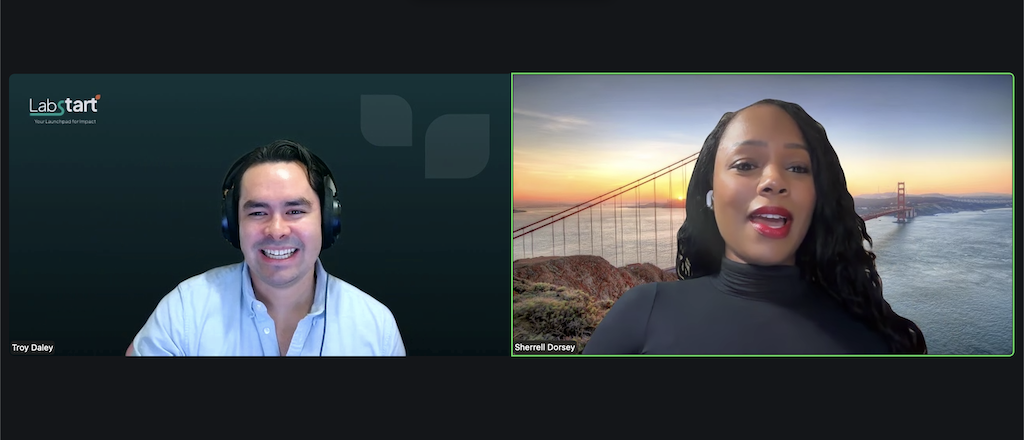
“These patents are just sitting on the shelves,” said Troy Daley, Program Director at LabStart, in the latest Plugged In conversation with host Sherrell Dorsey. “We’re talking millions and hundreds of millions of dollars being invested into all of these technologies, but not really anything being done with them.”
The lab-to-market gap remains one of the biggest structural failures in U.S. climate innovation. With the International Energy Agency estimating that 40% of the technologies needed to meet 2050 climate goals haven’t yet been commercialized, the stakes could not be higher.
LabStart is one of the few programs trying to rebuild that missing infrastructure, starting not with patents, but with people.
Problem-first commercialization
Daley’s own journey, from chemical engineer to strategy consultant to climate-tech operator, shaped LabStart’s counterintuitive thesis: start with customer pain points, not science.
“Most programs take technology and then try to find a founder,” he said. “But that’s a square peg into a round hole.”
LabStart reverses the sequence. Founders spend months doing customer discovery before they ever touch the patent library. Only when the problem is validated do founders explore whether a national-lab technology can solve it.
The one-year program then invests $100,000 per company, enabling participants, many of whom have families, student loans, or multiple jobs, to work full time on their ventures.
“In order to be a climate founder, it’s hard to grow and scale a company if you’re just doing something on nights and weekends,” Daley emphasized. For LabStart, commercialization is inseparable from workforce development and financial accessibility.
What to look for
For impact investors seeking early deal flow, Daley offered a concrete evaluation criteria—rooted in techno-economic reality rather than pitch-deck optimism.
“A lot of the TEA work people are doing is guesswork,” he noted. “Founders need to be showing that they’re going to have 4–5x savings at initial scale on paper, so that when they do the scale-up, it’s still 2–3x better.”
Key diligence indicators include:
- Proven customer pain points: “Climate companies can’t just focus on environmental impacts,” Daley said. “They have to think about carbon or water savings, yes—but also making a business that can stand on its own financially.”
- Signed LOIs or purchase commitments demonstrating willingness to pay.
- Differentiation clarity: Investors should look for a clean line between off-the-shelf industrial components and true scientific invention.
- Evidence the science works beyond the bench—and can survive early scale-up without catastrophic cost overruns.
With many investors shifting toward asset-light climate solutions (software, sensors), Daley argued that the market cannot afford to leave essential hardware behind.
“If we really want to see the impacts we need to solve the climate crisis, we need to be funding deep climate tech companies.”
Workforce pipeline
Daley sees a bigger picture emerging: climate commercialization, regional job creation, and blended capital are converging into a single opportunity. Lab-born technologies can become local economic engines, particularly for communities already on the frontlines of climate impacts.
Programs like the Clean Energy Leadership Institute (CELI) and networks such as Work on Climate are strengthening this talent pipeline.
“There’s an incredible amount of expertise entering the sector,” Daley said. “And the virtual community means people can access resources from anywhere.”
Yet with federal research funding declining, Daley argues that philanthropy and catalytic capital holders must step in to fill the early-stage financing gap.
Once-in-a-generation dealflow
The commercialization bottleneck is not merely a challenge, it is a generational investment opportunity. Tens of thousands of unused patents represent untapped IP waiting for entrepreneurial leadership, blended financial structures, and market-driven evaluation.
For investors hungry for new climate deal flow, Daley’s message was clear:
“The pipeline exists. What’s missing is translation, talent support, and capital with the right time horizon.”