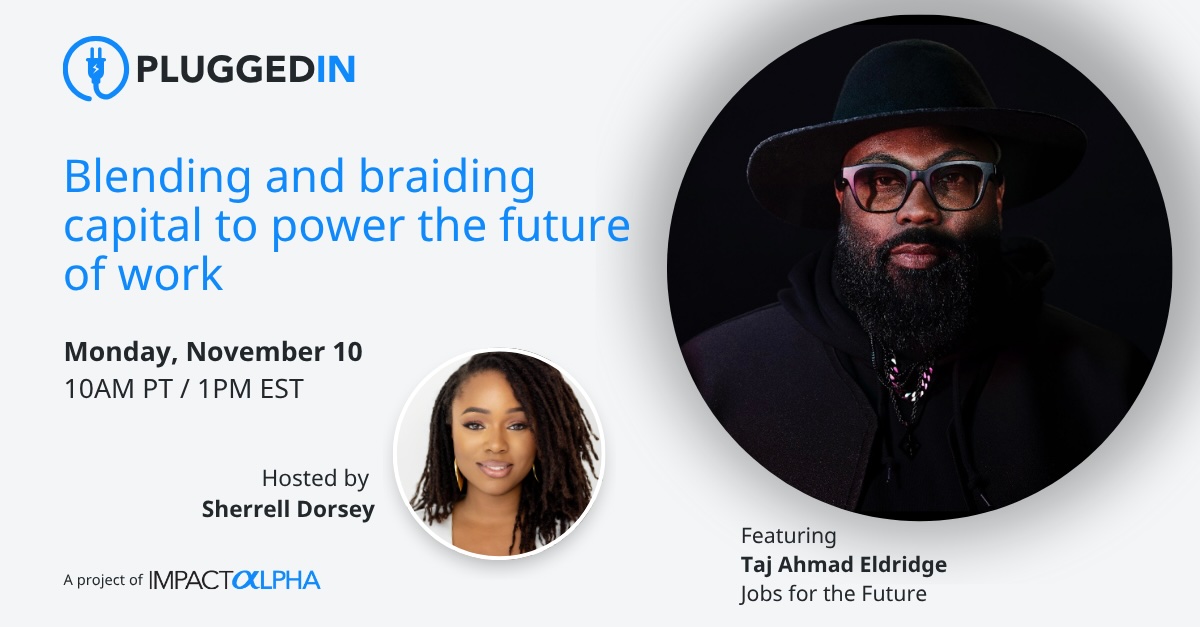

Between promising pilots and profitable scale lies a chasm that continues to swallow even the most innovative climate hardware startups. Investors call it the “Valley of Death”—the stage after seed funding when capital needs surge, timelines stretch, and confidence wavers. In a recent Plugged In conversation with Taj Eldridge of Jobs for the Future, investors Edward Jean Louis and Dr. Reginald Parker joined Sherrell Dorsey to dissect how braided capital and operational discipline can help founders cross that divide.
“Hardware always takes longer and costs more than founders expect,” cautioned Jean Louis, founder of Atail Venture Partners and the Montes Fan platform. “You might think you need $5 million to reach commercialization, but it’s really $15 million and another 18 months.” He added, “If you’re backing people with grand vision and ambition, they’re probably doing something that’s very hard, very difficult, and likely hasn’t been done before.”
Jean Louis’ point resonated across the panel: investors must underwrite patience, and founders must model reality.
Blending catalytic and commercial capital
Eldridge framed “braided” —or blended—capital as “the intelligent mixing of catalytic, concessionary, and return-seeking dollars” to finance climate infrastructure that conventional venture capital cannot yet carry. Philanthropic and government funds can absorb early risk; corporate and institutional investors can follow once de-risked projects show traction.
Jean Louis argued that new vehicles are already proving the concept for climate tech. “We’re seeing foundations deploy first-loss capital and corporates co-invest for strategic learning,” he said. “That’s what’s unlocking these next-generation green-energy companies.” For allocators seeking deal flow, he added, the opportunity lies in underwriting consortia rather than stand-alone funds—structures that can stretch across equity, debt, and grant instruments.
From pilot to profit
Parker, a technologist and private-equity professional who now chairs Freedman Green Bank, offered a pragmatic roadmap for founders through his “pilot-to-profit” framework. “Every company has three customers,” he explained. “Your employees buy into the vision, your investors buy the future revenues, and your end users buy the product or service. If any of them stop buying, you’re out of business.”
His advice: secure early pilots that validate not only technology but also operational maturity—bookkeeping, compliance, and data protocols that signal readiness for institutional money. “Capital goes where confidence lives,” Parker said. “You can’t manage what you can’t measure.”
Expanding the capital stack
Beyond venture capital, the panel pointed to green banks like Freedman, community development financial institutions, or CDFIs, and corporate procurement programs as under-used pathways. “Founders should diligence investors the same way investors diligence them,” noted Eldridge. “Mission alignment and time horizon matter more than logo prestige.”
The panel closed on urgency and optimism. The climate capital stack is diversifying, but coordination remains uneven. “We can’t rely on one form of money to save us,” Parker concluded. “Braided capital is not charity; it’s choreography.”
For investors, that means designing flexible vehicles. For founders, it means building disciplined, fundable companies. And for the broader ecosystem, it’s an invitation to stitch together the capital, talent, and infrastructure that will carry climate innovation from pilot to profit—and from promise to planetary impact.