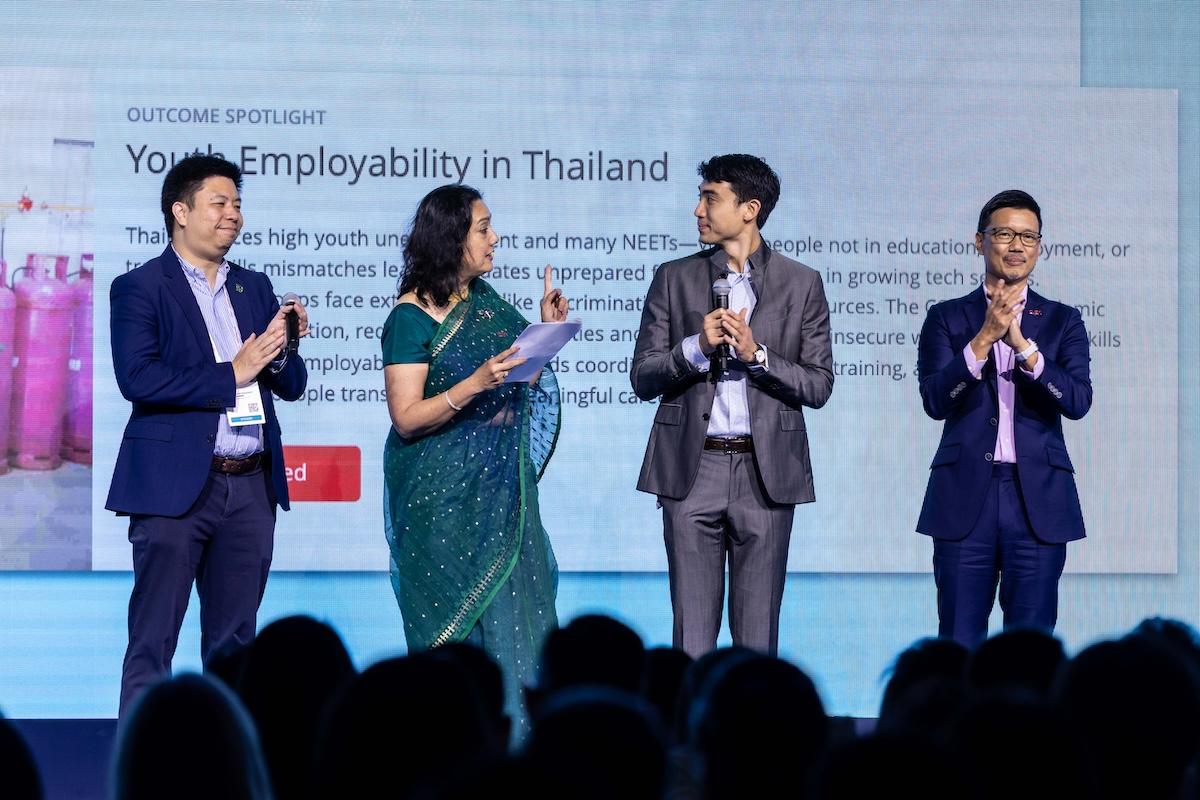
Typhoon Tapah put an exclamation point on the urgency of the climate crisis, bringing torrential rains and high winds to Hong Kong just as 1,500 gathered at last week’s AVPN conference.
Hong Kong’s unusually high number of intense storms in the past month was the talk of many of the philanthropists, families and other investors at the conference, underscoring a new raft of commitments to impact funds, sustainable business initiatives and resilient economic development under the theme, “Asian Leadership for an Inclusive World.”
“The interest, awareness and acceptance of climate risk is there,” said Katy Yung of Sustainable Finance Initiative, a Hong Kong-based network for Asian family offices. Wealth families in the region identify biodiversity, natural resources, regeneration and other climate themes as their top impact priorities, according to Social Finance Initiative’s survey of more than 140 family offices.
“The next step that needs to happen is to unlock more action,” said Yung.
Catalytic capital has thus become a key topic of interest, AVPN’s Vikas Arora told ImpactAlpha. Asia’s wealth holders, who have long separated their business and philanthropic endeavors, increasingly recognize that “there’s a market need to move away from grants,” he said.
Family office-funded Climate+ is working to restore mangroves in Southeast Asia while honing tools for remote monitoring in hopes of bringing more family offices into nature-based investments. Rumah Group, a Singaporean family office, is backing a $6 million impact bond for sustainable fisheries in Indonesia. A group of philanthropic organizations and family offices are investing in a feasibility study for a multi-billion-dollar clean energy project in Malaysia.
“The tipping point was USAID,” Arora said. About $40 billion in annual grant funding, “more than 60% of which went to Asia, disappeared overnight.”
“The climate crisis,” he added, “is front and center in our part of the world.”
Educational effort
The shift is significant in a region that has remained committed to traditional investment approaches. The term “impact investing” has carried a stigma – Asia’s wealth holders still largely consider impact investments to be concessional.
Ann Tan of the Center for Sustainable Finance and Private Wealth suggested more effective phrasing: “Doing well by doing good.”
“When you frame it as essential for future-proofing a family’s legacy, the mind and the heart open in a different way,” she said.
CSP, a spin-out of Harvard University, launched its Singapore team in 2021 to expand sustainable investing among wealth holders – and relevant capacity for wealth managers – in the Asia-Pacific region. The group has trained more than 2,000 wealth advisors and private bankers to have what Tan calls “constructive conversations” about sustainable and impact investing with wealth holders in a region where the open discussion of money remains sensitive at best, and often taboo.
“What we hear from bankers is, ‘My clients don’t do impact investing.’ And the common reason they offer is because their clients don’t talk about it,” Tan says. “But what we hear from their clients is that they do.”
The organization, with The ImPact, is out with a survey of eight Asian family offices that are shifting their businesses and their investment portfolios to impact. The report shares insights of what sent the families on their impact journeys and how family values, experiences and friction has shaped their evolving strategies.
“Our journey to impact was born from necessity, not ideology,” shared Kelvin Fu of Singapore-based Gunung Capital. “What began as a strategic response to save our family business became a catalyst for profound change within our family.”
He added that its impact mindset “is now our family’s most valuable asset.”
Tolaram Group’s Sumitra Aswani shared that her family’s displacement from their home country fostered a “deep empathy” that encouraged the future generations to embrace “the spirit of giving back, even as they made money.”
Hanson Gong of Oogway Capital leaned into his venture capitalist family’s appetite for risk to experiment with impact investing.
The report is meant to help Asia’s wealth holders learn from one another in a region where it can be hard “to get different families together in a space to talk about money,” says Tan. It’s also to help bankers and wealth advisors understand the role of values in families’ business and investment decision making.
“There has to be a mindset shift [among bankers] from focusing on the tools of how money is allocated to focusing on the person in front of them, and asking, ‘How can I help you achieve what you want? Talk to me about your needs’,” she says.
Wellbeing agenda
In the offices of Tsao Pao Chee Group in Singapore, the family business’s chairman Chavalit Frederick Tsao lights up at the mention of mindset shifts. He’s among the fourth generation of the family’s business leaders and is on a mission to realign not just TPC but all business in the region around impact.
Witnessing Asian economies’ rapid ascent from industrialization in the 1990s and early 2000s, to stagnation, economic inequality and environmental degradation forced Tsao to reckon with the purpose and role of business.
“Our neural wiring is the problem. We have to do it differently,” he told ImpactAlpha. “We always focus on the left brain, but rearranging things is not a left brain activity.”
The company allocated 16,000 acres of land to its Restore Nature Foundation to experiment with replacements for palm oil, one of the company’s former business lines. Most solutions for palm oil production — one of the biggest contributors to deforestation and habitat loss worldwide — focus on mitigating negative environmental impacts.
“You cannot win with a mitigation strategy,” he says. “If the team is just focusing on the fertilizer program, or just their relationship to the orangutan, there’s no attention to an adaptive business strategy. They can only think about small systems.”
“When there’s a blank table, then they can experience the creation process for the big system,” he says.
TPC Group is sponsoring this week’s convening of impact minds in Singapore to focus on the role of “wellbeing” in business and finance as a means to nurturing such creative, big-system thinking. A sample of the agenda: “Cultivating consciousness for systemic change”; “Healing the planet starts by healing ourselves”; “Rewiring the capital supply chain”; “Asia’s leap into regenerative climate economies”; and “Youth as co-stewards of a well-being future”.
A full day-long track for organizational leaders focuses on “the human reset,” including cultivating self-compassion, navigating burnout, digital detoxing, and “leading without losing yourself.” Workshops focus on meditative and creative practices rooted in ancient traditions, like Qi Gong, breathwork, tea ceremonies calligraphy, and ikebana – the art of flower arranging.
There will also be announcements on new climate collaborations, impact funds and community-led initiatives. More than 3,000 people registered, putting the event at full capacity. Impact practitioners from across Asia represent the biggest group.
“It’s a serious business agenda – no money, no honey, right?” says Tsao. “But with a different level of consciousness in how business models are developed.”