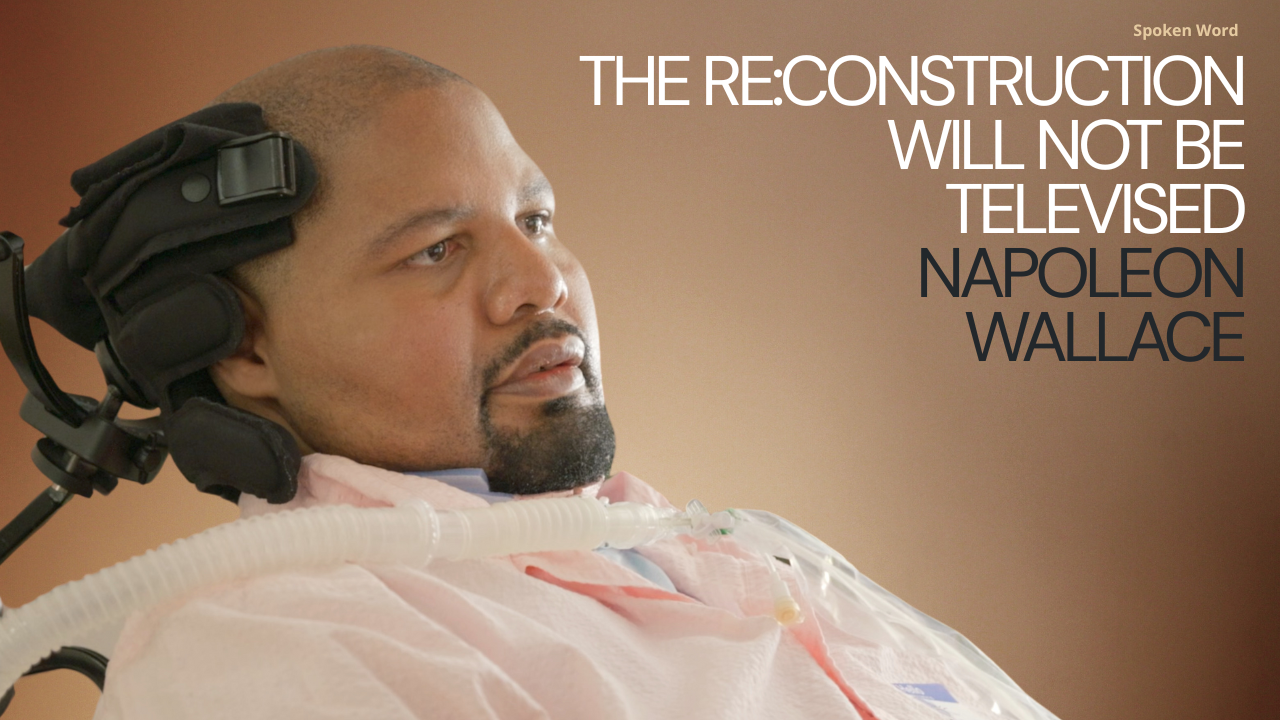
In time for Juneteenth, a newly released single turns community governance, local loan funds, real estate cooperatives and employee ownership buyouts into spoken-word poetry – with a familiar backbeat.
North Carolina entrepreneur Napoleon Wallace has rewritten and remixed Gil Scott-Heron’s 1971 classic to highlight bread and butter solutions that could unite rural and urban, red and blue, Black and white around economic uplift and local empowerment.
“Gil’s original was prophetic,” says Wallace, a contributing editor at ImpactAlpha. “It was a warning about letting media distract us from the real work of justice.”
“And it still hits,” he adds. “We’re in a similar moment of crisis, a recession of engagement. For that and for Juneteenth, I wanted to pay homage with a remix.”
It’s a five-minute Playbook for Shared Prosperity, in a half-dozen or so verses.
“There will be no reruns, fam,” Wallace narrates in one stanza. “You won’t get another shot at stopping the selloff of sacred land or buying back the corner store that’s now a Chase branch.”
“But you can join the movement to rewrite ownership like the East Bay Permanent Real Estate Cooperative, where tenants and neighbors are member-owners of homes and storefronts. No extractive profits. No silent evictions. Just permanence and power.”
“The Reconstruction doesn’t get a reboot. It gets built block by block, title by title.”
Juneteenth rising
Wallace is the subject of ImpactAlpha’s award-winning mini-documentary, “Equity and Ownership,” which charts his quest to build strategies for shared prosperity while living with the challenges of ALS, including the loss of his ability to speak. For the remix, Napoleon uses the AI-generated voice, cloned from a variety of podcasts, speeches and interviews recorded before his diagnosis, with which he also narrates the documentary.
“After the success of our film project, I picked up an editorial post with ImpactAlpha to work on the Playbook for Shared Prosperity,” Wallace says on The Activest Podcast, where he launched the single. The Playbook for Shared Prosperity is ImpactAlpha’s collection of dozens of practical strategies for reducing prices, building wealth, supporting families and restoring communities (add your favorite – or your own).
“Yes, the headlines are brutal, heartbreaking and demoralizing, but I also think they are clarifying, revealing which solutions actually hold up across political and economic cycles,” he says through his voice-to-text “eye pad.”
Wallace’s lyrics tie back to Juneteenth, the celebration this week of the arrival 160 years ago, of US troops to enforce the Emancipation Proclamation in the last remaining holdouts of Texas. This Juneteenth also comes 160 years after the beginning of the Reconstruction era, “the period of political and economic rebuilding that followed the defeat of the Confederacy, the end of slavery and the establishment of citizenship and political rights for black Americans,” said Micah Gilmer on The Activest Podcast, where Wallace launched the single. Wallace is a co-founder of Activest and its spinoff, Next World Assets, which are featured in the song.
After 1876, Gilmer explains, federal support for Reconstruction “infamously dissolved into Jim Crow and a generations-long pendulum swing of policy and political economy. But Black Reconstruction has never ceased forging a path towards progress.”
Wallace’s column is an anchor of ImpactAlpha’s project, Re:Construction, which ties back explicitly to that history while emphasizing the building of shared prosperity going forward. This Juneteenth, he says in the song, is “a chance to tally up what’s owed, decide what is necessary, and double down on what’s deserved. The Reconstruction is not a branding campaign. It’s a blueprint, a battle, a beginning. It will not be televised, but it will be ours.”
In the song, Wallace name-checks a half-dozen such restorative economic strategies.
“The organizations I highlight aren’t waiting for the storm to pass. They are the port in the storm, and they’re building through it. Cheering them on isn’t enough,” he says. “What they need now is alignment. They need capital that’s patient, partnerships that are principled, and policy that protects their progress.”
Prosperity strategies
To help listeners follow along with “The Reconstruction Will Not Be Televised,” ImpactAlpha has collected a handy reference guide:
Chicago Trend. The impact real estate developer is purchasing and renovating blighted neighborhood shopping centers in majority-Black neighborhoods. Chicago Trend invests alongside local residents through community investment vehicles that allow residents to pool together funds to purchase and own neighborhood real estate assets.
Boston Ujima Project. Community activists, local small business owners and impact investors came together in 2015 with a vision for a cooperative economy, where local residents collectively decide which real estate projects get built and businesses financed. The social enterprise was built on the philosophy of “Ujima,” Swahili for “collective work and responsibility.” Through its democratically-governed investment fund, the Ujima Fund, Boston working-class communities have invested nearly $2 million alongside institutions to build community wealth and power.
In its latest campaign, members have cast their votes for a potential $300,000 investment in the Boston Neighborhood Community Land Trust, which is focused on creating access to affordable rental housing and homeownership to combat the city’s rising displacement and gentrification.
East Bay Permanent Real Estate Cooperative. By removing land and housing from the market before they’re snatched up by speculative developers, EBPREC is aiming to preserve housing affordability in the fast-gentrifying neighborhoods of Oakland, Calif.
The cooperative launched in 2019 with over $185,000 raised from Oaklanders to help finance the $1.3 million purchase and rehabilitation of a four-unit affordable apartment building in North Oakland. The crowdfunding campaign led to a model that combines community land trusts, limited equity housing and real estate investment cooperatives. The framework allows local unaccredited, individual investors to buy $1,000 equity shares with a 1.5% return. Shareholders are required to hold the shares for at least five years before they can redeem them.
East Bay PREC has raised more than $15 million to acquire seven properties in the area. The financing from nearly 400 individual investor-owners and nearly two-dozen philanthropies and community development financial institutions, or CDFIs, is turning the apartment buildings into permanent affordable housing that are governed by local residents.
Kataly Foundation. In a series of articles on ImpactAlpha last year, Lynne Hoey, Kataly’s chief investment officer, detailed how the $400 million foundation is divesting from Wall Street to reinvest in communities and designing its investment strategy for non-extraction and racial justice. Kataly is actively working to redistribute wealth to communities, particularly Black and Indigenous communities and all communities of color, and to spend down its assets by 2028.
Black Farmer Fund. The fund provides flexible capital to farmers and food entrepreneurs in the northeastern US, “who were seeking capital that did not replicate the discriminatory and predatory lending practices driving Black farmers and land stewards off their land,” cofounder Melanie Allen wrote in ImpactAlpha several years ago. earlier this year.
About 44,000 Black farmers remain in the US, down from more than a million in the 1920s. Over the course of the last 100 years, Black farmers and their families have lost some $325 billion worth of farmland and acreage. The Black Farmer Fund has raised $12 million and invested in a dozen Black food businesses with gifts and low-interest loans.
Seed Commons. Using its US national network of community-based cooperative loan funds, Seed Commons has deployed $70 million of financing since 2011 in enterprises owned by their workers. The New York-based organization itself is cooperatively-governed by the member local funds. In Baltimore, Seed Commons has financed WaterBottle, a worker-owned cooperative with 34 worker-owners of color, which is acquiring and renovating old, blighted single-family rowhomes on the city’s west side.
Seed Commons is looking to raise $50 million for a shared capital pool that will provide financing to about three-dozen community lenders, which will on-lend the capital to worker-owned cooperatives in their communities. The lenders network aims to provide non-extractive capital to support their growth, with a focus on marginalized communities (see, “Creating democratic financial infrastructure for local communities”).
Apis & Heritage Capital Partners. Apis & Heritage leverages the employee stock ownership plan, or ESOP, structure to transition ownership of businesses to workers. The firm’s private credit fund offers mezzanine debt to retiring owners to cash in on their exits more quickly, without taking on more debt or diluting equity shares that could go to workers. Apis & Heritage says its model is designed to offer worker-owners payouts of approximately $120,000 upon exit.
Since 2021, Apis & Heritage’s inaugural $58.1 employee-led buyout fund created business ownership for 421 low- and moderate-income workers. The Washington, DC-based impact investor is raising a second fund, which has a $250 million target, to create 3,000 business worker-owners over five years.
Activest. As a “fiscal justice” investment advisor, Activist has surfaced the racially charged practices of many cities that balance their budgets, and fund their police, on extractive fines and fees. Activest has matured from a research outfit to a registered impact advisor. Through its affiliate, Next World Partners, it has received a $50 million mandate from Kataly Foundation to chart an equitable bond strategy. Its first deployment was in a $58 million bond issued by North Carolina Agricultural and Technical State University, a historically black land grant university, which is building new student housing to serve its growing enrollment.
Roodgally Senatus contributed reporting.