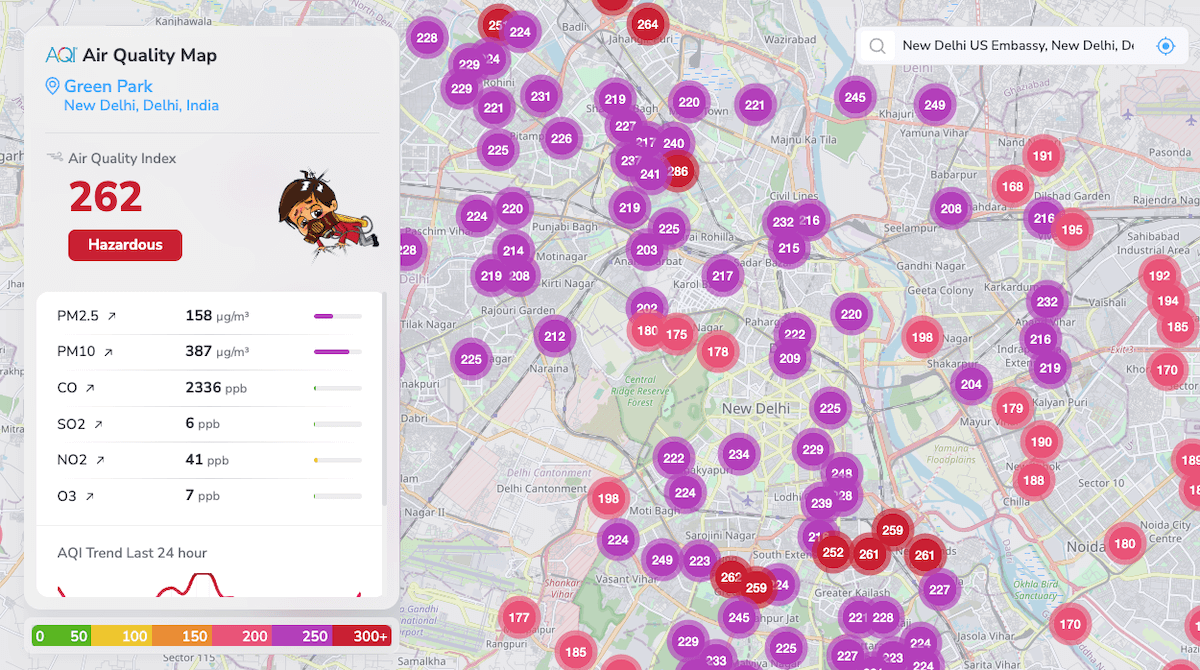

By this time of year, the toxic air quality in India’s northern cities is supposed to drop from winter’s “hazardous” levels to merely “very unhealthy”. But the air quality index across Delhi remains hazardous.
“We are at a crisis level,” said Nipun Sahni of private equity giant Apollo Global Management at a climate finance forum in the city last month. “It’s time to be very, very impatient.”
Putting capital to work in the mobility transition is one of the most immediate and proactive ways private investors can address India’s air quality crisis. Investors kicked off the year with a host of EV investments aimed at expanding the range and reach of vehicles available to everyday users. This week, Mumbai-based VoltUp, an EV battery swap-station operator for small EVs, raised $8 million in a seed equity round led by UK-based EM Impact Capital, while Indian bicycle maker AlphaVector announced plans to invest a billion rupees ($11.5 million) in making electric bikes and low-speed scooters.
This month’s deal list also includes early-stage funding for electric tractor maker Moonrider and electric motorbike maker Oben Electric, which is making both high-end and mass-market motorbikes. One of India’s biggest auto makers, Mahindra and Mahindra, secured 6.5 billion rupees ($75 million) from a consortium of international investors led by British International Investment for its production of electric cars. The funding was the final tranche in a partnership initiated in 2022 to get more private capital into India’s EV market.
The majority – 70% – of private climate finance invested in the six months between April and September last year went to companies making EVs and enabling EV adoption. Investors are being encouraged by strong government policy incentives that are buoying demand: sales in all EV segments in India grew last year, with sales in the biggest segment, electric two-wheelers, growing a third. Electric bus sales increased by nearly 40%.
Climate private equity
Fossil-fuel powered vehicles are one of the biggest contributors to India’s air quality crisis. During the winter months, however, the problem is exacerbated by farmers’ burning their fields en masse as they try to clear their land for the next harvest.
In Delhi, pollution also jumps after the Hindu festival of Diwali, during which many people burst firecrackers. Combined with cooling weather and slow winds, pollutants don’t disperse easily. A fog made up of dangerous particulate matter settles over the city for weeks on end. Schools are shut down, the government imposes measures to take vehicles off the roads and to pause construction work, and hospitals are flooded with patients complaining of cough and respiratory problems.
Apollo’s Sahni and other private equity and venture capital investors convened amid the toxic smog last month in search of solutions to India’s climate challenges. It’s not only about money, but about each person taking the onus of pushing for solutions on the ground, Sahni said at the gathering, hosted by the Indian Venture and Alternate Capital Association.
Apollo, which manages more than $70 billion in assets, has set a target of investing $50 billion in climate and sustainable transition solutions by 2027. It doesn’t appear to have any climate-related investments in India yet, however.
Other private equity giants have been active in India in recent years. TPG’s impact focused Rise group has invested in Tata Motors’ electric passenger vehicles subsidiary, as well as solar power developer Fourth Partner. KKR invested in solar and wind power developer Hero Future Energies and Serentica Renewables. It is also invested in waste management business Re Sustainability. Waste management and circular economy solutions are registering more interest among India’s climate-minded investors, according to Impact Investors Council.
Most investment firms at the IVCA’s climate finance gathering represented traditional investors that don’t necessarily have impact mandates. Many are keen to explore climate investment opportunities because “they see returns here,” said IVCA’s Rajat Tandon.
Climate deal match-making
To facilitate that exploration, IVCA introduced on-the-spot impact matching at the event. Startups were given a chance to pitch their businesses to a room of investors and others.
One pitch came from Eekifoods, which sets up greenhouse-like structures to grow vegetables in a climate-controlled environment. Founder Abhay Singh said their farm yields 18 times more vegetables than a typical soil farm. Its existing investors include Avaana Capital, which last year closed its first climate tech fund, and General Catalyst Partners.
Singh said that even though the company isn’t actively fundraising, IVCA’s pitch event allowed him to connect with investors who cut much larger checks than he’s used to – $25 million to $35 million.
“This has actually helped me,” he said.
Also making a pitch to investors was the International Big Cat Alliance, a body created by the Indian government to promote the conservation of tigers and other big cats.
“By conservation of big cats and habitats, we will be not only conserving the species [but] addressing to a large extent, climate change,” said Soumitra Dasgupta of the Alliance. Preserving their habitats, he said, will provide more forest space for storing carbon dioxide and provide gainful employment to millions of people.
Nine international organizations and 26 countries are supporting the Big Cat Alliance, whose goals are to provide managerial skills and other training to other countries implementing conservation efforts. The Indian government fronted $20 million to the effort, but more funding is needed.
Harnessing green hydrogen
India’s overall climate goal – reaching net zero 2070 – requires $10 trillion in funding and investment, according to a report by IVCA and EY.
Participants at IVCA lamented the lack of international support.
Amitabh Kant, former chief of the Indian government’s public policy think tank NITI Aayog, called last year’s COP29 summit in Azerbaijan “a miserable failure” because it concluded with a commitment of just $300 billion in climate finance for developing countries, against an ask of $1.3 trillion.
Meanwhile, developed countries continue to guzzle energy as they set up new artificial intelligence and data centers. By 2026, data centers will consume as much electricity as the country of Japan, according to the International Energy Authority.
“There will be no carbon space left for the developing countries,” said Kant.
India is moving ahead on its ambition to produce 500 gigawatts of renewable energy by 2030, up from 200 gigawatts today. One key source, Kant said, will be “green hydrogen,” which is made using green energy sources like solar or biogas. India aims to use its size and scale to bring down green hydrogen’s production costs from $4.5 per kilogram to $1 per kilogram by 2030.
India’s road transport minister Nitin Gadkari told participants at IVCA that India could become the biggest producer of green hydrogen and exporter of green ammonia, which is essentially hydrogen in liquid format. “No country can do it other than India.”
ImpactAlpha’s Jessica Pothering contributed reporting.