

As we all know, early on Saturday Feb. 28th, the US and Israel conducted a joint massive military strike on Iran.
Ever since, the region, global leaders and investors have been trying to understand the implications and what can come next.
While nobody can predict what will unfold in the coming days or weeks, this moment brings to the surface a key tension in the debate over the future of energy for the planet.
Since the dawn of fossil fuel usage for industrial purposes, global demand has only gone in one direction: up.
While such abundant energy has unlocked great prosperity, it has both destabilized our climate and directed an extremely unbalanced share of global power to those countries that happen to sit on such reserves of fossilized energy.
Up until the past decade, such was the fate for the majority of other countries, those without large fossil fuel reserves. You could choose economic growth or (greater) geopolitical independence, but not both.
Now, for the first time, with the rise of cheap solar and wind, and the secondary, but maybe even more important, rise of cheap batteries and EVs, such formerly fossil-fuel-dependent countries have another option.
Yet a question remains: Do the unique, novel properties of renewable energy, batteries, and electrification (transport and heating, particularly), signal that an “energy revolution” is emerging? Are we indeed entering what many in the climate movement have dubbed an “energy transition?”
Or…
Is this yet the next chapter of “energy evolution”? Where, like all novel forms of energy before them, humans use the newly unlocked advantages to just use more… energy.
The case for “energy addition” is strong
The energy addition argument goes something like this:
Yes, solar, wind, batteries, etc. have their advantages.
But look at the history. Humans have never globally swapped one source of energy for another. They simply say “thanks!” for the new energy source and just use it, without pausing on what they were doing before. Basically, the argument is that when it comes to energy, we’re insatiable.
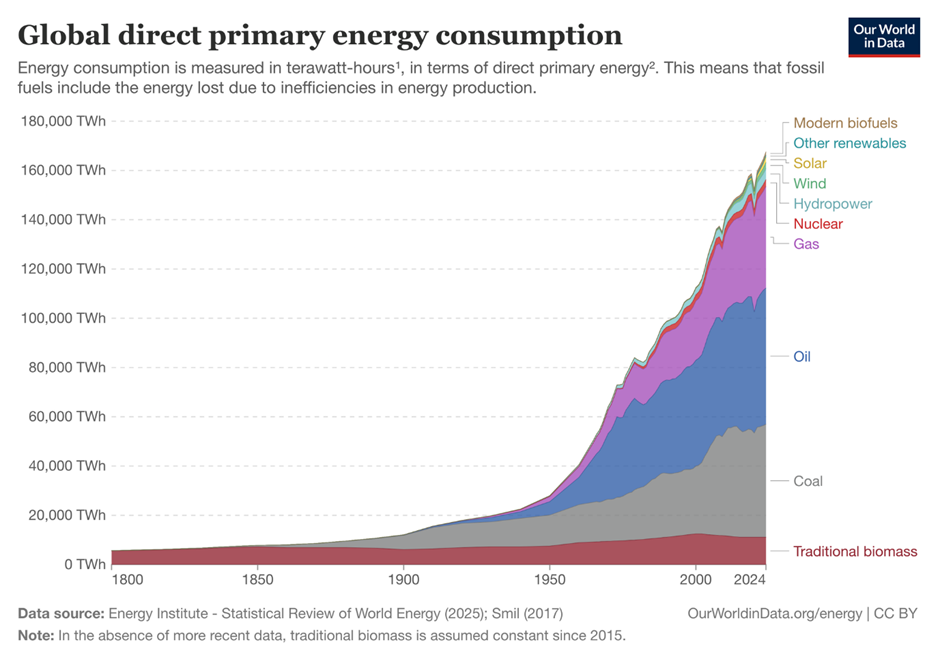
Given this pattern, why would we think that when it comes to the rise of renewables, batteries and electrification “this time is different”?
Momentum for the energy transition
With multilateral government action on hold for now (to put it mildly), the greatest hope we have for reducing emissions is that capitalists realize that choosing renewables, batteries, and electrification over incumbent tech will make them the most money.
And not just the most money in the long term because it avoids more damage from greater warming, but the most money right now.
That case is compelling and has been getting stronger, which I’ll detail below.
But the first year of the second Trump administration, painful as it has been for many, has highlighted a secondary hope: that governments will push the adoption of renewables, batteries and electrification for reasons of national sovereignty and independence, not just economic and environmental ones.
Charlie Munger, Warren Buffett’s partner at Berkshire Hathaway, famously said: “Show me the incentive and I’ll show you the outcome.”
Why do I believe that we are indeed headed for an energy transition?
The incentives are increasingly aligning behind one.
The economics behind renewables, batteries and electrification
If you look at the graph above, you’ll notice that the major stacking lines of energy sources all have something major in common: combustibility.
Biomass, coal, oil, and gas are all combustible fuels.
While each has its own unique details, the economic structure for each is pretty similar.
You invest in infrastructure to extract, process and transport the fuel. The customer buys the fuel and burns it to generate energy. Repeat.
The economics for coal and gas plants are basically:
- Low up-front cost – they are generally fairly cheap to build (although that’s getting less true for top-shelf combined-cycle gas turbines).
- High operational cost – fuel is the driving cost of these plants, but maintenance can be meaningful, especially as such plants age.
The revenue comes in per unit of electricity generated (MWh, etc.).
So, the more units of electricity such plants can generate per year, the more their fixed costs (cost of construction, capital and maintenance) can be spread.
In other words, the economics of gas and coal plants work best when they are used more or less 24/7. The industry term for this is baseload power.
So what happens when a cheaper form of electricity generation comes?
Gas and goal get used less.
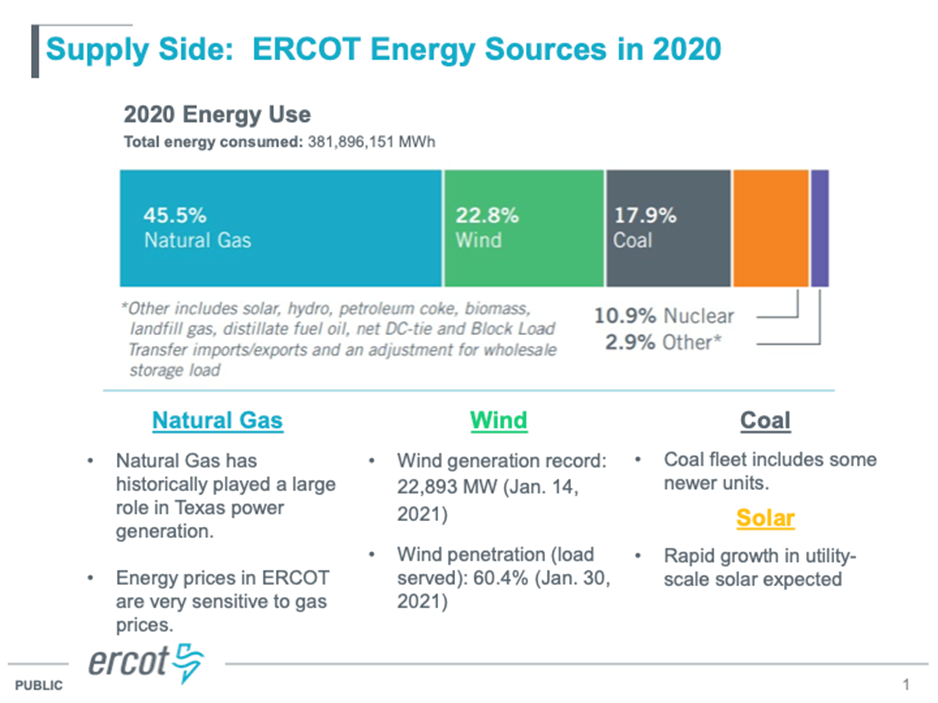
One of the easiest places to see the electricity generation economics at work is ERCOT, Texas’ low-regulation power grid.
Here’s their generation mix from 2020. You can see a lot of wind, but 45.5% gas:
And here’s the generation mix from March 2nd, 2026:
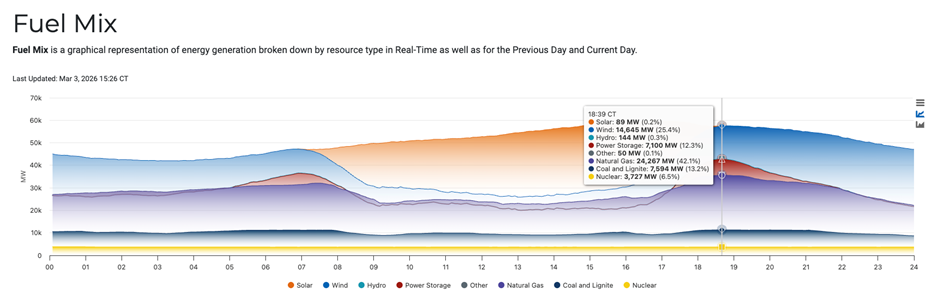
I realize that may be a little hard to see, but that big orange space in the middle is solar, which you’ll note was not even in ERCOT’s 2020 generation mix.
And, zooming in: See that red bump?
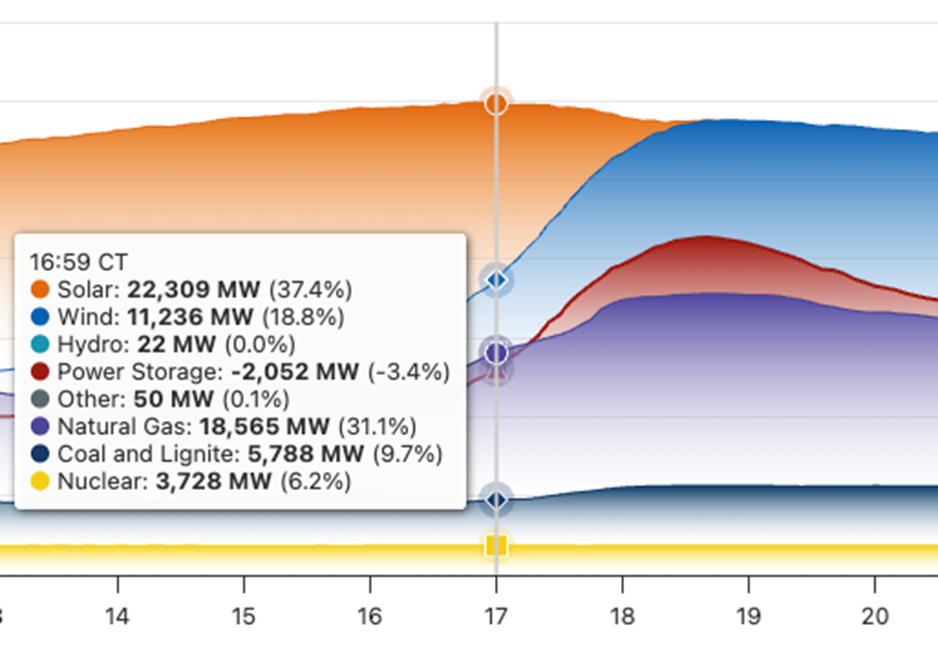
That’s power storage operating on the ERCOT grid.
These batteries buy super cheap solar power when the sun is shining, and sell it back to the grid when the sun goes down.
And you know who they sell it back for cheaper than?
Gas.
Batteries are a game-changer for renewables, particularly solar. They allow you to capture unused solar power when it’s the cheapest and then utilize it after the sun goes down. They move solar that much closer to being able to provide electricity coverage from when people wake up to when they go to sleep.
Which brings us to the crux of the argument for why, when it comes to renewables and batteries, yes, this time is different.
The more that renewables and batteries – which are expensive to build but essentially free to operate – are deployed into a given grid, the more they undercut the economics of existing fossil fuel plants.
This is happening already in India where the country’s large (and growing) coal fleet is already being utilized meaningfully less than it was projected to because of the rise of cheaper solar and batteries.
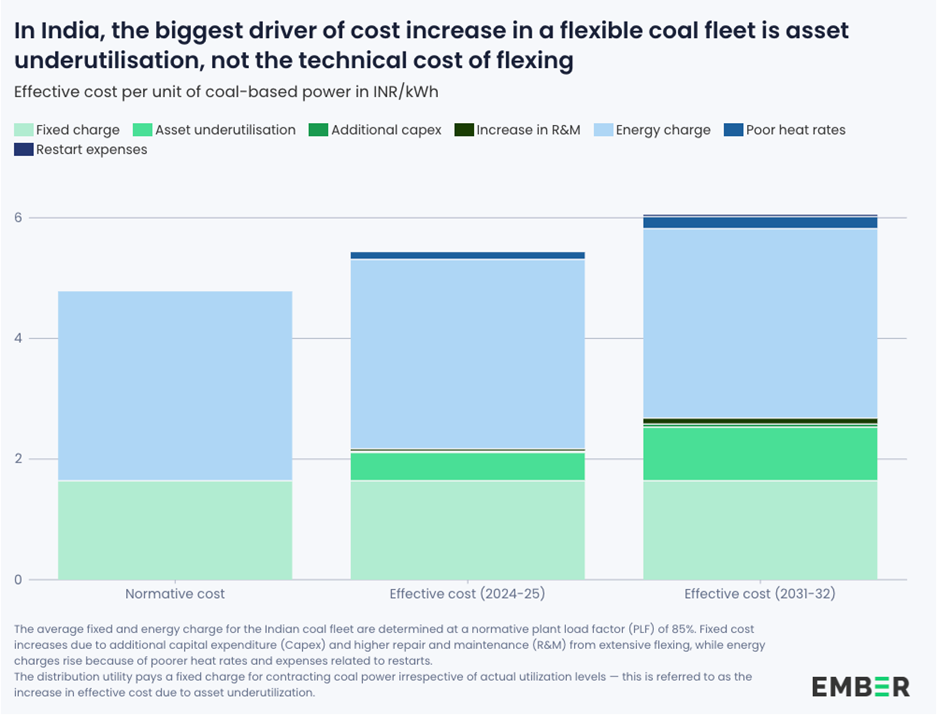
Solar is already making coal more expensive in India because the plants are being used less.
Look at that bright green bar in the middle column. That’s Asset Underutilization. That’s fixed costs not able to be amortized across as many units of electricity.
The revolution of renewables plus batteries is that this phenomenon is a one-way street. The more solar and batteries that are deployed, the worse the economics look for fossil fuel-powered alternatives.
Already in India, the cost of running some existing coal plants is worse than it would be to finance new solar and batteries.
This is why it’s hard to look at the electricity system in particular and not see some level of transition coming. Because, unless you have a geopolitical reason to (more on that below), why keep paying for more expensive electricity when you don’t have to?
Renewables have gotten so cheap that now the entire grid needs to adapt around them.
This is the core argument for transition. The more of them that comes onto the grid, the more batteries that help cover nights and cloudy/windless days, the harder it will be for coal and gas to remain profitable. They’re not likely to totally disappear on the grid in the next 30 years, but their utilization will continue to fall, potentially back down to just baseload power (until long term storage and other superior baseload forms of electricity generation come online like advanced geothermal.)
So when that plant comes up for refurbishment or retirement, the capitalists will ask themselves: Should we replace this expensive thing with the cheap one? Batteries are the unlock that will mean for a lot more of the grid, the answer will be “Yes.”.
But what about oil?
The economic argument against oil in favor of electrification is strong, but the geopolitics is more interesting, so let’s cover it next.
A geopolitical tipping point for fossil fuels?
A solar panel lasts about 30 years.
A barrel of oil lasts… minutes? Seconds?
In the paradigm of giving people fish vs. teaching them, solar, batteries and EVs are proverbial fishing poles. You still need to participate in the global supply chain to get one, but once you have it, you don’t need to keep buying fish from other people.
Prior to the pandemic, supply chains were focused on reducing redundancy to maximize efficiency.
But when you reduce redundancy, you also reduce resilience. And boy, did the global supply chain fail the resilience test in 2020.
If the pandemic was the opening salvo, President Trump, with his tariffs, military intervention and open corruption, is acting as the finale.
Those countries that do not have sufficient redundancies in their economies, supply chains and energy sources now face resilience risk.
What this will mean is likely a doubling down on domestic fossil fuel use for the countries who have them.
But 40-45% of global oil is not used domestically. It’s exported. Especially by the US and OPEC.
So that means that 40-45% of end-use oil customers are facing the paradox of how to reduce their dependence on foreign energy.
We’re already seeing it. As covered in the Bloomberg Zero Podcast, in 2024 Ethiopia made the call to ban all imports of new ICE cars and only allow EVs. Not for climate reasons, but for fiscal ones. The country was facing heavy economic hardships. They were spending 5% of GDP on imported oil, but had abundant, cheap electricity.
And unlike with OPEC in the 1970’s, there is a very real alternative to using oil for road transportation: EVs and electricity.
EVs are superior to gas cars in a lot of ways, principally their efficiency. Something like 60 – 80% of the energy in gasoline that’s used in a gas car is wasted as heat. That’s only 20 – 40% reaching the wheels.
In a world of abundant local renewable energy, batteries, electrified transportation, and heating systems, what happens in the Straight of Hormuz matters a lot less.
Why be dependent on oil and gas when some guy in another country can force your prices up 50% overnight, if you don’t have to?
And that’s not to mention how fossil fuels are far more fragile in armed conflict. Sure, it can be more efficient to have a giant power plant to power your city. A central place to bring all inputs, etc. But is that more redundant? More resilient? Ukraine is asking for more solar panels, wind turbines, batteries and generators. They aren’t asking for more combined cycle gas turbines.
The ruthlessly efficient, rules-based order was really good for fossil fuels. But if what comes next is a world of less interdependence, more independence, greater redundancy and more resilience to shocks – that’s a world where their burgeoning alternatives can really shine.
So… Viva la Transition!
Zach Stein is a co-founder of Carbon Collective. ImpactAlpha has partnered with Carbon Collective to provide a monthly analysis on how individuals, companies, and organizations can incorporate the realities of our changing climate and energy systems into their investments. The analysis originally appears in Carbon Collective’s newsletter.
All content is solely for informational purposes and should not be used as the basis for investment decisions.