
There are nearly two dozen investors in Acumen’s $250 million Hardest-to-Reach Fund to bring clean energy to some of the world’s 700 million people still living without electricity.
The entities include philanthropic funders seeking to encourage companies to enter markets like Chad, Malawi and Burundi; catalytic investors like the Green Climate Fund, which is providing a first-loss reserve to crowd in commercial investors; Shinhan Bank, South Korea’s largest commercial bank; and a $20 million sleeve of “impact alignment” incentives to reduce interest payments for portfolio companies that beat their energy-access targets.
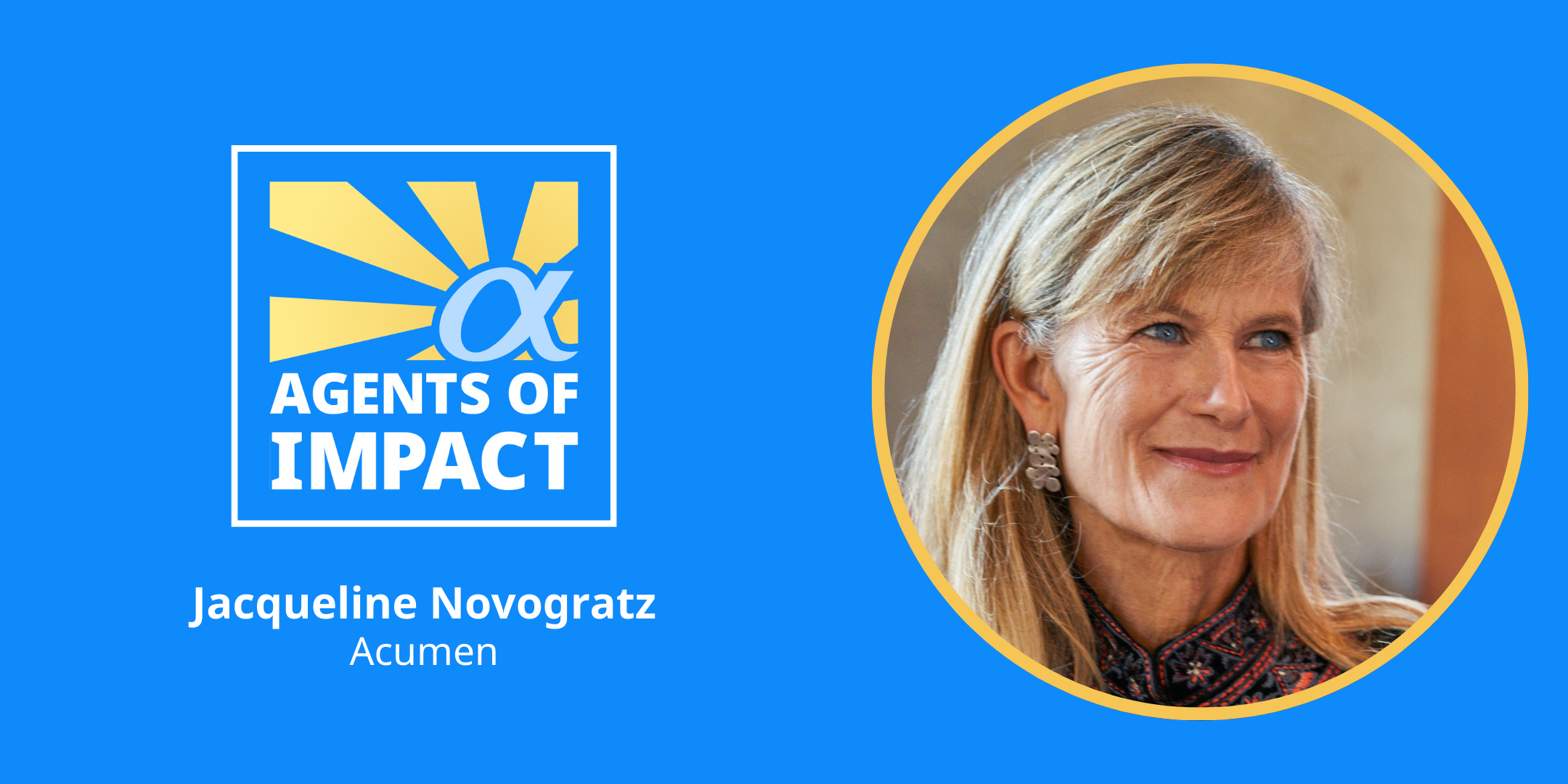
“It’s essentially a rebate,” Acumen’s Jacqueline Novogratz explains on ImpactAlpha’s latest Agents of Impact podcast. “At the end of the day, there’s a blueprint for what the private sector can do with the right incentives.”
Get the podcast in your feed by subscribing on Apple, Spotify, or YouTube.
The Hardest-to-Reach Fund will focus on 17 countries where electrification rates remain shockingly low. Some 85% of the 700 million people living without electricity are located in less than two dozen African nations.
Says Novogratz: “This is the biggest planetary market failure of our lifetime.”
Growth stage
After 24 years, the nonprofit Acumen is on pace to more than triple its assets under management. In addition to the Hardest-to-Reach energy access fund, the Acumen Resilient Agriculture Fund is one of the world’s largest climate adaptation investors, raising and deploying up to $300 million to help smallholder farmers upgrade their irrigation, crop selection and market strategies.
Take EthioChicken, a poultry venture in Ethiopia. Acumen provided the company with patient capital for nearly a decade. Then the Acumen Resilient Agriculture Fund stepped in with growth capital. Today, EthioChicken is a subsidiary of Hatch, which last year sold five billion eggs through more than four million farmers and sixteen thousand agents, injecting over a billion dollars into underserved markets, says Novogratz.
She pointed to new business models that make resilience investable. “There’s real opportunity to build companies that support the farmers in even the most difficult circumstances, whether it is through better storage or production or cold storage or or seeds or insurance against heat and droughts,” she explains.
“What we’re seeing in the adaptation and resilience space is a new generation of very, very gritty, smart entrepreneurs,” she says. “Farmers are willing to pay for it because this is their survival.”
All told, Acumen is raising as much as $750 million and has recently recruited as president and chief investment officer Carsten Stendevad from Bridgewater Associates, Ray Dalio’s $92 billion hedge fund.
“I feel like I’m just starting, and Acumen is just starting,” Novogratz tells ImpactAlpha’s David Bank on the podcast. “We’re living proof that if you dare to try and you stick with it – you will fall down, you will fail and so will your companies – but those that stay in the game end up winning the game, and change happens.”
Risk, adjusted
As Novogratz likes to say, “Climate finance is not scarce. It’s scared.” Acumen’s next frontier is changing systems – and perceptions of risk.
“Risk is not just a financial concept. It’s a social concept, an environmental concept, and it is a moral concept,” she says. “And we have to ask ourselves as well, ‘What’s the risk of not daring?’”
Indeed, inaction is a greater risk. “We could do nothing and leave 700 million people in the dark, and that is only going to create more emissions. It’s going to create more migration, more instability,” she says. “Or we can recognize that we have the spectrum of capital, that if we deploy it, and we find the right entrepreneurs, and we hold them through the ups and downs, we can solve the problem”.
Acumen aims to be at the vanguard of “building systems that show what it looks like to put our shared humanity and the earth at the center.”
That’s particularly important as innovators and investors adapt to the dramatic decline in traditional foreign aid.
“What we want is a world of dignity,” Novogratz says. “You feel it in young African entrepreneurs who want to build systems of, by and for Africans. And so it behooves us to then match their desire, their hunger, with systems of capital and markets and management support that helps them do that.”
Stay up to date with all of our podcasts by subscribing on Apple, Spotify, or YouTube.