Hanging from a scale mounted on a steel beam in a cavernous industrial space in west Berkeley, Calif., is a large plastic bag filled with a ton of carbon.
The colorless, odorless gas, extracted from the air outside, will be further refined to remove any remaining air and then sold to beverage makers, meat processors, hospitals and even laser manufacturers. A ton of carbon dioxide does indeed weigh a ton, and can fetch $300, $400 or even $2,500 from such commercial customers.
In recent years, the term “carbon market” has come to suggest the nascent, fragmented and sometimes suspect mechanisms for trading low-priced credits generated by avoided emissions or higher-quality credits for carbon capture and storage (for background see, “Corporate buyers nudge voluntary carbon markets toward higher-quality projects”).
But there’s a much older “merchant” market for actual CO2, which is widely used in greenhouses, refrigeration (think dry ice), medical equipment, concrete and the small steel canisters that can be tapped to quickly reinflate your bicycle or automobile tire. Allied Market Research estimates the merchant market for carbon dioxide neared $70 billion in 2023.
Aircapture, the six-year-old startup that is capturing, weighing and selling those tons of carbon, is aiming to become the low-cost provider of removing carbon, with container-sized converters that suck carbon right out of the air to supply the customers that need that carbon. Each container will be able to remove 500 tons of carbon per year.
Aircapture recently won a contract to supply all the CO2 needed for AB InBev’s brewery in Gran Canaria in the Canary Islands. AirCapture in June raised $50 million in Series A financing led by Ripple founder Chris Larsen’s Larsen Lam Climate Change Foundation.
“The global economy runs on carbon,” says CEO Matt Atwood as he shows off the Berkeley R&D facility, where one of its modular direct air capture, or DAC, units was being readied for shipment to Japan. “We’re focusing on selling the carbon molecules themselves to customers in industry that need it.”
All of the above
Carbon removal has moved up the agenda of climate investors, as it becomes clear that the scale-up of renewable energy and decarbonization won’t be fast enough to significantly reduce the carbon load in Earth’s atmosphere.
However, that same slow scale-up, along with high per-ton costs, has cooled enthusiasm for technology approaches to direct air capture. One of the largest DAC startups, Climeworks, last month raised $162 million – bringing its total fundraising haul to more than $1 billion since 2009. Climeworks’ Mammoth facility in Iceland is able to remove 36,000 tons of CO2 a year. But Switzerland-based Climework’s own per-ton costs remain high and the company is evolving from a DAC pure play into a broker for carbon removal credits more broadly, sourcing for its customers credits from such as reforestation, rock weathering and biochar.
Such nature-based approaches are gaining traction. In April, Houston-based Mati Carbon won the XPRIZE Carbon Removal competition, taking home the $50 million grand prize backed for its rock weathering technique that sequesters carbon and improves soil health. Mati has now raised debt financing from JPMorgan to establish carbon-removal projects in India, Zambia and Tanzania.
And biochar is emerging as the low-cost, locally based carbon removal approach.Through pyrolysis, agricultural waste and other biomass can be turned into stable carbon and stored in soil or other sinks, removing carbon from the atmosphere. High-quality carbon removal credits from biochar are fetching $120 per ton or more. And as a fertilizer, biochar restores soil health, increasing farmers’ yields and incomes and reducing the use of synthetic and often imported fertilizers.
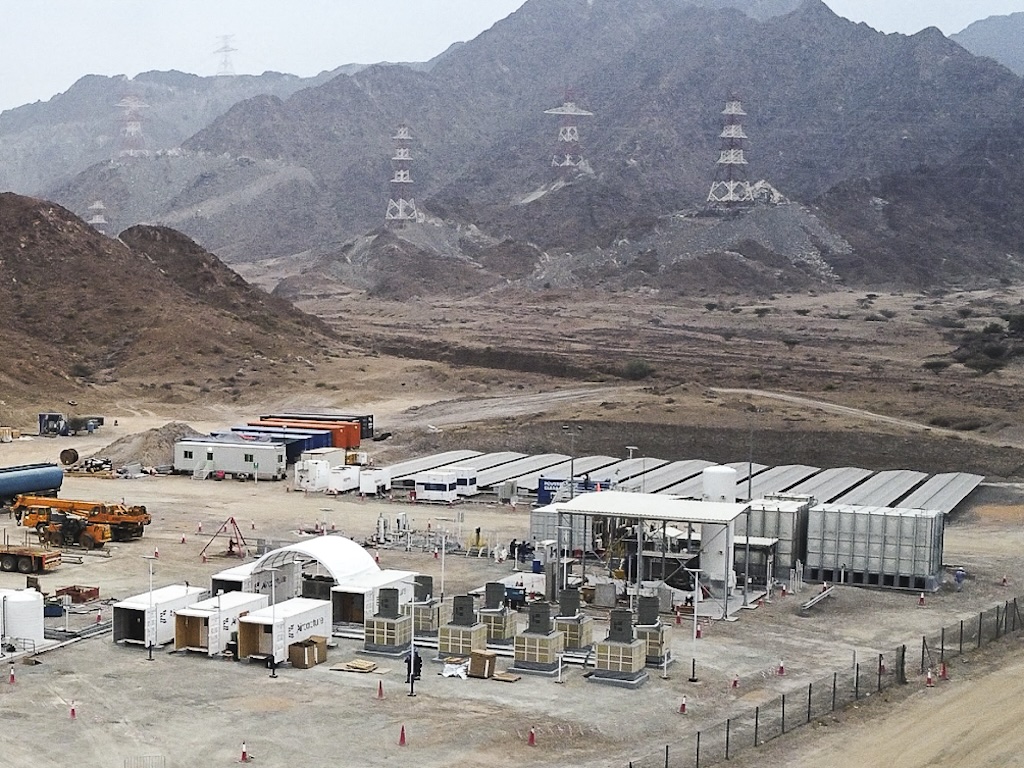
Aircapture itself won a special $1 million XPRIZE for Project Hajar, a collaboration with the Oman-based carbon storage company 44.01 to capture and store carbon at a site in Fujairah in the United Arab Emirates. In just 17 days, the company deployed its modular DAC machines and integrated with 44.01’s technology to mineralize the carbon and convert it into rock within subsurface geological formations. Including transportation logistics, the project was deemed to produce net carbon reductions.
Learning curve
The half-disassembled machine In the back of Aircapture’s facility shows the ceramic contactors that collect the CO2 from the air blown through from a fan through a series of substrates, much like a catalytic converter in an internal combustion car. Steam releases the carbon from the contactor for collection and refinement from 97 or 98% purity to the 99.99% required for food applications.
If tomorrow’s market is carbon storage and sequestration, today’s business for Aircapture are the commercial and industrial customers that will pay good money for actual carbon.
Some of those customers, such as concrete producers that inject carbon to strengthen their product, do indeed sequester the carbon more or less permanently. Others, like beverage producers, do not – that CO2 is released back into the atmosphere each time you pop a beer or a soda.
Atwood estimates it will take five to seven years for the development of full carbon removal infrastructure, including suitable storage sites. By deploying hundreds and then thousands of its Aircapture units in the meantime, he says, the company can leverage technology learning curves to be the low-cost producer of carbon removal when the market is ready. In solar, for example, each doubling of technology capacity meant a 20% reduction in cost, a ratio that has come to be known as Wright’s Law.
“We’re going to market first into the merchant market, where prices are often high, where customers need a more reliable, higher parity supply,” Atwood says. “With DAC, it stands to reason that if you build a larger number of smaller machines, your costs are going to come down more rapidly at a lower cost, than if you build a smaller number of bigger machines.”
“In order to get there, you’ve got to have financeable projects. You have to be bankable. And there’s a very mature market. People are buying CO2, sometimes at high prices.”
Pricing in the merchant market is driven by the distance the carbon has to travel. Most carbon is produced as a byproduct of ethanol and other fuel production, or ammonia production in Europe. Aircapture can eliminate those transport costs by producing the carbon onsite, from the air. The physical footprint of its machines is usually less than the truck bay needed to transfer the carbon coming from afar to their internal systems.
In Aircapture’s model, the company owns the production facility and transfers the product to customers under standard 10-year take-or-pay contracts.
“We’ve trademarked ‘CO2 as a service.’” Atwood says. “Our machines are on our customer sites, and we’re selling them the carbon dioxide in the purity that they require and in the form that they require, with high grade liquid CO2.”
Road to bankability
Atwood, a chemist and physicist by training, discovered the merchant carbon market as a customer himself. After working in first-generation biofuels developing large-scale biodiesel plants, he built a second-generation startup, Algae Systems, to grow algae on wastewater and convert it into fuels. With his co-founder, John Perry Barlow, Atwood successfully built and ran a large algae plant in Alabama.
John Perry Barlow, who died in 2018, is a two-time legend, first as the lyricist for the Grateful Dead and later as a founder of the Electronic Frontier Foundation, a seminal civil liberties organization in the early days of the Web. The two met, of course, at Burning Man. “I was the first idiot ever to try to become his boss,” Atwood laughs.
Atwood discovered direct air capture while looking for CO2 supplies to accelerate algae growth. “And then in 2019 after looking at the technology for a while, finally, a light bulb went off. ‘Oh, build a smaller machine and sell the CO2,’” he says. “It only took me 10 years to figure that out. So that’s what we’re doing.”
Atwood’s strategy slingshots off the merchant market to be ready to compete for carbon removal credits when they become bankable. Unlike some other companies Aircapture hasn’t forward-sold carbon removal credits on the hope that production costs come down fast enough to meet the terms of such contracts.
“I could sell carbon credits to Microsoft for five years, but a bank is going to look at that and go, ‘OK, great. What about the next five years? The next 15 years?,” he says. “What it all comes down to is, do you have a product? Can you make money? And will somebody pay to build this stuff? We just can’t raise money forever.”
Aircaptures recent fundraising included project financing along with equity to finance customer deployments. Its investors include family offices and strategic partners with experience in industrial gas and infrastructure.
“These large scale projects require bankable project financing, and the way to get to that is by having many commercial machines operating, demonstrating the technology is not only cost effective, but reliable,” Atwood says.
“We think our go to market approach is the right way to be the low cost provider of this technology at scale when the infrastructure is mature.”