
There are plenty of technical challenges still to solve before abundant, clean fusion energy becomes a reality. But increasingly, it is a financial game.
Exhibit A: Commonwealth Fusion’s blockbuster $863 million raise last week. The Massachusetts-based company has raised some $3 billion to date and has broken ground on its first prototype plant outside of Boston.
Fusion hopefuls have raised over $12 billion in the last 10 years — capital that has brought down early basic science risk. “Fusion is entering its critical decade,” David Siap of family office network CREO tells ImpactAlpha. “With $100 billion or so needed to reach commercialization over the next decade, “the sector is entering a fundamental shift where the bottlenecks are increasingly financial in nature,” he said.
Siap is the author of a Capital Stack Formation for Commercial Fusion, a new report shared exclusively with ImpactAlpha that plots out financing needs for fusion’s next decade.
Wealthy individuals and families have been early investors in fusion, which fuses atoms to release energy. Some of the public names that have invested in CFS in their personal capacity or via family offices or funds they control: Bill Gates, Eric Schmidt, John Doerr, Marc Benioff, Robert Downey Jr., Stanley Druckenmiller and Jonathan Soros.
“CFS has a significant amount of support from ultra high net worth individuals and family offices — both in this round and in previous rounds,” a CFS spokesperson tells ImpactAlpha.
As investors with patient capital, family offices are well-matched for the long-term horizons of fusion, a form of nuclear energy that has been in development for decades. “These folks aren’t on a 10-year cycle, so they can hang on for liquidity,” Siap tells ImpactAlpha. Even the most ambitious fusion hopefuls don’t envision delivering grid-connected commercial fusion energy until well after 2030.
For impact investors, says Siap, “it’s both a career-defining opportunity and a chance for impact capital to lead the next phase of the energy transition.”
Almost two-dozen CREO members have made investments in fusion. Of 28 non-Chinese fusion startups tracked by CREO, the network’s members were direct investors in 18. CREO members have also participated as LPs in funds that have backed fusion startups, according to CREO.
With the technology entering a critical decade of capital stack formation, more patient capital will be needed. CREO estimates the sector will require $80 billion to $120 billion to commercialize, and that each eventual market leader will need about $12 billion in corporate equity and $15 billion in project equity and debt to support commercialization through their first 2 gigawatts deployed.
Here are some highlights:
Competitive race
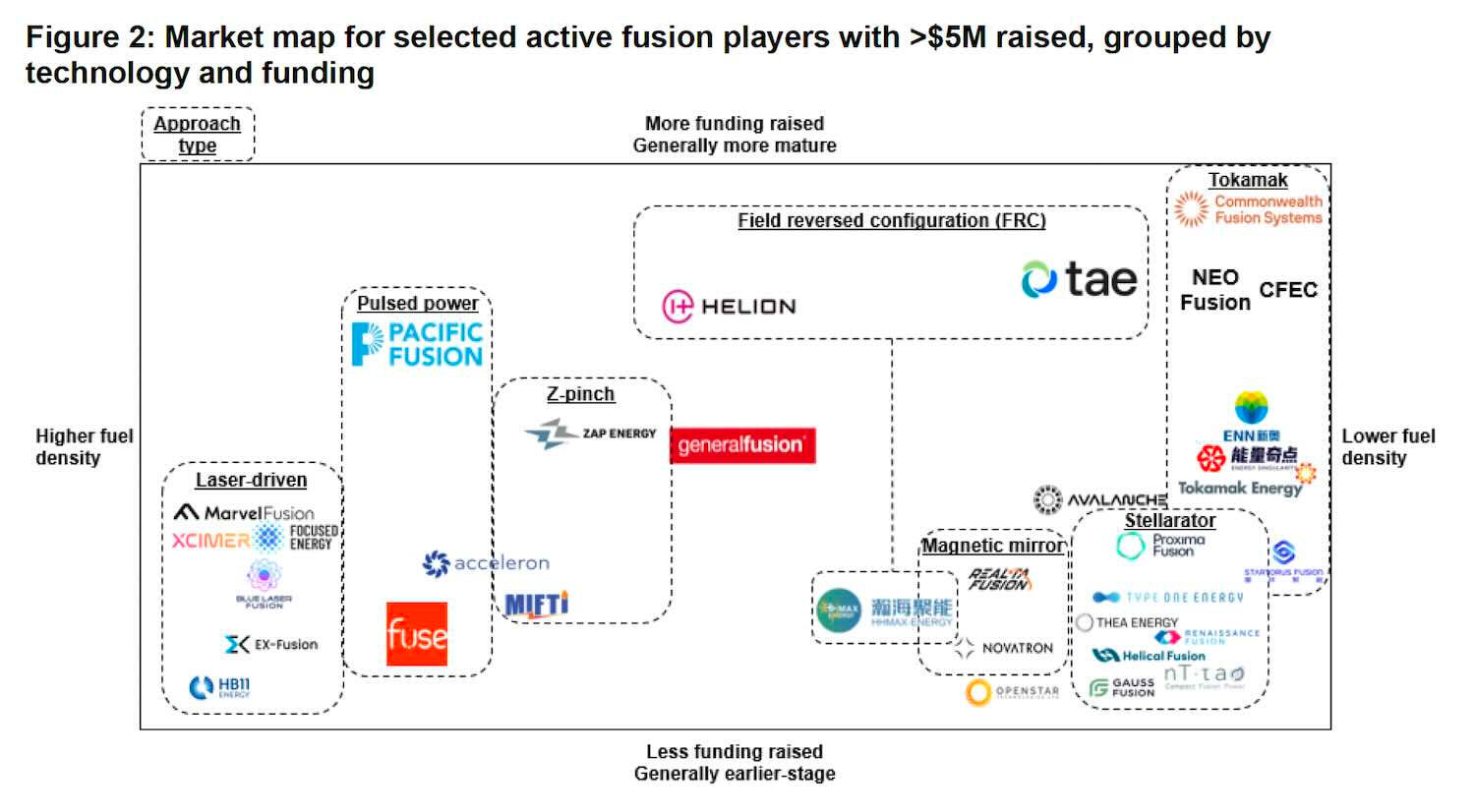
Although some fusion companies, such as CFS, are leading in fundraising and milestones, the field is still wide open, notes Siap. Startups are clustering around different approaches, including tokamaks, the most studied approach, stellarators and laser-driven inertial fusion. New startups are entering the field with innovative technology, supercharged by AI. “It is not only unclear which company, but also what technology, will be commercially successful, if any,” he says.
Fusion funding evolution
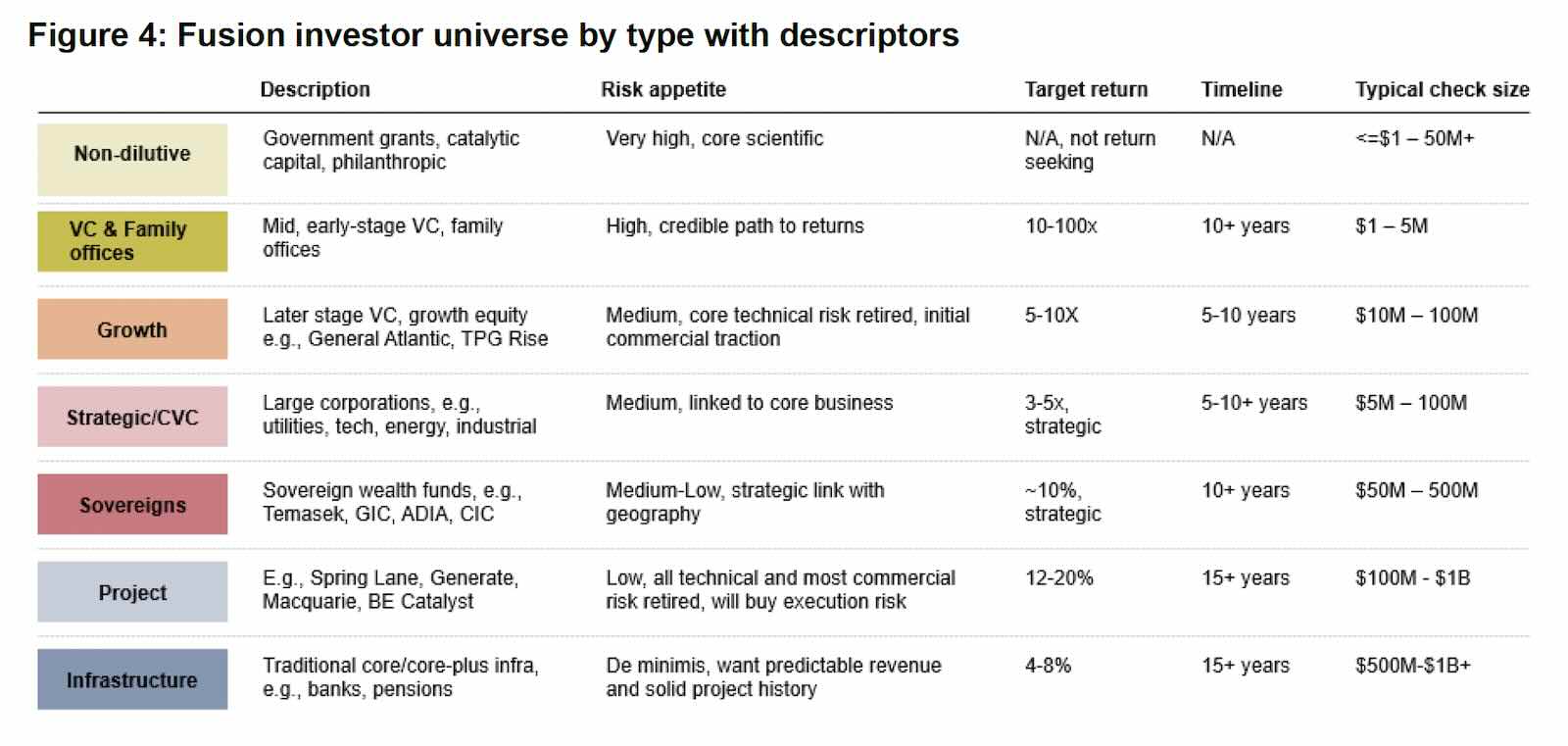
Many fusion companies are contemplating, or building, their first demonstration plants. Their economic viability may hinge on the cost of capital. “For financiers, fusion’s transition from technology development to plant deployment may represent the future of energy infrastructure finance and a $100 billion+ blue ocean for early movers,” notes Siap.
Offtake agreements, government backing, and other measures can help smooth the funding path for FOAK plants.
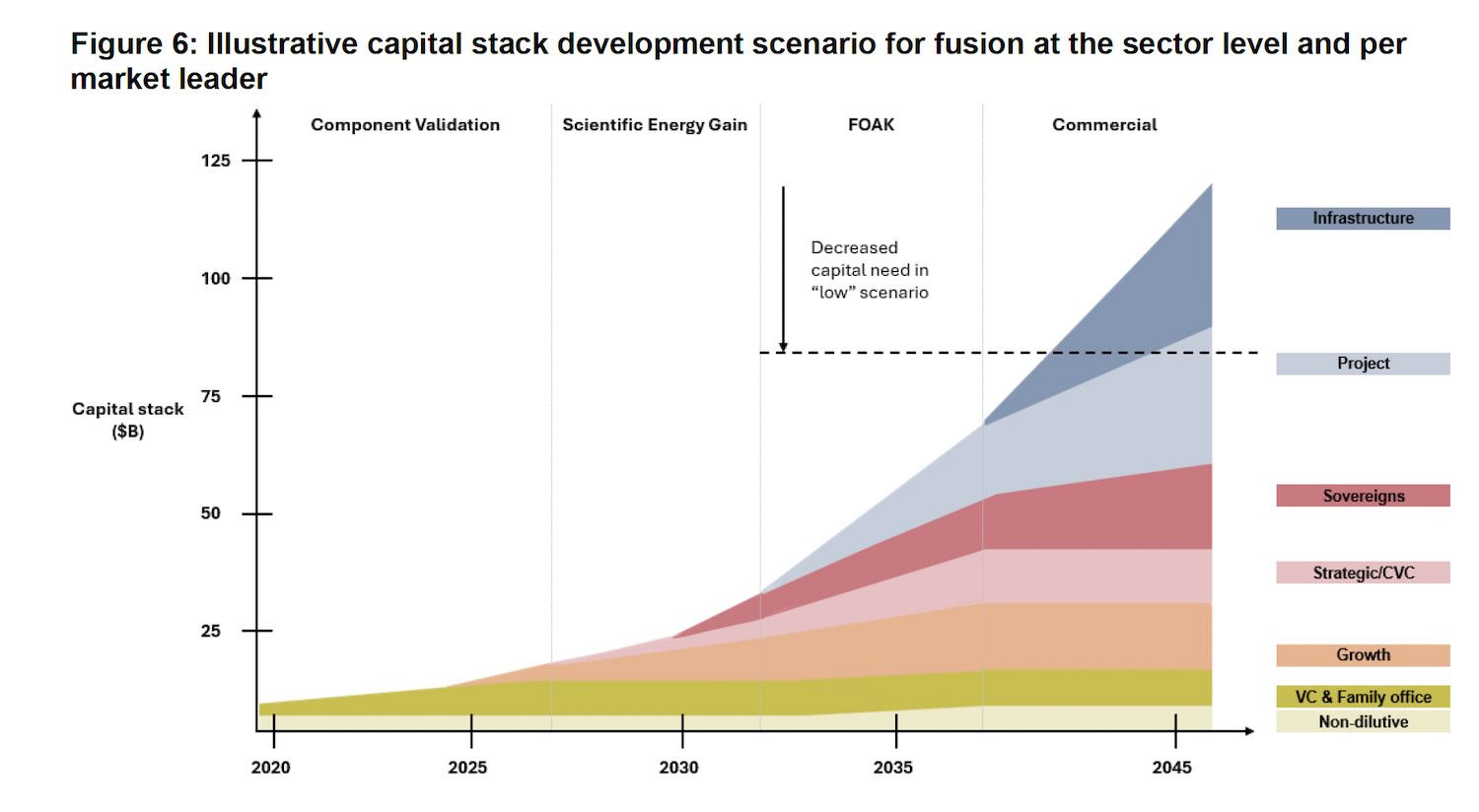
CFS plans what has been described as the first commercialization-relevant scientific energy gain demonstration, likely in the first half of 2027. Based on a successful outcome, it will build Arc, a 400 megawatt commercial plant in Virginia that is expected to come online in 2032.
The fusion energy capital stack is evolving from government funding at the earliest research phases to family offices and venture capital when a company has a credible path to commercial fusion. When it comes time for first-of-a kind, or FOAK, plants, sovereign wealth funds, project finance and strategic and growth investors for first-of-a-kind plants. Grid-connected commercial fusion — the Holy Grail — would shift financing to infrastructure and project finance funders and sovereign wealth funds.
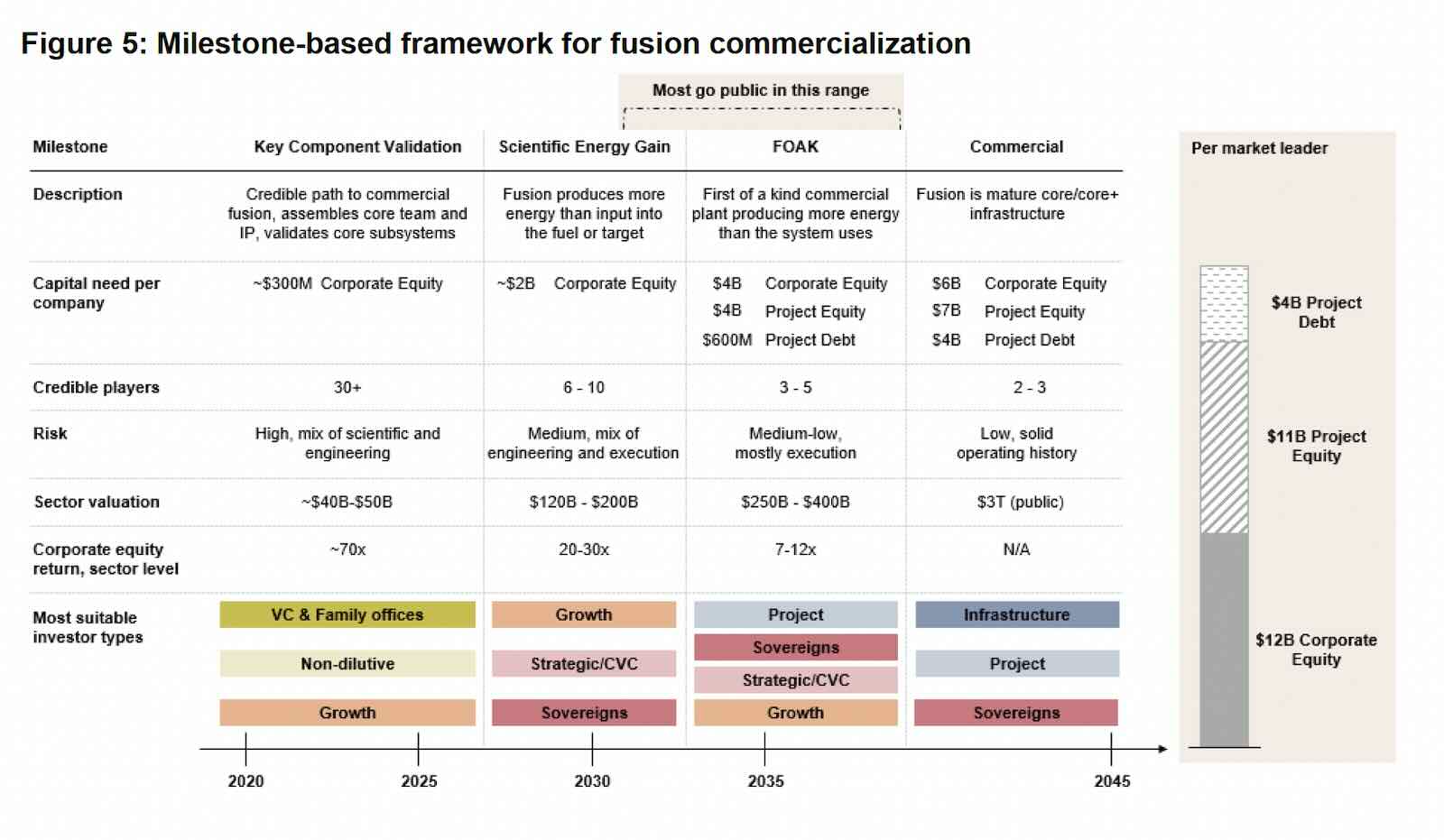
Fusion companies will likely seek IPOs after key milestones, such as reaching net energy gain (more energy produced than required to ignite a reaction), yielding valuations in the $50 billion to $100 billion range. Those holding off until completion of their FOAK plants, likely in the mid-2030s, would reward early investors even more, commanding valuations of between $100 billion to $200 billion or more, projects CREO.
“Global competition is intensifying to capture fusion’s massive strategic value,” says Siap. “The West cannot afford to cede leadership in this sector to China, as it did with cleantech 1.0 technologies like solar, wind, and batteries.”