
From great power brinksmanship to real-time dealmaking, the signals from the World Economic Forum in the Swiss Alps are clear: challenges are mounting, governance structures are straining, and instability is opening space for new solutions.
“We are at an inflection point,” Isabelle Hau of the Stanford Accelerator for Learning writes from Davos. “Technology is accelerating faster than our social contracts. The work ahead is not just technical or economic; it is relational, ethical, and deeply human.”
The Trump administration’s increasing hostility to Europe brought calls to tax the rich and boycott US goods. Sweden’s $110 billion Alecta pension fund moved to divest most of its US Treasury holdings.
In a defiant and confident speech, Prime Minister Mark Carney of Canada called on “middle powers” to unite in the face of increasingly hostile “great powers,” now including the US as well as China and Russia. As a central banker in both Canada and the UK, Carney had earlier sought to put climate risk and income inequality at the center of global finance.
Collective investments in resilience, he said in Davos, “are cheaper than everyone building their own fortresses. Shared standards reduce fragmentations. Complementarities are positive sum.”
Buried in Carney’s speech was a call to build coalitions with partners that share common ground and to create “dense web of connections across trade, investment, culture on which we can draw for future challenges and opportunities.”
Bridging divides
In meetings, sessions, and panels in Davos, “there’s a lot of attention on impact investing,” reports Amit Bouri of Global Impact Investing Network, who was among the community of impact investors making the scene. “Through its inherent focus on finding solutions, impact investing remains a bright spot that can bridge a lot of divides,” Bouri shared with ImpactAlpha.
He acknowledged, “People have also discussed the need for more clarification on where impact investing can be helpful – and where it can’t.” Spotted in Davos: TPC Chairman Chavalit Frederick Tsao, Katapult Ocean’s Jonas Skattum Svegaarden and Second Muse’s Todd Khozein.
Alongside WEF, the International Rescue Committee launched Airbel Ventures, a humanitarian impact investing fund designed to accelerate the entry and scale of breakthrough technologies in crisis-affected communities.
Nonprofit Canopy introduced a blended finance model to mobilize at least $2 billion for low-carbon materials and transform paper, packaging and textile supply chains in India.
Reckitt committed $10 million to WaterEquity’s Everspring Fund to provide long-term financing to financial institutions in Asia, Africa and Latin America that provide loans for water and sanitation solutions.
EU Inc.
At Davos, entrepreneurs and investors from across Europe network and critique without regard to national borders. Back home at work at their startups, they’re hamstrung by the welter of financial and legal requirements in Europe’s 27 member states.
European Commission President Ursula von der Leyen took the European startup scene by surprise with the launch at the World Economic Forum of “EU Inc,” reports ImpactAlpha’s Danielle Rossingh in “With EU Inc., Europe looks to scale startups across borders.”
The aim is a single and simple set of rules to allow entrepreneurs from Rome to Vilnius to enjoy the same capital regime across the entire bloc – and register a company online in any member state within 48 hours.
“Ultimately, we need a system where companies can do business and raise financing seamlessly across Europe – just as easily as in uniform markets like the US or China,” von der Leyen said.
“This shows that Europe’s politicians are being bold and serious about creating the conditions for innovation and scale-up to happen at home, rather than elsewhere,” Impact Europe’s Jana Bour told ImpactAlpha. “Sometimes the most important news at Davos isn’t the headline-grabbing stuff,” wrote Lennard Kooy of Lleverage, a Dutch startup building an AI operating system for medium-sized companies.
Shaping the algorithm
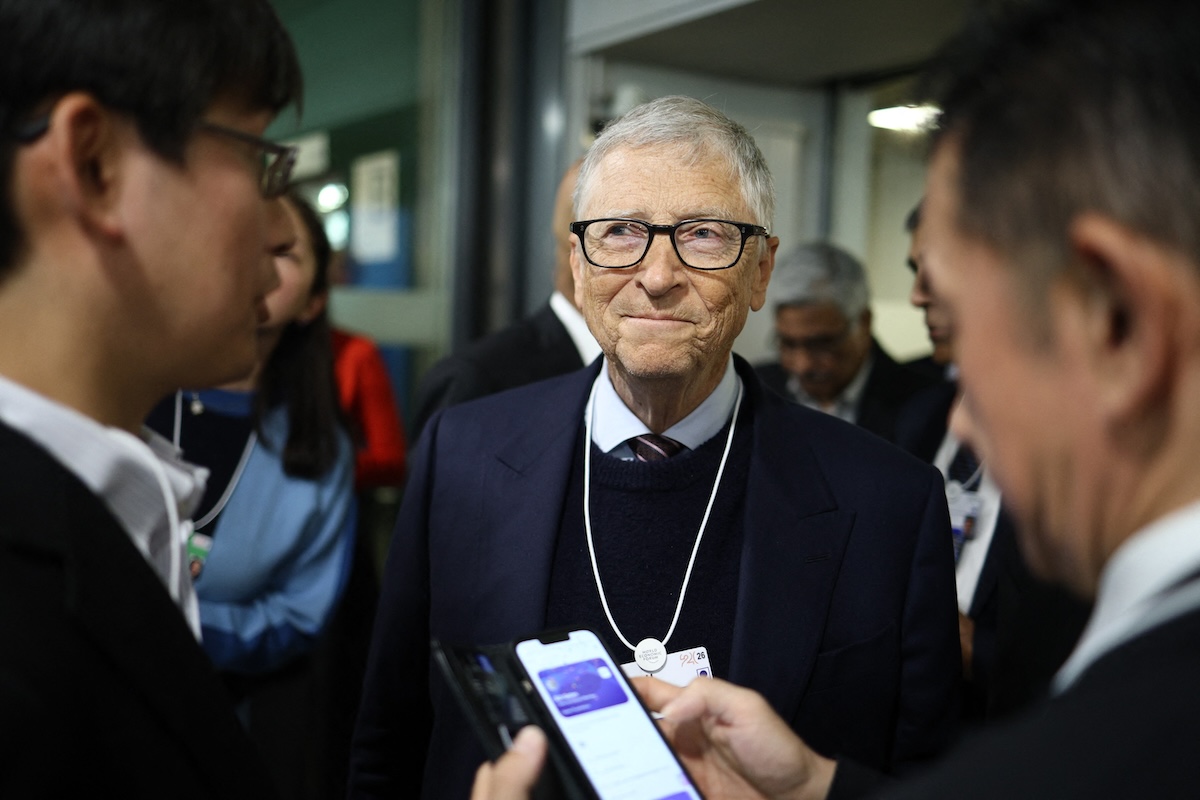
The Gates Foundation and OpenAI committed $50 million to Horizon1000, to help several countries in Africa, starting in Rwanda, improve their health systems amid cuts to global aid. “AI can be a gamechanger in expanding access to quality care,” Bill Gates said in a blog post.
“These AI tools will support health workers, not replace them,” he added. In Davos, the pace of technological advancement was unmistakable, said Stanford’s Hau. So too was the undercurrent of unease about governance.
In many rooms, “People pushed beyond what AI can do to ask what it should do, and what it must never replace,” she said. “There was growing recognition that learning is not only individual, and that progress without human connection is fragile.”