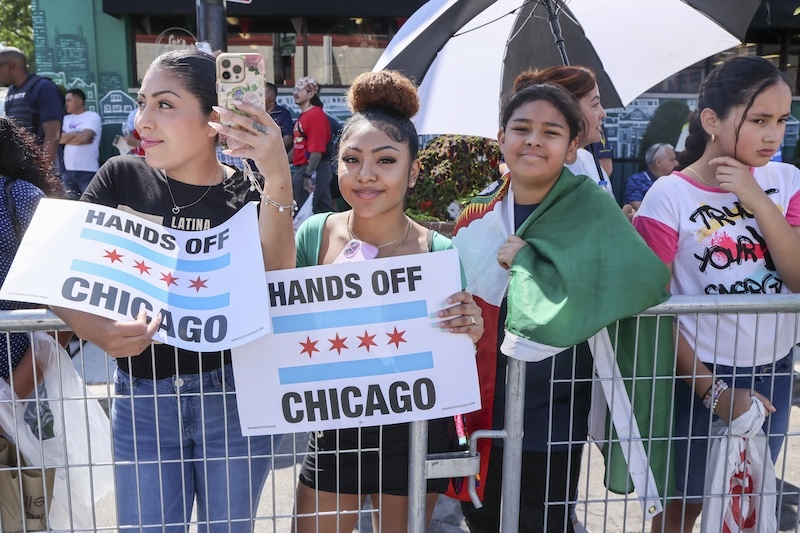
I arrived in Chicago last month on the same day federal agents from ICE and the Border Patrol appeared on the city’s downtown streets. The National Guard weren’t far behind.
President Trump, in his speech at Marine Corps Base Quantico, had just told the assembled generals and admirals to use U.S. cities as “training grounds” to combat “the enemy from within.”
The operators, investors, activists and other practitioners I met at the Neighborhood Economics conference the next day saw Chicago and other cities as training grounds for something far different – shared prosperity and community revival.
In coming weeks, ImpactAlpha’s team will continue the conversation about how to move forward at a time of maximum peril and maximum opportunity. We’ll be gathering more examples for our growing “Playbook for Shared Prosperity,” which already includes dozens of on-the-ground initiatives that are building wealth, lowering costs, creating opportunities and, along the way, reducing the toxic divisions that would pit groups against one another.
Next week, I’ll be at the Aspen Ideas: Economy gathering in Newark, NJ, to talk about building a suite of financial products to nurture “a nation of owners.”
ImpactAlpha’s Amy Cortese will be at the Opportunity Finance Network’s conference in Washington, DC, hosting a screening of our mini-documentary, “Equity and Ownership,” and a conversation with Martin Eakes of Self Help Credit Union, which has delivered more than $11 billion in financing to more than 168,000 families.
Our fall tour continues the following week at SOCAP25 in San Francisco, where Amy and I, along with Dennis Price and Roodgally Senatus, will lead more than a half-dozen panels on the future of global finance, catalytic capital, nature-based solutions and “justice and economic prosperity for all” (see below for details of the ImpactAlpha “track” at SOCAP25).
At SOCAP, I’m moderating a particularly apt discussion, “Surviving four more years: Protecting and advancing impact.” I’m looking forward to practical wisdom from Candide Group’s Morgan Simon, VertueLab’s Aina Abiodun and Adriana Abizadeh-Barbour of Kensington Corridor Trust in Philadelphia around actionable strategies, including affordable housing, community land trusts, clean energy, land stewardship and employee ownership models like co-ops and ESOPs. Indeed, the Kensington Corridor Trust, with its model of community-owned investments to build neighborhood wealth and preserve culture and affordability, is the kind of shared-properity “play” that other cities can replicate.
Next month, ImpactAlpha will take the conversation to the heart of Wall Street at the New York Federal Reserve Bank’s “Making Missing Markets” gathering. The New York Fed’s David Erickson and I will talk about how to connect new sources of capital and link buyers and sellers to address critical community challenges.
The excitement around common-sense strategies to revive communities, redress disparities and create wealth may seem incongruous at a time when federal agents and National Guard troops are deploying in Chicago, Portland, Memphis and other cities to come. In fact, these examples of mutual aid, economic development and shared prosperity are the best rebuttal to false narratives of urban chaos.
At Neighborhood Economics, for example, the Rev. Jonathan Brooks described how Lawndale Christian Community Church on the city’s west side has spawned a community development corporation building affordable housing, a health center training medical professionals and a legal center that is helping keep young people out of prison to break the cycle of incarceration.
I shared the stage with Lyneir Richardson, whose Chicago TREND real estate fund had just scored an exit on a shopping center in the Chatham neighborhood, netting hundreds of neighbors / investors a solid five-fold return on their investments of between $100 and $5,000. With the Brookings Institution, Richardson has produced “A playbook to buy back the block.”
And I interviewed Wilson Lester and Talib Graves-Manns, who are expanding Partners in Equity from North Carolina to Chicago and other cities to help small business owners buy the commercial properties where they operate as a way to build assets and generational wealth. Lester recounted the story of his grandfather, a painter and contractor who became the first African-American to own an apartment complex in Florida.
“Why I do this is because I have a personal connection to what ownership looks like,” he said, “and for a family to own assets and to be able to transfer those assets from one generation to the next.”
Ownership suite
Instead of the rarefied air of the Rockies, Aspen Ideas: Economy, the inaugural gathering of the Aspen Institute’s specialized track on wealth-building and ownership, will be embedded in the urban fabric of Newark, NJ. In Newark, as elsewhere, concentrated wealth, stagnant real income and rising prices have many families feeling anxious about the future.
I’ll be leading a discussion about creating an “ownership suite” of financial products that steer capital toward strategies that foster “a nation of owners” – of real estate, businesses and financial assets. Some advocates are talking about ownership as an asset class, others about embedding shared ownership across asset classes, from public and private equities to private credit to municipal bonds.
I’ll be joined again by TREND’s Richardson, who is expanding opportunities for community residents to invest even small amounts in commercial real estate in their neighborhoods, giving them a chance to ride up with, rather than be displaced by, rising property values. Gary Community Ventures’ Santhosh Ramdoss will share strategies like The Dearfield Fund, incubated at Gary, which provides down payment assistance to homebuyers facing barriers to home ownership in Denver.
Such efforts can not only be replicated, but scaled, by aggregating projects into standardized products that capital markets understand, Calvert Impact’s Catherine Godschalk said on our prep call. Calvert’s Community Investment Notes have raised more than $550 million for funds, enterprises and other intermediaries tackling inequality and climate change in the US and around the world.
“I do believe we have replicable models, and there are parts of this ownership economy absolutely ready for scale,” Godschalk said. “How do we build the infrastructure that connects capital markets to these replicable and successful models like Chicago TREND?”
The panel will be kicked off by Bloomberg Philanthropies’ Garnesha Ezediaro, who leads the foundation’s Greenwood Initiative, a collection of efforts to accelerate wealth accumulation for Black families and redress systemic underinvestment in Black communities. Last year, the initiative committed $600 million to four historically Black medical schools to help redress racial disparities in medical care.
Access to finance
ImpactAlpha’s Amy Cortese and Roodgally Senatus will be at the Opportunity Finance Network’s annual gathering of community development finance institutions in the nation’s capital, where thousands of federal workers have been furloughed and entire agencies gutted amid a government shutdown.
The event comes as staffers in the Treasury Department’s three-decade old CDFI Fund, a key lifeline for capital-starved community development financial institutions, have been laid off amid the budget standoff and government shutdown (a federal judge has at least temporarily blocked the layoffs). The CDFI Fund is instrumental in helping mission-oriented lenders working on tight margins expand their work; it also administers key incentives like the New Market Tax Credits that facilitate the development of affordable housing.
CDFI’s, which provide vital financial services for businesses, community organizations and families in overlooked communities in every state, have long enjoyed bipartisan support. The CDFI Fund this spring survived an earlier attempt to shutter it by the Trump administration.
Against that backdrop, ImpactAlpha will screen our mini-documentary, “Equity & Ownership: Napoleon Wallace and the Reconstruction of Black Wealth,” which chronicles Wallace’s multi-pronged strategy to address the causes of wealth inequality – while living with the challenges of late-stage ALS.
After the screening, Self Help’s Eakes will join Amy to talk about fostering home ownership, fighting predatory lenders and extending the benefits of the clean energy transition to all communities. Eakes founded Self Help in 1980 to “translate the civil rights movement and the women’s movement into the economic arena.” Self Help has developed the kind of market linkages that mobilize institutional capital for rural, low-income, immigrants and people of color – vital plays in the Playbook for Shared Prosperity.
Step up
You won’t be able to make it to all of the SOCAP panels led by ImpactAlpha’s tireless team – many of the sessions are scheduled at the same time (see the full schedule here).
Dennis Price is taking on big challenges in the opening panel of SOCAP’s future of global finance track. He’ll lead Amit Bouri of the GIIN and Elizabeth Boggs Davidsen of GSG Impact in conversation about the bold shifts needed to embed positive social impact in the mainstream economy.
Amy will open the climate and nature-based solutions track with Betsy Fore of Velveteen Ventures, Kate Williams of 1% for the Planet and Chante Harris of the Eunoia Group. They’ll discuss how to embed climate and biodiversity considerations into financial decision-making, and set the stage for collaboration and collective action to unlock the social co-benefits of nature-based solutions to remove and store carbon and revive degraded landscape.
Roody will tee up SOCAP’s track around justice and economic prosperity for all. Adam Kiki-Charles of The Equity Alliance, Curt Lyon of Transform Finance and Susan Gouijnstook of Jobs for the Future will discuss strategies to close racial and economic wealth gaps, expand equitable access to capital, and promote community ownership models— and identify other collaborations needed to foster an equitable future for all.
And I’ll help kick off the “Catalytic Capital 2.0” track with the MacArthur Foundation’s Urmi Sengupta, a leader of the Catalytic Capital Consortium, which supports ImpactAlpha’s coverage of the catalytic capital beat. Greg Neichin of family office Ceniarth and Carolina Suarez Visbal of Latimpacto, a network of families, foundations and field builders in Latin America, will detail the deployment of catalytic capital to crowd in commercial capital and nudge the mainstream economy toward positive impact.
Amy will engage Alisha Murphy of the Navajo Nation Division of Economic Development and Tonitrice Wicks of Winrock International about equitably unlocking small business potential. They’ll share real-world examples of how targeted business support programs can increase business sustainability, and create resilient local economies.
All of that might help in protecting and advancing impact over the next four years, the topic of the final panel in the ImpactAlpha track, which will help close the three-day SOCAP gathering.
“If you’re wringing your hands and upset about all the ways that Trump is looking to gut clean energy, CDFIs, affordable housing, and you haven’t doubled down in your investments – stop complaining,” Candide’s Morgan Simon said in our prep call. “If you’ve been wondering when was the time to step up, here we are.”