
As artificial intelligence reshapes the economy, the benefits of its productivity gains are predominantly flowing to a small group of wealthy owners and investors. Workers, meanwhile, bear the costs of the AI disruption, with little share in the upside.
How can the gains of AI productivity be more fairly distributed?
Rutgers University’s Joseph Blasi, a leading researcher on employee ownership for more than half a century, proposes a version of a sovereign wealth fund or funds, akin to Alaska’s Permanent Fund – fueled by data and AI rather than oil.
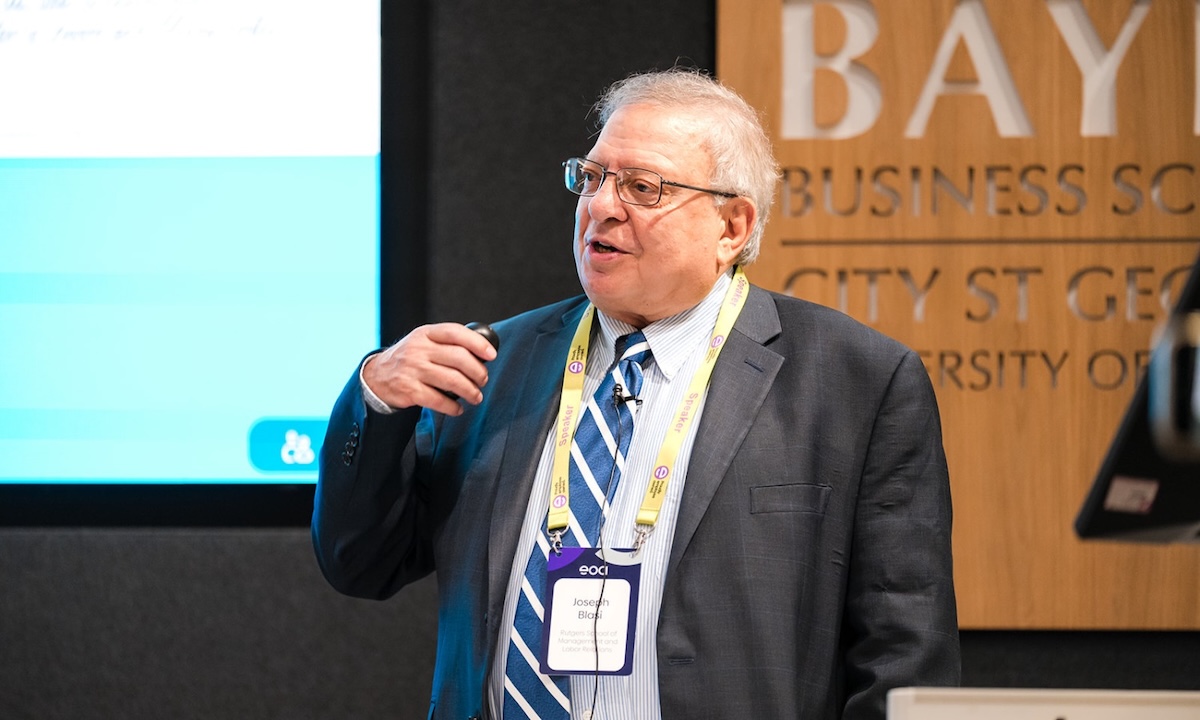
Blasi has revised “The Citizen’s Share: Reducing Inequality in the 21st Century,” the book he co-authored over a decade ago to argue for broad-based profit sharing and employee ownership, adding a call for shared ownership of the new means of production. Blasi spoke with ImpactAlpha about what a “citizen’s share” of AI could look like.
“Right now, the priority is to develop capital ownership ‘homestead stakes’ by as many citizens as possible,” added Blasi, referring to the Homestead Act of 1862 which, though it excluded many enslaved and Indigenous people, gave citizens an ownership stake in government land.
A “homestead stake” in AI companies, and the software, data and infrastructure that underpin them, would not prevent the displacement of workers by artificial intelligence. But it could mitigate some economic harms by giving displaced workers a share of the productivity gains and profits generated by AI.
“One approach is to create funds like the Alaska Permanent Fund in various states along with a national artificial intelligence permanent fund,” says Blasi. “And those permanent funds should be allowed to raise money through bond issues, borrow money and invest those funds in all of this artificial intelligence software infrastructure.”
The Alaska Permanent Fund, a sovereign wealth fund owned by the state of Alaska, is often cited as a real-world model for Universal Basic Income (see, “What Alaska’s oil dividend can teach us about Universal Basic Income”). The $85 billion fund, which was created from a 1977 deposit of $734,000 in oil proceeds, pays annual cash dividends ranging between $1,000 and $3,000 to each Alaska resident. For a family of four (including children), that could be a combined household payment of up to $12,000.
Like Alaska, an AI permanent fund would “use the dividends and some of the capital gains to create capital income payments,” Blasi said. The payouts would go at first to individuals most affected by AI, but over time would become a broader endowment for the public good.
New Mexico’s $67 billion State Investment Council, which in recent years has grown rapidly into the second-largest sovereign wealth fund among US states, covers the costs for more than one-quarter of all K-12 education in the state and for more than three-quarters of early childhood education. Families in New Mexico are eligible for assistance paying for childcare, regardless of income level, through the $10 billion Early Childhood Trust Fund, part of the State Investment Council.
Norway’s $2.1 trillion sovereign wealth fund, also seeded with oil revenues, contributes about one-fifth of the country’s annual budget. President Trump has floated the idea of creating a US sovereign wealth fund.
Broad-based employee ownership plans would also help cushion the AI disruption. Blasi said “it will be easy” for AI companies to expand equity participation plans to include both part-time and full-time workers, as well as contractors and vendors.
“The companies dominating all of those markets should be required to have a broad-based equity participation plan for all of their employees,” Blasi said. “Their use of certain common goods, energy infrastructure and Internet infrastructure and such should be conditional on having those plans.”
This Q&A has been condensed and lightly edited for clarity.
ImpactAlpha: As you’re updating your book, “The Citizen’s Share: Reducing Inequality in the 21st Century,” what new themes, data, or topics are you incorporating?
Blasi: First of all, I’m bringing in a new set of facts. On the issue of employee share ownership and equity participation, there has been a fetish, in the Jungian and Freudian sense, for majority or 100% employee-owned companies. And what the book is going to say is, “Sorry, guys, a 3% ESOP at ExxonMobil can deliver several hundreds of thousands of wealth security to the average ExxonMobil employee. So let’s not get so attached to majority employee ownership without a utopian conversation.” A small amount of a large stock market company can do a lot, and we have a lot of examples of that.
The second thing is that one needs to spread broad-based property ownership in the business world. ESOPs are the dominant form of broad-based property ownership in the United States. ESOPs are very preferred by retiring business owners who want to sell to the employees and managers who can get loans with tax incentives to buy out the company. In the companies where the current family business owners don’t want to retire, it’s a cash or deferred profit-sharing trust that’s more likely to be the shared capitalism approach.
Private equity is now controlling a large percentage of the economy. We need a method so that workers of their portfolio companies enjoy the upside that happens in those 5-7 years of theoretically trying to improve those companies. That’s what KKR and Ownership Works are bringing to the table. Mosaic Capital has figured out how to use ESOPs and private equity to purchase portfolio companies and still make money. There’s the development of employee-owned trusts in the United States. And more worker cooperatives are being formed as a result of transition from retiring business owners. You need a multiplicity of formats.
One format I haven’t discussed yet is equity compensation plans in publicly-traded companies, and we need some significant policy changes for that. We have to have an equity- and profit-sharing format for every sector. The US is in the best position in terms of policy and legal structures to do that.
ImpactAlpha: At the Aspen Ideas Festival last year, you raised the idea of sharing AI and productivity gains with workers. What would that look like in practice?
Blasi: I can give you some ideas about what that looks like. Land was the first big opportunity for broad-based property ownership. Housing, which requires a lot more attention, was to spread home ownership. And then businesses offering shared-equity plans in the public and closely-held markets. But now the new land and the new company shares are who owns software, IT, artificial intelligence, and the energy infrastructure that powers them and so forth.
Let’s be clear, the corporations and the individuals currently owning those things are getting use of the Internet for free, the backbone of the electrical system in the country for free, and they’re benefiting because they got there first, right? That’s sort of like saying that the 20 people in 1750 who had grants of 10 million acres each from the British king should have eventually ended up owning the whole damn country. That’s not how it ended up, right? There was a revolution partly over that. So this is a financial problem, in my view.
One approach is to create funds like the Alaska Permanent Fund in various states along with a national artificial intelligence permanent fund. And those permanent funds should be allowed to raise money through bond issues, borrow money and then invest those funds in all of this artificial intelligence software infrastructure. And then, just as Alaska does, use the dividends and some of the capital gains to create capital income payments.
Let’s be clear, I am not talking about nationalization and I’m not talking about public ownership. I’m simply talking about what all people who become rich do, which is that you borrow $1 and you pay it back because the business you invested it in makes more than the dollar, and allows you to pay back the loan and then have capital ownership of the asset. This was the initial idea that Louis Kelso had for the ESOP and for an idea similar to the Alaska Permanent Fund.
The dividend payments based on the capital gains and dividends from the AI fund would be sent to those individuals initially most affected by AI, defined by each state legislature and by the US Congress, as determined by a Joint Committee of both political parties. There would be an income test initially; workers in the top 10% of income in each state would be excluded. Recipients would have a social service weekly work requirement to help non-profits within the state. This group would widen as time would go on.
Another idea is that the companies dominating all of those markets should be required to have a broad based equity participation plan for all of their employees. Their use of certain common goods, like energy infrastructure and Internet infrastructure and such should be conditional on having those plans.
ImpactAlpha: Are there politicians or legislators who are beginning to think about something like this and crafting proposals?
Blasi: No, there isn’t broad thinking about this happening in state legislatures or in Congress. And what I’ve tried to do with my new book is to make a very careful historical and economic and financial set of arguments. One could look to the Alaska Permanent Fund with assets from royalties and profits on Alaska, energy and mineral and other resources, and then use the capital gains and the capital income from those things, until recently, to create very significant dividends for each citizen. Now, the Alaska legislature and governor has decided to raid those dividends to close a budget, but there was a time in which those were throwing off dividends of not $1,000 but multiple thousands of dollars, and not per family, per member of the family, three kids and and two adults could have a significant amount of dividends.
I think there’s a lack of creativity right now. We have really good capital markets financial creativity. We have Wall Street and insurance companies and major firms and what private equity is doing with broad based equity participation. KKR is not doing employee share ownership because they think it’s just something that is only a good thing to do. They’re claiming that they have lower turnover, better productivity and better safety at these portfolio companies. So we’re way beyond that this is just sort of a good thing, so let’s do it. We’re way into a different type of more practical territory, and it’s the legislators and the presidential administration that are behind. They’re at the end of the line here.
ImpactAlpha: How would a state permanent fund or a national AI fund be initially capitalized? And would they have the authority to borrow or issue bonds right away?
Blasi: I see this as a “technology homestead program,” similar to the original Homestead Act, not as a payments program.
The state funds would be seeded from several sources: 1) by an initial investment from the state treasury, depending on the financial situation of each state; 2) by the issuance of state tax-free bonds; 3) by a tax on the use of the internet, electricity, and real estate in each state by the AI industry, similar to Alaska’s revenue sharing from oil and mineral reserves; 4) by contributions from billionaires who live in the state or from outside the state, similar to the recently announced contributions by Michael Dell and his wife to create Baby Bonds; 5) by borrowing money at a zero interest rate from the US Treasury or the discount window of the US Federal Reserve and investing it in purchasing a percentage of a diversified basket of AI companies; 6) by asking AI companies doing business in their state to issue 1% of their equity in stock options owned by the AI fund each year.
The Federal AI Permanent Fund would be similarly funded. The initial group of people receiving payments would be limited until the program got off the ground. The overlap of both state and Federal programs is intentional since we need as wide coverage as possible and some may be more effective than others. Cities and counties that have a large AI presence may also develop programs.
ImpactAlpha: Who exactly would receive the capital income payments? And could state AI funds exist alongside a national one?
Blasi: The initial program would go first to retirees whose jobs were affected by AI. Second, would be workers in industries nearing retirement whose jobs were affected by AI. Third, would be a Baby Bond to create a capital stake for young children at the beginning of their lives.