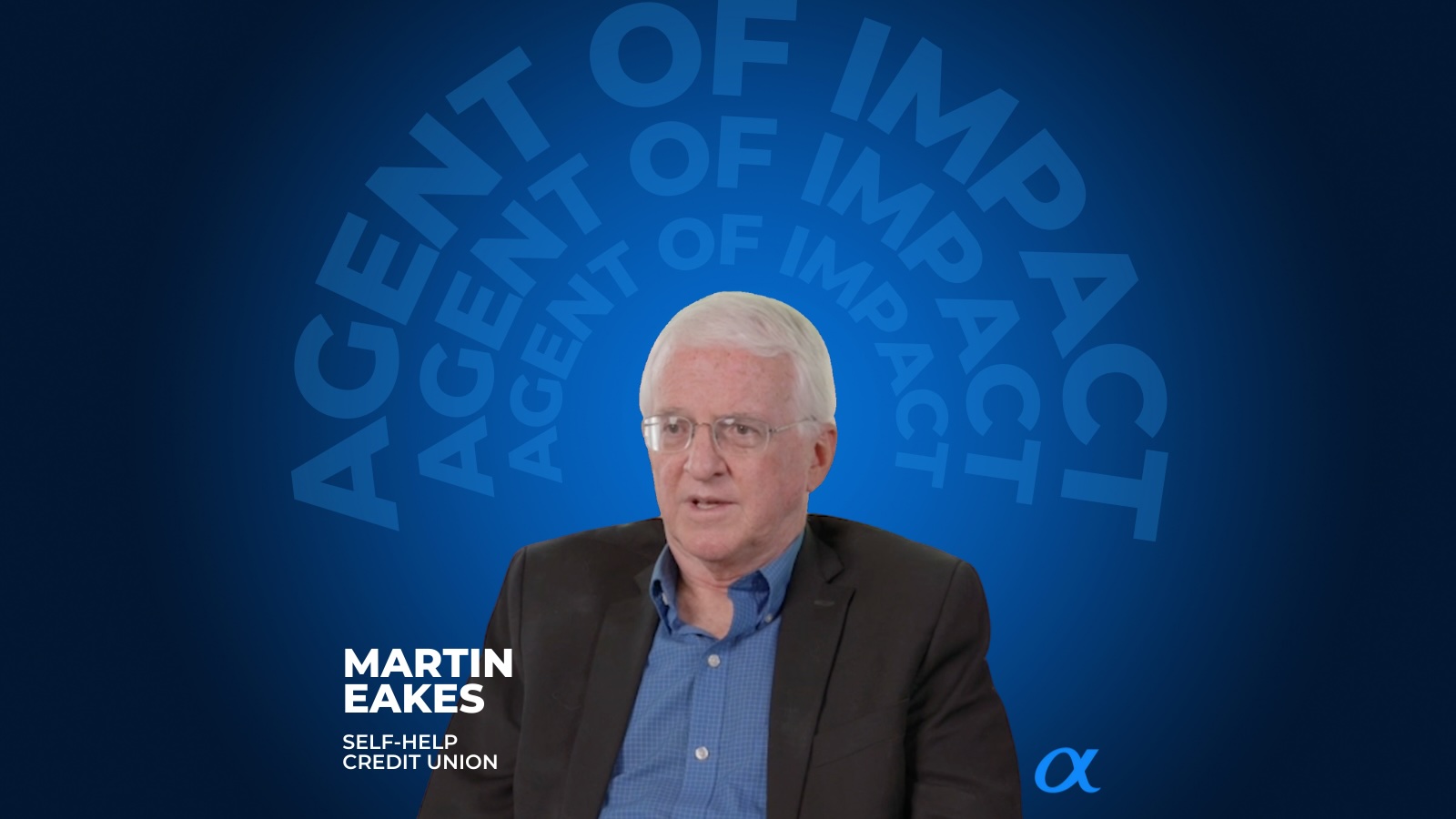


The way Martin Eakes tells it, the first $77 came from a bake sale in New Bern, North Carolina. Churches and other groups soon rushed to make deposits into the new Self Help Credit Union.
Eakes and his wife started Self Help to expand civil rights into economic gains for working families. The original credit union now has more than $2 billion in assets; a second unit in California and other states, Self Help Federal Credit Union, has another $2 billion or so. Together, they’ve delivered more than $11 billion in financing to more than 168,000 families.
“If anyone had ever told me we would become a finance organization, I would have laughed at them,” Eakes tells ImpactAlpha. “We were a civil rights group. That was our calling.”
Self-Help soon expanded to home mortgages. Home equity represented about two-thirds of all household wealth, for both Black and white families, he found. “So, if you wanted to build wealth, you had to start there because that’s where the wealth resides,” he says.
A Self Help study, mostly of single mothers, found that a family starting with $200 in net cash that rented its home over 10 to 15 years had only $400; a family able to get a home loan had almost $40,000 in net worth.
“I became 30 years ago an apostle for home ownership,” he says.
In its first 10 years, Self Help made $100 million in loans to borrowers rejected by other banks, without losing a penny. Given a fair chance, he says, people of ordinary means “can survive and thrive, but not if you put roadblocks up that make it impossible.”
Among the biggest of those roadblocks were extractive subprime mortgages that drained low-income borrowers of what little they had.
Eakes, who grew up in a Black neighborhood in Greensboro, is always up to fight the good fight. Long before the Great Financial Crisis, Self Help’s Center for Responsible Lending took on issues such as exorbitant fees and penalties for pre-payment.
“We became the most hated entity for subprime lenders and for payday lenders in the country,” he says proudly.
Eakes and Self Help again find themselves in the fight. As one of three partners in Climate United, Self Help was geared up to help other community lenders deploy nearly $7 billion in Greenhouse Gas Reduction Funds for energy efficiency, solar power and electric vehicle loans for low-income households, small businesses and nonprofits. With the Environmental Protection Agency now trying to claw that money back, Climate United has gone to court to unfreeze the funds and service its loans.
Climate justice is about more than reducing emissions, Self Help’s Crystal German said when the award was announced last year. “It’s about ensuring that everyone, particularly communities of color and lower wealth communities, can breathe cleaner air, see energy savings, and build resiliency and opportunity.”
And as one of the nation’s largest community development finance institutions, Self Help also has a stake in the fate of the Treasury Department’s CDFI Fund, which the Trump administration has sought to eliminate; with bipartisan support, the fund may escape termination.
“Martin remains one of the nation’s fiercest and most committed advocates for low-wealth families,” says Napoleon Wallace, who worked closely with Eakes at Self Help.
As a white guy working with predominantly Black borrowers, Eakes has a special appreciation for strategies for shared prosperity. He tells the story of a Black woman in Raleigh who told him there was no room in the community for an organization headed by a white man. He says he listened and then responded, “If what you’re telling me is that I can’t help single African American mothers that I’ve spent my life working with, I just need to tell you up front, I’m going to run right over you.”
Her response: “I think I can work with you.”
Eakes says most of his childhood friends “were destroyed economically as the years went on.” Through death threats and political obstruction, Eakes said he has been motivated by the memory of John, his best friend in high school, a charismatic leader who was coaching kids on a playground in Greensboro when a crosstown tough killed him with two shots in the neck.
“When I started Self Help, the pledge I made to my childhood friend was that I would live the rest of my life as if I’m living for the two of us,” he says. “We’ve never stopped, because my friend would have never stopped.”