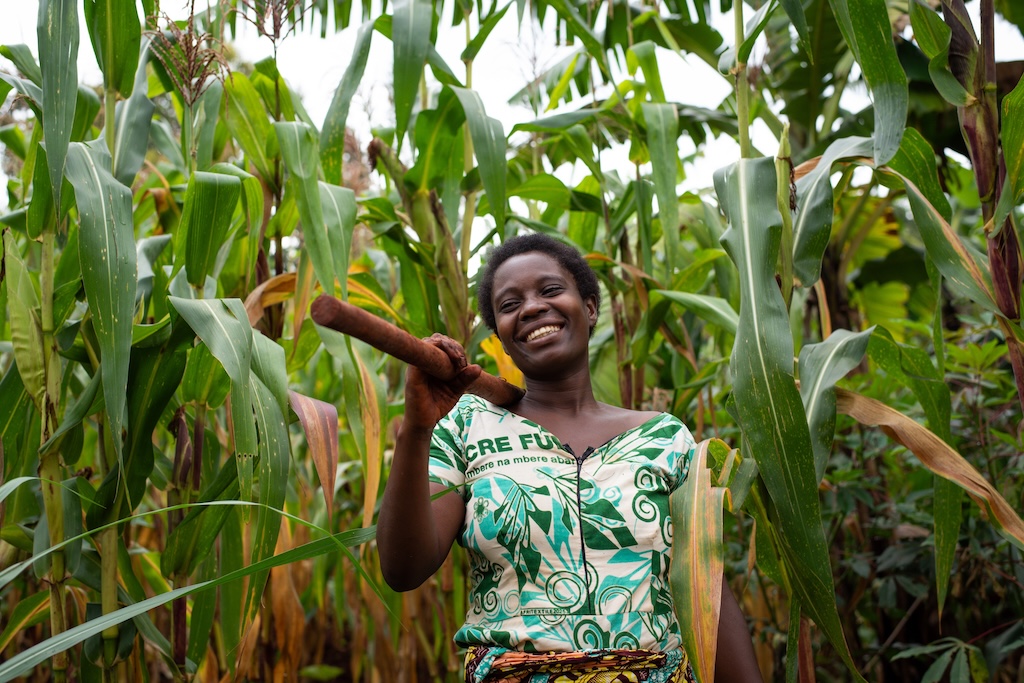
There are more than 50 million smallholder farmers in Africa who are poorly served by a private sector that doesn’t find them profitable enough, and by a public sector that struggles to meet its resource commitments.
One Acre Fund, a nonprofit social enterprise working in Africa, is working to close this gap. It mobilizes working capital finance to purchase farm inputs and other products and sells them to smallholder farmers on credit, with affordable and flexible terms. It uses philanthropic resources to subsidize services such as training and insurance.
In 2020, our team embarked on a bold new chapter. One Acre Fund received a $20 million subordinated loan from a group of catalytic capital investors, including MacArthur Foundation, ELMA Growth Foundation, Ceniarth, Jasmine Social Investments, Netri Fundación, and A to Z Impact, and supported by a guarantee from the Ezrah Charitable Trust. MacArthur’s loan was made to advance its Catalytic Capital Consortium initiative. (Disclosure: The Catalytic Capital Consortium initiative provides support for ImpactAlpha’s coverage of catalytic capital.)
This pool of catalytic capital enabled us to build a first-loss layer into our capital structure to absorb risk for other investors. This subordinated capital opened the door for new investors, bolstered our financing track record and accelerated our ability to grow — with the overall goal of supporting our efforts to empower smallholder farmers across Africa.
Five years later, the results speak volumes. With real-world experience under our belt, we can look back at the original theses behind the deal and see how catalytic capital has reshaped our trajectory.
Thesis No. 1: Catalytic capital will sustain our work and support rapid scaling in existing and new markets.
The results here are a success. In 2019, we reached 2.2 million African farm families. With the additional financing from catalytic capital, we envisioned reaching 10 million annually by 2030. Despite many setbacks — COVID-19, inflation, etc. — we are still on track five years in.
We continue to serve the hardest-to-reach farmers and operate a business model that achieves high-impact returns but cannot achieve full commercial viability. We have proudly maintained our focus on supporting those living in extreme poverty. Our fastest-growing markets this decade – Burundi and Malawi – face some of the highest rates of poverty and climate vulnerability on the African continent. We have also steadily increased our impact and efficiency, providing strong impact returns to catalytic lenders while preserving their capital.
Thesis No. 2: Catalytic capital will open doors for sizable senior debt
The outcome here, again, is inspiring. Between 2020 and 2023 — despite the global standstill brought on by COVID-19 — we held countless exploratory meetings with development finance institutions, or DFIs, commercial banks and investment funds. These doors simply would not have opened without catalytic capital at the table.
Beyond the financial leverage, the visibility and credibility generated by this consortium of lenders created a powerful halo effect that motivated lenders who might otherwise consider loans to entities serving smallholder farmers too risky.
Even when these discussions didn’t lead to immediate investments, they were valuable for sparking future opportunities, giving us insights into blended finance and our value proposition and strengthening our brand in the field.
Thesis No. 3: Catalytic capital will catalyze up to 5X in new senior debt within five years.
Here, the story is more mixed — but still encouraging. We have received new debt commitments three times greater than the catalytic capital loan, a significant milestone, even if 3X falls short of the ambitious 5X target within the first five years.
The gap reflects how complex and time-consuming it can be to finalize senior debt deals, especially as a nonprofit social enterprise. For many lenders, we were their first potential transaction with a nonprofit organization, which meant extra diligence, modeling and negotiation.
While the journey took longer than expected, our pipeline suggests we can achieve the 5x catalyzation during the next phase of this facility.
Thesis No. 4: Catalytic capital will de-risk One Acre Fund by creating a first-loss layer, improving our capital base and attracting lower-cost commercial and DFI financing.
The outcome here is also a partial success. The structure did improve our resilience, but lenders’ concerns extended beyond capital base strength. Our rapid growth, the inherent volatility of our earned revenues, our nonprofit structure and our operations in rural Africa all made lenders cautious. Subordinated debt helped, but it was not enough on its own.
We learned a crucial truth: Since the global financial crisis in 2008, the banking community has faced increasing requirements for risk-based capital. Only guarantees — often from AAA-rated sovereign institutions — provide the level of immediate risk transfer many lenders demand.
Thesis No. 5: Catalytic capital would make us a better borrower.
On this front, the outcome has been transformative. Over the past five years, we have learned about the intricacies of structuring complex transactions and built in-house technical capacity on loan covenants and repayment structures. We have also gained an understanding of the true timelines required from conversation to deal signing and gained deep insights into how lenders perceive our creditworthiness.
Perhaps most importantly, we have built the capacity to manage a diverse group of lenders with varying goals and expectations.
Looking back, we see opportunities where we could have aligned these stakeholders even better—but those lessons are now assets that will guide our next stage of growth.
Building on the momentum
Catalytic capital has reshaped what is possible for One Acre Fund. It opened doors we could not have opened alone, accelerated our reach to millions more farmers and equipped us with borrower knowledge and credibility.
While not every thesis played out exactly as predicted, the collective outcome has been undeniable: Catalytic capital was the spark that set a powerful chain reaction in motion.
Social enterprise models like One Acre Fund are popping up across the continent, and we hope the lessons learned here support these enterprises and prospective lenders to create value-adding, blended finance transactions – and to march closer to a day when no child of a farmer goes hungry.
Clémence Michelsen and Brian Heese work in investor relations at One Acre Fund.
Guest posts on ImpactAlpha represent the opinions of their authors and do not necessarily reflect the views of ImpactAlpha.