
Building markets for lifesaving drugs in Africa. Forging channels for daily products in India. Derisking the clean energy pipeline in coal guzzling South Africa.
In the past decade, British International Investment has deployed nearly $1.9 billion in catalytic capital to deepen impact, inclusion and opportunities for commercial investors in emerging markets. Its tallies of wins and losses so far in its Catalyst program have resulted in a break-even portfolio that meets the organization’s capital preservation requirements, and which will allow it to continue moving capital into investment-deprived sectors, geographies and enterprises.
“It’s still a young portfolio,” couches BII’s Sarah Marchand. “But the signs are that we’ve got an unequivocally high-impact portfolio, and – at a portfolio level – we have the balance to keep making these decisions to do difficult things and to continue to scale it up.”
BII just this week announced the latest Catalyst investment: a $50 million default guarantee, matched by GuarantCo, to help South Africa’s independent renewable power producers secure the revenues they need to start building new clean energy projects.
The program has also impacted BII’s broader investment activities. Catalyst investments now account for about 20% of the organization’s capital deployments, reveals in a new report, “Pioneering catalytic capital: A decade of learning.” A number of Catalyst deals have since graduated into BII’s more mature “Growth” portfolio. The decade-long experimentation with new financial tools, including patient equity, concessional debt, guarantees and technical assistance has also influenced investment decision-making, creativity and flexibility in other divisions.
“It is embedded across the organization. Every team at BII can avail themselves of catalytic capital. And that’s where we wanted to go from the beginning,” says Courageous Capital’s Laurie Spengler, who has served on BII’s board since 2017. “The commitment was there to deliberately, thoughtfully ensure that the entire organization would ultimately benefit from Catalyst, not make it a siloed capability.”
Market building
Until 2014, the impact investing activities of BII (then CDC Group) focused on a £75 million fund of funds strategy. A shove from its sole shareholder, the UK government’s Foreign, Commonwealth and Development Office, or FCDO (then DFID) drove the development of the Catalyst strategy to give BII more flexibility and agency to take greater risk and be more responsive to fund managers’ as well as markets’ and entrepreneurs’ needs (listen to ImpactAlpha’s interview with newly-departed BII CEO Nick O’Donohoe, and read, “An investor’s journey: How CDC Group is innovating with catalytic capital”).
“Shaping nascent markets was the strapline for Catalyst,” says Marchand.
BII in 2017 helped incubate and launch MedAccess with a $200 million equity check — still the largest investment in the Catalyst portfolio — to help bring down costs and improve access to lifesaving drugs and health products in Africa. The organization, which has since been spun out of BII, provides purchase guarantees to drug and health product manufacturers to convince them to enter markets they consider too risky or insufficiently profitable, like Zimbabwe and Guinea Bissau.
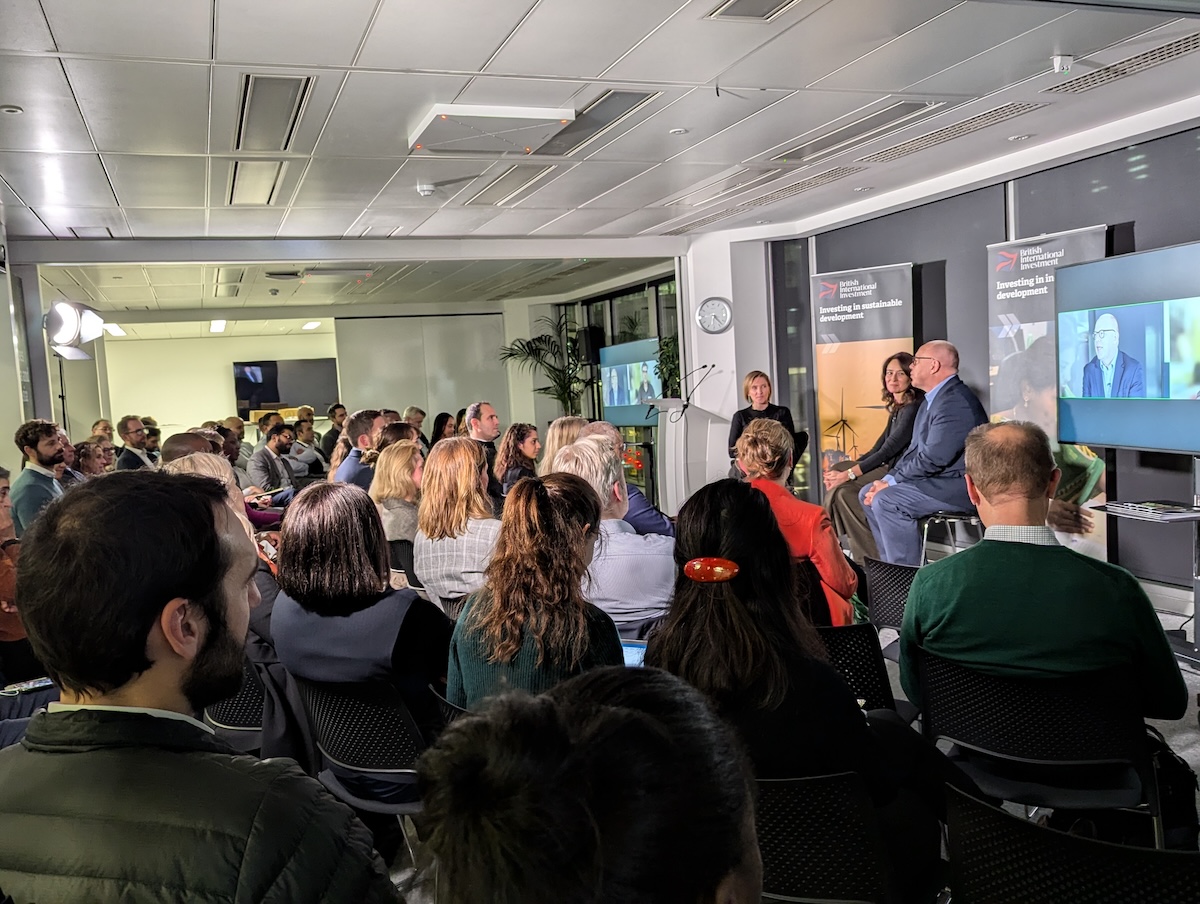
“It’s effectively sales insurance,” MedAccess’s Michael Anderson explained at an event on the Catalyst portfolio hosted by BII this week in London. The guarantees extend for two to six years, which MedAccess hopes is long enough to prove that a high-volume, low-margin model can work and that a competitive market can take root.
“These contracts operate at a very significant scale,” says Anderson.
The dozen or so projects in MedAccess’s portfolio cover several types of HIV tests, improved mosquito nets, treatments for latent tuberculosis (which affects about 25% of the global population) and more. The treatments and products it has supported have reached about 540 million people.
Among its success cases was a guarantee for drug maker GSK to bring its malaria vaccine to market and for UNICEF to secure and distribute personal protective equipment during Covid.
Not all of its initiatives have worked. A guarantee to enable African governments to buy Covid vaccines at reduced prices the Gates Foundation-based vaccine alliance GAVI fell apart, for example. But none of its guarantees have so far been called, says Anderson.
“I’m really pleased that in each case, what we’ve seen is that the guarantee dropped the price equilibrium in the market and therefore, after we leave, competition keeps the price low and the supply high,” he adds.
MedAccess is soon announcing guarantees for several new treatments. Every deal is unique and complex. One learning is that few features of its deals can be easily replicated in new markets or with new products.
“Right now we basically operate on a break-even model,” says Anderson, “so the unique, patient capital from BII is absolutely essential to our operation.”
Fit-for-purpose capital
At the other end of the spectrum, BII in 2020 provided $2 million in equity to Bangalore-based Loadshare, a last-mile logistics company that makes e-commerce and food delivery available to people in India’s smaller cities and towns. The company was founded in 2017 by Raghuram Talluri, Tanmoy Karmakar and Rakib Ahmed after witnessing the emergence of e-commerce in India’s large cities and wanting to expand that access.
“We grew up in these locations, so we had a sense of how value-adding it would be to customers,” Talluri says.
The Series B round in which BII participated closed within days of the Covid lockdown, giving the company runway to pivot and expand and “focus on long-term opportunities” at a time when most other companies were struggling to keep up with a business environment that changed almost daily, explains Talluri.
BII also provided technical assistance funding that enabled Loadshare to experiment with medicine delivery and other new services during Covid.
Four years on, Loadshare is eying a new opportunity: helping its delivery drivers adopt electric vehicles. The Indian government has incentives in place to encourage consumers to buy electric two- and three-wheel vehicles. But financial institutions are reluctant to provide electric vehicle financing because they don’t have enough experience and data to underwrite the loans.
A loan from BII’s Kinetic program, which is even more flexible and can take even more risk than Catalyst, is helping Loadshare procure and finance EVs for its drivers. Loadshare is finding that the lower cost of operating EVs, because of fuel savings, is attracting drivers from lower-income backgrounds than its core fleet. The EV initiative is therefore demonstrating its social impact and economic inclusion potential alongside environmental benefits, says Talluri.
To accelerate broader EV adoption in India, BII’s loan agreement requires Loadshare to share data with other financial institutions to help lenders become more familiar with the market.
Rethinking risk
The Catalyst team has faced some hard lessons. Investments in Afghanistan made before the Taliban returned to power, and in Myanmar before the military coup, had to be written off. A few investments in Africa’s chronically under-funded agriculture sector didn’t pan out.
“We’ve learned not to layer too many risks on top of each other,” says BII’s Maria Smith. For example: a closed-end equity fund with a new fund manager in Africa’s agriculture sector. Geopolitical shocks are a reality in many of the key markets development finance institutions serve.
“The role of DFIs is to work in these markets and also to be counter-cyclical – to double-down with investees during challenging macro times,” says Smith. That’s what Catalyst has done with investees in Egypt through its current economic crisis and Bangladesh through its current political crisis.
”You’re not going to be able to mitigate all of these potential risks, but if you build a diversified portfolio – and I think the Catalyst portfolio shows that – you’ll have winners as well,” Smith adds.
Over time that changes an investor’s risk perception and appetite.
“What you perceived previously as high risk becomes familiar risk. You deploy the capital more confidently,” says Spengler.
Deals that once qualified as a Catalyst investment, like Indian agtech and impact investment funds Omnivore and Ankur Capital, now align with BII’s Growth portfolio.
The question then becomes, “Where does that take me next? How do we take more risk?” Spengler says. “Those are the conversations we’re having to make sure we remain at the forefront, because the impact industry is evolving.”