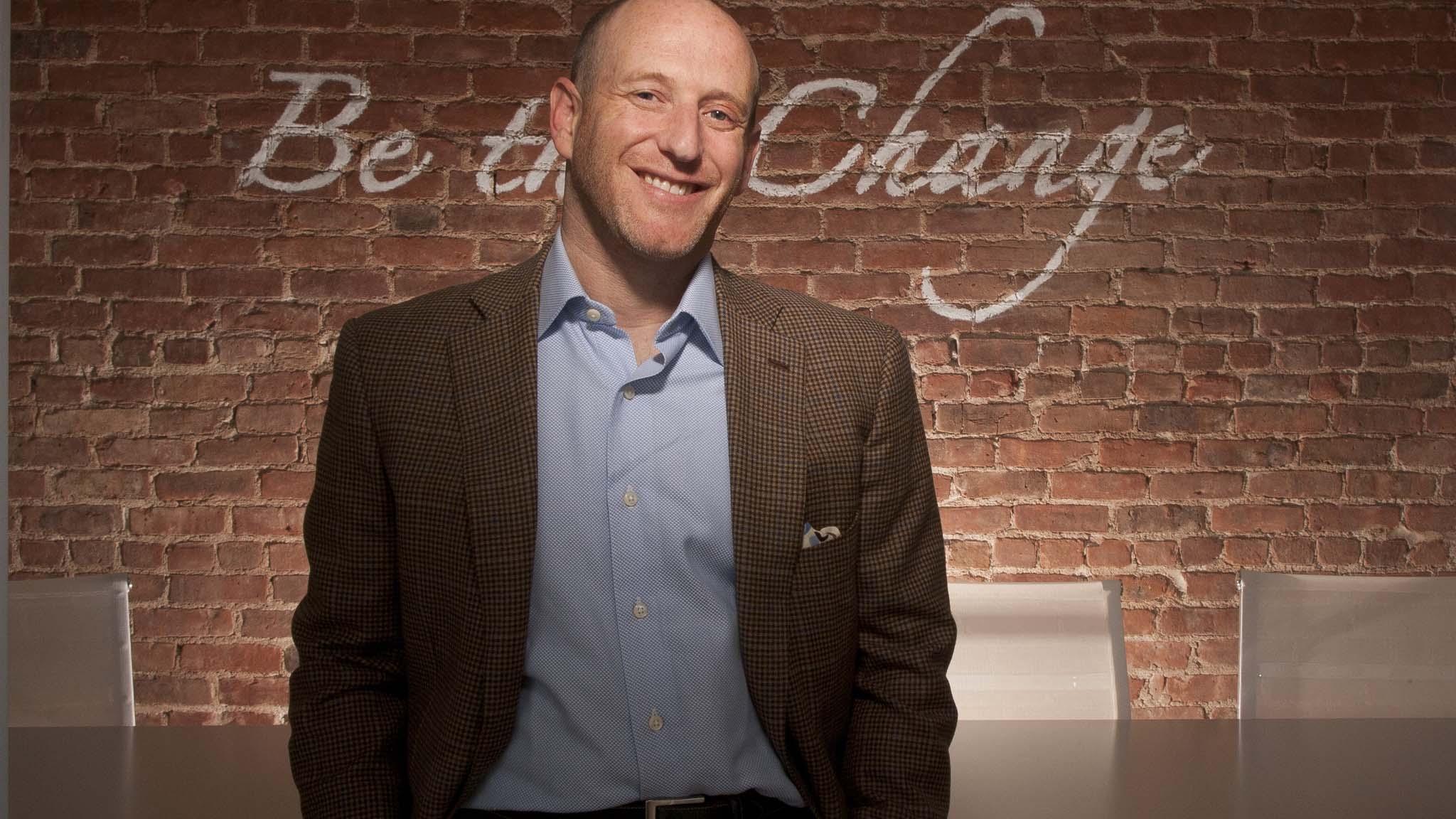


Andrew Kassoy, co-founder of B Lab, died last week at age 55 after more than two years with advanced prostate cancer. With permission from B Lab, ImpactAlpha is republishing Andrew’s 2007 essay (originally published by Wealth & Giving Forum) to honor his early vision that helped spark a movement to align capital with purpose.
My wife says that I am a painfully deliberative decision maker – I guess this is a reasonable conclusion for her to draw after spending four hours at REI, the outdoor-gear store, watching me investigate backpacks. While I aspire to be the guy who experiences immediate and life-altering epiphanies, in fact I require lots of time, and lots of trial and error, to absorb information and make reasoned decisions about my course of action. And so it was with my decision to devote my life’s work to social entrepreneurship.
I have spent my entire career in private equity and real estate, investing several billion dollars in the United States, Asia, and Europe, and accumulating wealth along the way – more than most, probably less than many readers of this compendium. In August of 2001, I was awarded a Crown Fellowship by the Aspen Institute to join a group of twenty individuals from the private sector to spend six weeks over the course of two years exploring values-based leadership. Two weeks after my first session in Aspen, I watched the tragedy of 9/11 from my apartment in SoHo, less than a mile from Ground Zero. This experience marked the beginning of a slow-burning epiphany about my need to define my values, to live consistently with them, and to use my capital purposefully to that end.
Grab a pencil and write in the margin your response to the following question: What is the purpose of my capital?
For me, this question crystallized slowly as I wrestled with a series of dilemmas that I would like to share here. A quick summary: In recent years, nonprofit and for-profit social entrepreneurs have generated recognition as crucial change agents who spark social progress, often by interacting with or attempting to mimic traditional capital markets. They are creating a hybrid marketplace of enterprises that range from nonprofits run with an entrepreneurial business style to for-profits driven by a social mission or “do no harm” ethos. The evolution of these social-purpose capital markets raises questions about our values: What is the purpose of capital? Should our decisions about investment and consumption incorporate values other than price and financial return? Is charity dead? Should programs for social change be subject to the same competitive market forces that traditional capital markets are? Is government no longer capable of leading social change? Can private enterprise be harnessed for public benefit?
The evolution of social-purpose capital markets also raises more practical questions about achieving scale and measuring impact: To have an impact, do we need a market infrastructure with new regulations, tax laws, and market norms, along with a dedicated financial-services industry? Will this infrastructure evolve organically, or can it be rapidly purpose-built? What role should foundations or individuals play through either giving or investing their capital? What tools for due diligence, reporting, standards, transparency, and measurement are required to incentivize capital providers to invest or give their capital responsibly?
While I was working hard and accumulating wealth throughout the 1990s, I wasn’t blind to the growing gap in access to the American Dream. I saw that unprecedented wealth was being generated by a few. I had always felt a deep sense of empathy for people who were suffering or making do with less than they needed. Like many affluent Americans, I was generous in my charitable giving. At the beginning of our marriage, my wife and I started a small donor-advised fund and tried to figure out who could use the money. For the most part, we gave it to big national organizations we had heard of or to local organizations that tugged at our heartstrings. But simply writing checks to charities still left me with a deep desire to obtain more meaning in my life.
The closer I got to financial success, the more it seemed that the traditional definition of the American Dream was far too narrow. I started to notice a schizophrenic behavioral pattern in myself. This pattern is, I believe, pervasive in our society today. On the one hand, I was participating in a unique period of explosive growth in global capital markets, entrepreneurship, and technological innovation, one that was generating incredible wealth for some and progress for many (and stagnation for many more). On the other hand, I was trying to find meaning through charitable giving, specifically by helping to solve some of the same problems this explosive growth was engendering.
Citizen sector
I need a new framework to reconcile success and significance. As I searched, I realized that a seemingly disparate and rapidly growing group of voices protesting this paradox in our society – Christian evangelicals, socially responsible investors, environmentalists, conscious consumers, engaged philanthropists, human-rights activists, and community volunteers – were all expressing the same deep desire to take control of their lives and their society in a purposeful way. These people were all trying to remedy the injustices being stimulated, or left unattended, by globalization and rapid economic growth.
It took me a few years to see this clearly. But in 2004, I found the right words to describe the spectrum of voices demanding a society that behaves more consistently with their values. Bill Drayton, of Ashoka, a visionary mentor and field builder for social entrepreneurs, calls that spectrum of voices the citizen sector. The citizen sector encompasses vast numbers of people who sense our essential interdependence – even if they might not call it that – and are engaging in some form of active citizenship. They embrace both individual responsibility and civic duty.
As Paul Hawken, the entrepreneur and author, says, “The time for heroes is past; it is up to all of us.” The leaders of the citizen sector are not the politicians or movement activists – the “heroes” of the past. They are entrepreneurs in the purest sense of the word. They are innovative and competitive; audacious and pragmatic; laser-focused on performance, measurement, and efficiency. Above all, they aspire to excellence. But they are totally driven by a mission. For them, the words nonprofit and for-profit rely upon a meaningless distinction. The only question is which approach will best achieve their targeted social ends.
I was introduced to social entrepreneurship through an organization called Echoing Green. I fell in love with the organization’s work and quickly joined its cause as a board member. Echoing Green is a nonprofit, but it functions more like a venture-capital fund, providing seed capital to social entrepreneurs. It has a twenty-year track record of identifying the most innovative ideas for social change and the most talented entrepre-neurs who can turn those ideas into reality. In addition to seed capital, Echoing Green provides its social entrepreneurs with technical support, it finds them mentors and additional sources of growth capital, and it gives them a network of relationships upon which to build their organizations. The results would make a top-tier venture-capital fund jealous. In Echoing Green, I found both inspiration and results. I became so deeply involved in helping it grow and in mentoring its fellows that it became more of a part-time job than a conventional board position.
Echoing Green also gave me a window on the nonprofit sector, and what I saw, while often inspiring, was also discouraging for an experienced investor like me, for two reasons: the systemic barriers to innovation and the lack of infrastructure to allow the sector to scale up effectively. The systemic problem with innovation is a legacy of the pre-globalization era, during which society was divided into three distinct sectors – public sector/government, private sector, nonprofit sector – separated by imposing walls that acted as barriers to social innovation.
In this tripartite system, government used public policy to address social issues at a macro level while nonprofits provided charity for those who couldn’t help themselves or were ill served by public policy. The job of the private sector was to create jobs and to generate profits for entrepreneurs and shareholders to use as they chose. In this model, social entrepreneurship was simply categorized as nonprofit work, diminishing the revolutionary impact it will ultimately have as we tear down the walls between the sectors. Innovation is impeded when social entrepreneurship is simply categorized as nonprofit-sector work.
The other problem I found in the nonprofit sector was the absence of infrastructure to allow the best ideas to scale up. In fact, the nonprofit sector is terribly fragmented. There are 1.4 million nonprofits in the United States alone, with a combined annual budget of $1.3 trillion, most of which is funded by government reimbursements for health care and education (only $220 billion comes from individuals and only $40 billion from foundations). Seventy-three percent of public charities have a budget under $500,000. There are too many nonprofits competing for capital primarily from individual donors in a sector that is only around 5% of GDP in the first place. On average, nonprofits spend 25 to 50 percent of their budgets just raising capital.
The nonprofit sector, I learned, has few standards with which to measure impact; no common comprehensive reporting package; minimal competition (other than “not invented here” replication); no creative destruction to redirect capital from less effective to more impactful programs; few breeding grounds for future leaders and managers; minimal collaboration among foundation donors; few pooled-fund vehicles with sector expertise to aggregate capital from numerous donors and allocate it effectively; and, to the great detriment of the sector, an underwhelming supply of service providers to do research, administration, agency and principal banking, and so many other tasks – service providers that are readily available in the global capital markets and facilitate the flow of money there.
I started to work extensively with several Echoing Green fellows who had created novel business models to address some of these issues. Sara Horowitz, a former labor lawyer, had created Working Today, a health-insurance provider for independent workers who don’t have the benefit of affordable coverage from employers. Originally created as a nonprofit, Working Today was addressing systemic social issues – shifting employment patterns toward contract and part-time workers without benefits, the working poor, young workers without health insurance – with an innovative business model that could be scaled to address a large population in need. Sara had developed such an attractive model that she was actually making a profit while providing health insurance at 33 to 50 percent discounts.
We developed a business plan to transition Working Today into a for-profit business that could access capital to grow faster. Predictably, however, potential investors wanted to know why we weren’t increasing premium rates and operating margins. They also wanted to control major decisions, such as the sale of the company. In other words, all they saw was another investment opportunity with a brilliant entrepreneur in a growing market with limited competition – but what about our original mission? We wanted to be profitable in order to be sustainable. Most investors, however, did not share our social goals.
We have found only a few foundations and socially motivated investors who have agreed to invest in a preferred-equity instrument that offers a bond-like maximum return, a long maturity period, and no control of the business. This limited pool of capital is a drop in the bucket when compared with the vast resources available in capital markets. Some foundations and donor-advised funds will make investments in mission-driven businesses like Working Today as program-related investments (PRIs). These are funds drawn from the foundations’ annual 5% giving budgets (currently about $40 billion), which means the PRI will squeeze out funding streams to other nonprofits. Furthermore, this annual payout accounts for only 3%t of the charitable sector’s budget.
Even fewer foundations will make a mission-related investment (MRI) in a venture like Working Today, which would mean using a portion of the foundation’s investment capital (corpus) normally allocated to pure market investments. Less than 1% of the $600 billion of foundation capital invested annually is allocated to MRIs. Depending on how you look at it, that 1%, or $6 billion, is about 0.025% of the $20 trillion invested in the U.S. equity markets, or 2.3% of the $260 billion of annual charitable giving. Either way, it simply won’t have a big impact, particularly relative to the remaining 99% of foundation assets that are invested using traditional portfolio-allocation theory and risk-adjusted-return models to maximize endowment growth over time and ensure foundations exist in perpetuity.
There are at least two problems with this approach. First, almost 100% of foundation assets are dedicated to growth for the sake of growth, potentially forever, with an unknown use of the increased value at an unknown time in the future. I believe the world needs more help right now. Second, with $600 billion invested in the market, some portion of a foundation’s capital is likely to be invested in businesses that contribute to the very problems the foundation is trying to solve (the extreme hypothetical example being a lung-cancer research foundation that invests in tobacco stocks). Shouldn’t foundations, whose purpose is to provide a public benefit, use their capital for public benefit, or at least not to counteract public benefit?
Individuals and infrastructure
I found the same issues in my own portfolio. As an experiment, my wife and I decided to reallocate the capital in our very small foundation (which was also a small percentage of our net worth) to mission-aligned – or at least non harmful – investments. I looked at the holdings of socially responsible-investment (SRI) mutual funds and found some tools for negative screening – removing clear offenders in industries I deemed harmful – but most of the $179 billion in these funds does not contain much that is positively mission-related.
I also looked at many double- bottom-line (DBL) and triple-bottom-line (TBL) private-equity funds – funds that incorporate social, environmental, or governance impact into their investment decisions – and found very few clear standards or measurement tools. There are about one hundred of these funds with only $1 billion total in capital, a rounding error on any scale in the private equity or public capital markets. Furthermore, almost all SRI and DBL funds claim that there is no sacrifice of financial return in their strategies (you can have your cake and eat it too), a claim that I found dubious on its face, but which also made me uncomfortable based on my Working Today experience. After all, shouldn’t we sacrifice some financial return for social return?
And finally, the ultimate reality check: Was I actually willing to invest my entire portfolio in Working Today, and a few other similar businesses, at a modest 5% return?
Give me the benefit of the doubt briefly and assume you can measure the social and environmental impact of an investment and therefore a combined financial-social total return. Now, pick up your pencil again and answer the following question:
How would I allocate my entire portfolio of investment capital among the following range of opportunities?
For this exercise, combine your family capital and any foundation-type capital, exclude what you need to live on, and assume the financial returns in parentheses.

As my wife and I discussed this conundrum, the schizophrenia of our life became extremely clear to me. Americans are very generous with their wealth in comparison with citizens of most countries. But most of us don’t connect the different compartments of our lives into a whole. Our philanthropy, even as it becomes more engaged and more impactful, is rarely consistent with our investment decisions. And neither our philanthropy nor our investment patterns are likely to be connected to our consumption decisions. It gradually dawned on me that we might solve some of our larger social problems and have a happier society if we all gave, invested, and consumed consistently. But harmonizing these three areas in reality is damned hard, maybe impossible.
So what to do? We did move our foundation’s assets into a donor-advised fund, at RSF Social Finance, because it had a team of professionals who analyzed mission-aligned investment opportunities. However, I can’t say what impact we are having on problems we care about, or whether we are getting market-average or below-market-average financial returns. I do, however, know that we are doing no harm with this small part of our wealth (I can’t say the same for the rest of my portfolio).
Traditional capital markets have developed over hundreds of years to allow us to allocate capital efficiently. These markets are also supported by a sophisticated infrastructure of regulation, legal and tax structure, service and capital providers, and exchanges to trade every conceivable financial instrument. These markets are scaling globally at an unprecedented rate, and this affords them enormous impact. But there is a glitch: Capital markets aren’t people, and they don’t have values.
The good news is that capital markets are driven by capital, and capital, when we look through the layers of intermediaries, is ultimately owned by individuals – individuals endowed with the freedom to make choices about how they will use it. It’s at this individual level that I believe we have the opportunity to choose to infuse our capital with purpose. The goal is therefore clear: We must build a marketplace where it is possible for individuals to do the right thing. This mission-oriented or sustainable for-profit sector must have a broad system of standards for defining socially responsible businesses that investors or consumers can rely on if they want to align their investment and consumption decisions with their values.
There must be legal structures to allow the consideration of stakeholders other than shareholders; a marketplace for an entrepreneur or a venture-capital investor to seek liquidity while ensuring that the social mission continues; an effective means for individual investors whose capital is invested on their behalf through pension funds or other financial intermediaries to demand an alignment between their investments and their values; and a way to measure the positive and negative impacts of those investments. In short, we urgently need a system that makes being good easy for investors, donors, consumers, and entrepreneurs.
Birth of B Corps
Two years ago, I spent a few days with Jay Coen Gilbert and Bart Houlahan, two friends of mine with whom I have been close since we lived together some twenty years ago at Stanford. Jay and Bart are entrepreneurs who, along with three other partners, grew a business selling T-shirts out of their apartment into a $250 million global basketball footwear and apparel company called AND 1. They had carefully built their values into AND 1’s DNA, compensating employees generously and distributing ownership broadly, providing good benefits and giving away a percentage of AND 1’s profits.
When I visited Jay and Bart, they were in the midst of selling the company. And as the process unfolded, it became clear that the highest price was going to come from a buyer who saw numerous opportunities to profit by altering the firm’s DNA. Jay and Bart were distraught, but this was the system for which they had signed up in raising earlier rounds of capital.
We talked about starting a new business together that would have a mission focus, but we knew systemic issues would stand in our way. While for-profit social entrepreneurship, SRI, and conscious consumerism have reached a critical mass, the current marketplace is confusing and fragmented, with no standards for social and environmental performance; it’s nearly impossible to distinguish good companies from good marketing. Furthermore, there is a system-design problem: Corporations are required by law to maximize shareholder value, often at the expense of employees, communities, and the environment. This makes it difficult for profitable, beneficial businesses to maintain their missions as they scale.
We realized that the market needs an organizing platform to accelerate the development of a new sector of the economy, one that harnesses the power of private enterprise to create public benefit. This platform must first make it easier for consumers, investors, and policymakers to support good companies; and second, create the legal framework for a new type of corporation that creates benefits for all stakeholders, not just shareholders.
Jay, Bart, and I decided to start B Lab, an organization whose mission is to support a new kind of corporation, the B Corporation. B Corporations are unlike traditional responsible businesses because they meet comprehensive and transparent social and environmental performance standards; incorporate the interests of employees, communities, and the environment into their corporate-governing documents; and build a collective voice through the power of a unifying brand.
By becoming a B Corporation, an entrepreneur can stand out as a leader and differentiate his or her business through the billions of dollars of collective market presence and millions of dollars of marketing spent annually to promote B Corporations. The B is for the public benefit these businesses create.
To build this marketplace with integrity, we decided B Lab must be a 501(c)3 nonprofit organization. B Lab supports B Corporations by certifying them as businesses that have achieved a minimum score in the B Ratings System, a survey of a company’s social and environmental performance across its entire range of products, practices, and profits. B Lab also disseminates a legal framework to institutionalize stakeholder interests within existing corporate law, promotes B Corporations through a unifying brand, and develops a mission-aligned capital market. B Lab will be self-sustaining through licensing revenues, and we hope B Lab’s success will accelerate the development of purpose-driven capital and consumer markets.
I am also working with several groups that are trying to build parallel infrastructure for nonprofit social entrepreneurs to allow more capital and more talent to flow into the sector. This requires very unglamorous work, like designing new regulations, metrics, standards, ratings, and exchanges; seeding and building research organizations, professional-school curricula, and research firms and ratings agencies; building financial intermediaries with due-diligence and distribution capabilities; and lots of “herding cats” (convincing existing organizations and individuals that they will all do better by participating in the same marketplace).
Declaration of Interdependence
A generational vision would be to integrate these social-benefit capital markets. Nonprofits have always relied on philanthropy, and the private sector has always functioned on the basis of risk-adjusted returns and modern portfolio theory. Now we can begin to think about what author Jed Emerson calls blended value. This means targeting the highest risk-adjusted returns on our capital, but with a return definition that measures social, environmental, and financial value creation, and with a risk definition that incorporates financial factors as well as externalities that create costs for society.
To translate that into everyday language, our capital can be deployed all along the spectrum, from pure philanthropy (negative 100% financial return combined with potentially high social return) to for-profit investment with acceptable financial return and some level of positive social return. I would like my personal capital allocated across the entire blended-value spectrum, but I am far from achieving this goal.
I have been a pragmatic investor for a living, so I realize that these are audacious objectives. Some of my peers in the private sector, particularly those under pressure to meet short-term performance targets, scoff at the notion of allocating assets by any measure other than maximum financial return. But I believe they are simply failing to calculate the real long-term returns on their investments. In any event, the transformation in values and market infrastructure I have outlined will not be completed next year, or even in ten years. Changes in systems and values are rarely rapid. Nonetheless, we must start somewhere, with individuals who choose to plant a flag out where the buses don’t run – yet.
As I complete this essay, on July 4, 2007, reflecting on the commitment of the Founding Fathers 231 years ago, it is clear that we have reached a new moment of opportunity. It is time for all of us to sign a Declaration of Interdependence, grounded in both the hard realities of our time and the transcendent capabilities of humanity. I have come to believe this so strongly that I recently left behind the ongoing wealth-creation opportunities of the private sector to dedicate myself to building B Lab and the broader social-benefit capital markets. The purpose of my capital now is to help build a marketplace of ideas, talent, and capital that will improve the condition of every human being and the earth we collectively inhabit.
Andrew Kassoy was a cofounder of B Lab. He passed away in June, 2025 at age 55 after more than two years with advanced prostate cancer.