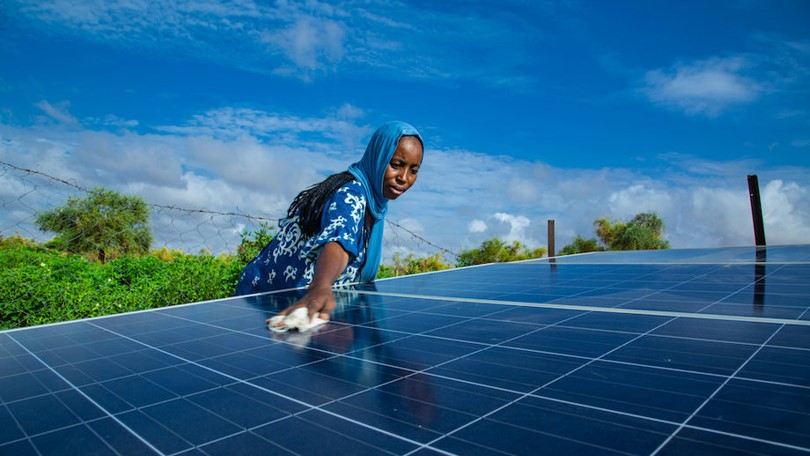

Five years ago, the practice of applying a gender lens to climate investing was still nascent. The argument was clear: if you wanted to uncover new market opportunities, mitigate risk, and build durable businesses, you had to account for the needs, innovations, and participation of the full population. But the discussion was still mostly conceptual, hashed out in working groups and field-building conversations such as the Gender and Climate Investment Working Group launched in 2020 by the late Suzanne Biegel and peers across the field.
Their vision is now material. Gender-smart climate investing is a market in motion, with more than 150 private market funds active at the intersection of climate and gender, and more than 70 are currently raising. Pipelines are broad, strategies span the risk-return spectrum, and the evidence base has grown to the point that this can no longer be dismissed as an experiment at the margins.
Heading for Change, the catalytic endowment Suzanne created in her final year of life, was designed to accelerate this market shift. Our mission is threefold: to invest in leading climate and gender funds and share our process so that others can do the same; to contribute to the evidence base for gender-smart climate investing; and to provide catalytic grants to initiatives that could grow the field.
Together, this “capital-plus” approach — combining investment, grant-making and field building — reflects the systemic strategy needed to spur lasting change. This week, we released Climate and Gender Investing in Action, which distills our learnings from the past two and a half years.
Meet the funds that are leading the way
In GenderSmart’s landmark 2021 report on gender and climate investing, Suzanne and other field builders outlined how gender could support investors to find new opportunities, mitigate risk, drive long-term value, amplify impact, and better meet fiduciary duty.
What felt conceptual in 2021 is now visible in practice, with a growing body of funds demonstrating how these principles sharpen climate investing:
- Nordic-based Unconventional Ventures backs underestimated founders in high-impact sectors — including climate — advancing solutions mainstream investors often miss. Its portfolio ranges from clean energy innovators to companies tackling emissions in overlooked industries.
- KawiSafi Ventures in East Africa demonstrates how gender-smart design strengthens business models and profitability. By investing in companies that tailor their products and financing to the realities of women customers, KawiSafi expands adoption and enhances long-term growth.
- Circulate Capital integrates women waste pickers working in the informal economy into formal recycling supply chains across Latin America and Asia. The approach improves livelihoods while securing reliable streams of recycled plastic for corporate buyers, deepening both equity and market resilience.
- MCE Social Capital finances climate adaptation for smallholder farmers, many of them women, by improving access to water systems, renewable energy and financial services. The result is stronger household resilience and more secure food systems in the communities most exposed to climate shocks.
- Just Climate treats climate, nature and inequality as financially material factors. Its approach illustrates how integrating equity considerations into climate strategies strengthens long-term competitiveness and systemic resilience.
These are not funds that treat gender as a compliance metric. They are managers who use gender to deepen their investment practice: to design products that work, to identify markets that others miss, and to build companies more likely to scale and endure.
Ready for more capital to flow
What stands out in our new report is not just the logic of climate and gender investing but the abundance of opportunities. There are more than 150 funds across geographies and sectors, each showing in its own way how gender analysis sharpens climate investing. For those who want to see what this looks like in practice, the examples are rich and inspiring — ranging from clean energy and sustainable food to circular economy and advanced manufacturing. It is a field with depth, diversity, and momentum.
The urgency, of course, has never been greater. Climate change is a present reality reshaping every corner of our economy. Yet climate finance still falls short — not only in volume, but in distribution. Too much remains concentrated in mitigation, and too little reaches the people and communities on the front lines of climate impact. What offers hope is that the opportunity to invest in a different way exists, and the evidence is increasingly robust. There are managers already doing this work and doing it well — and they are ready for more capital to flow.
Investors face a choice. They can hold back, waiting for someone else to prove the case further. Or they can recognize that the market is moving and that they have the opportunity — and the responsibility — to bring it to scale. Early catalytic funders helped to lay the foundations for the abundance of climate and gender investment opportunities that exist now. The next wave of investors can now accelerate the transition by moving capital with urgency and foresight.
Gender-smart climate investing is not a side note. It is a strategy for building stronger portfolios and more resilient economies. The opportunities are here, the managers are ready, and the time for investors to step up is now. The next chapter depends on how boldly we scale this momentum.
Sana Kapadia is the chief catalyst at Heading for Change. Rachel Hills is a strategic communications consultant at Heading for Change.