
Democratic backsliding rarely arrives as a coup.
It comes through the slow consolidation of economic and institutional power – the narrowing of who can access resources, whose voices shape systems, and which communities can build durable futures.
The current US political trajectory offers a vivid, live case study in this pattern. As autocracy takes hold and public institutions are dismantled, our communities have been left with a massive gap in funding and resource access.
Those who work in impact have a choice: Watch as decades of work are unwound, or step up to meet the moment. The broader “Antidote to Autocracy” series, of which this piece is a part, was developed to counter this alarming retreat and to equip our industry with the tools to fight back.
If impact capital is going to function as democratic infrastructure, its practitioners and its operating mechanics must embody the values we espouse. If impact investors are to attain their goals of systems change and optimizing for net positive impact, we must be courageous with our capital investment strategies and practices. We must be courageous in this moment.
It is time we take an honest look at the systems and structures we’ve built, and have the courage to modify them to meet the moment. The issues discussed below are not new, and have persisted in our community through decades of political and social change. Today’s reality offers a unique opportunity to reflect and do better, so we can fill the void left by dismantled public institutions.
Cowardice masquerading as fiduciary duty
To be clear, some in the impact community are stepping up. Last year’s “Unite in Advance” campaign rallied hundreds of philanthropies to “reject attempts to exploit political violence to mischaracterize our good work or restrict our fundamental freedoms, like freedom of speech and the freedom to give.”
As McKnight Foundation’s Tonya Allen said at this month’s Mission Investors Exchange conference, “When you’re in unpredictable times, this is not the time to shrink, but the time to get bolder.”
Allen said the popular response in Minneapolis, where McKnight is based, taught her “that democracy is fought on doorsteps, on neighborhood streets, on commercial districts. We have to bring our fight to the places where they’re coming.”
Unfortunately, much of the community is taking the opposite approach. Whether framed as risk management, fiduciary duty or “quiet leadership,” a majority of foundations, family offices, endowments, high-net worth individuals and other allocators are slow-walking if not delaying their deployment of capital as an intentional choice in the face of rising autocracy. They are avoiding hot-button topics like DEI and shifting their investments and catalytic capital toward areas perceived as “safe.”
This caution is frequently laundered through the language of fiduciary responsibility. But fiduciary duty has never been purely financial. In a moment of civic crisis, a narrow, traditional reading of fiduciary duty becomes a political act. Today’s fiduciary duty must account for the the harm of extractive processes, the systemic risk of delayed capital deployment and the cost of inaction.
We can not, and should not, accept this posture, not while decades of our community’s work are erased.
Mechanics of courageous capital
Every allocator will need to reflect on their practices to best evaluate how they can meet the current moment. At minimum, we should:
Reframe the recipient as a constituent. Embedding anti-authoritarian and pro-democratic practices in impact investing starts with a shift in how we relate to and engage with those seeking capital.
By reframing the recipient as a constituent, not a supplicant, we have the opportunity to improve longstanding roles and relationships and increase transparency and self-empowerment. Investment processes should be built around the nonprofit, startup or fund manager—not simply the asset owner, board or donor, and not the investment committee’s comfort level. In a democratic frame, the recipient is a constituent whose time, dignity, and resources deserve institutional respect.
Act with courage. As public institutions, and those aligned with the autocratic regime, make equity, climate, health and other urgent issues controversial and political, we must respond in kind and recommit to those issues publicly, with conviction. This is not the time to hide, but the time to act and speak truth to power whenever possible.
Accelerate capital deployment. Slow deployment is a wealth filter, and it carries a substantial societal opportunity cost. Founders with existing capital networks, credentialed advisors, and patient runways might survive a 12-month diligence process. First-generation founders, community-based fund managers, and early-stage social enterprises generally cannot.
As autocracy continues to take hold and public resources dwindle, an allocator’s speed and quality of process may no longer be somehow justified as operational virtues—they are equity interventions.
Recommit to inclusion. Autocracy’s dismantling of public systems has dramatically deepened the racial, gender, and class divides facing our society today, demanding an even stronger response from the impact allocator community.
If we hope to have lasting and sustainable impact, we must publicly recommit to equity and inclusion. This commitment must address who makes decisions, who receives capital, how diligence is conducted, and how funding is structured and priced.
In the current political environment, the pressure to retreat from these commitments will only intensify. Holding the line here and now has become a civic obligation, not just a moral one.
Align process with today’s urgent reality. Moving quickly is just one piece of the puzzle. As society tilts towards authoritarianism, we have a unique opportunity to practice democracy across our entire investment process. That includes:
- Clear processes and established timelines. The investment process should be defined up front and allocators should maintain those timelines to the best of their abilities. This enables the recipient to effectively plan their operations and fundraising to efficiently deliver the impact allocators seek. Any ambiguity becomes a tax. Opacity is a power move, whether intentional or not.
- Efficient onboarding and underwriting. Intake, underwriting, and reporting should align to the quantum of capital being deployed. Complex diligence and intake forms are a disproportionate burden on under-resourced organizations, especially now. We cannot afford to drain founders’ already limited time and capacity with misaligned diligence and endless forms. We must critically evaluate how much of our process serves the mission versus merely satisfying institutional comfort.
- Consistent and transparent communication. Proactive transparency is not just a courtesy—it’s a signal of who you believe deserves respect in this relationship. If a founder has to chase an update, the allocator has failed.
- Simple, standard legal terms. Novel deal structures invented to signal sophistication impose disproportionate cost on under-resourced recipients. Standard instruments exist because they work. Complexity kills deals and concentrates advantage among those who can afford to navigate it.
Recommit to radical accountability. Last but not least, we must do a better job holding ourselves accountable and listening to our constituents when our processes fail. Accountability comes in two main forms: creating safe pathways for feedback and building incentive structures for managers and allocators to internalize and act on such feedback.
Recipients of impact capital rarely feel safe offering honest, public critique of the allocators they work with. Not because they lack opinions (they have plenty!) but because the professional cost is too high. This is not a soft cultural problem. It is a structural power problem mirroring the same dynamic that makes it so hard to build systems of accountability in autocratic political systems. This must change:
- Make the cost of inaction—the cowardice tax—visible.
- Exact a cost for the retreat from stated values.
- Encourage and support the deployment of courageous capital!
We should start by making it standard practice to ask for feedback—and to genuinely welcome it. We can implement standardized, anonymized feedback mechanisms such as those championed by 60 Decibels, through which all founders and fund managers (those we fund and those we don’t) rate us on speed, transparency, and genuine support of the strategy.
Those who hold the purse strings for allocators should encourage funds to publish this feedback, alongside metrics like Time to Term Sheet, Time to Wire and Time to No in their impact reports. Managers should be required to publish demographic data on who receives capital and who makes decisions.
This information should then be made publicly visible to boards, stakeholders and asset allocators/stewards. The people who receive capital must have standing to evaluate the institutions that deploy it.
We should also seek to tie allocator compensation and manager performance reviews to deployment speed, founder net-promoter scores, demographic reach of capital and catalytic impact metrics.
Transparency is not just a best practice—in this moment, it is a form of institutional accountability that democratic systems require from those who claim to serve them.
Are we courageous enough?
In the end, this work requires a fundamental shift in posture and values. If we truly believe that our job is to create the greatest impact for our communities, we must face this moment with courage and resolve.
Yes, there may be consequences. But there are also consequences to inaction. What side of history do we want to be on?
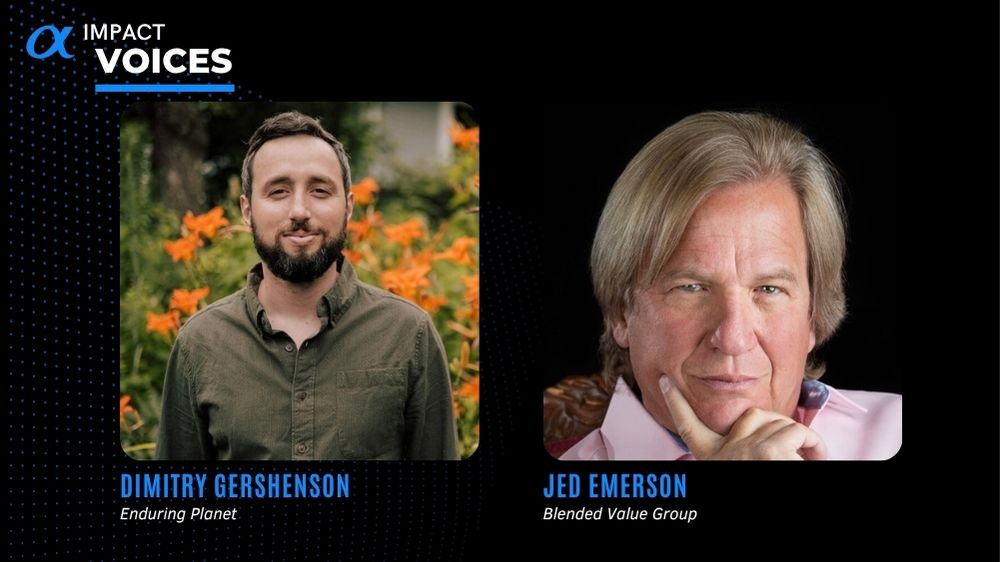
Dimitry Gershenson is co-founder and CEO of Enduring Planet.
Jed Emerson is principal of Blended Value Group
Guest posts on ImpactAlpha represent the opinions of their authors and do not necessarily reflect the views of ImpactAlpha.