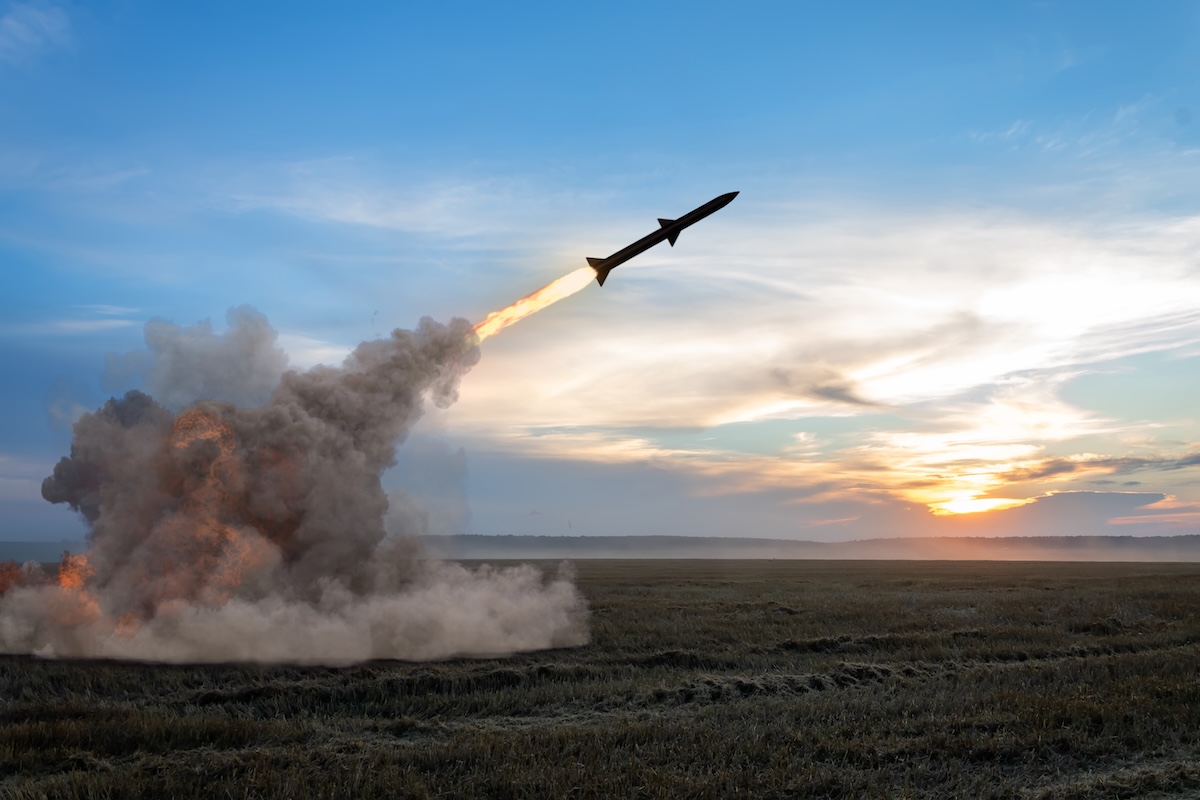

Defense has dominated global headlines in recent weeks, as the world teetered on the brink of World War III breaking out in the Middle East. With the US appearing to be an increasingly unreliable partner, NATO member countries meeting at the Hague officially committed to spending 5% of GDP on defense, up from an average of 2.6%.
Behind the scenes, private investors are expanding the private sector’s role in financing European military technology and innovative solutions for national – and international – defense.
That has sharpened the debate over whether investments supporting Europe’s rearmament are incompatible with principles of sustainable investing and ESG – or indispensable. Without security, the argument goes, there can be no sustainability.
This has devolved at times into a heated battle of words, with critics referring to investors supporting defense tech as “war profiteers.” They accuse defense investors that are using terms like “resilience investing” and “dual use investing” of impact washing – and of rebranding themselves in order to dodge conversations around ethics.
Several of the largest European LPs, including Denmark’s PFA Pension and AkademikerPension, are considering dropping their longstanding exclusions on defense investments. The European Investment Fund, the largest European LP, launched a €175m Defence Facility last year to invest in innovative “dual use” defense tech.
The Defence, Security and Resilience Bank, proposed by Rob Murray, Nato’s former head of innovation, has announced it is fundraising to become a new multilateral financial institution, modelled on the World Bank. The institution would offer commercial lending and guarantees to commercial banks – an important mechanism to implement the ReArm Europe Plan’s €800 billion in short-term spending, and to finance Europe’s ambitions to shape alliances in the Indo-Pacific and Global South over the long-term.
Venture capital and private equity investors, too, are rushing to get a seat on the defense tech rocket ship. Defense is now the fastest growing segment of VC in Europe, with investment flows four times higher than in 2019, according to research from DealRoom. The number of European VCs investing in defense has tripled since this time last year, German VC firm Project A estimates.
Governments are also getting in on the action. DARPA, the US defense research agency that gave the world GPS and the internet, among other things, just launched Venture Horizons, a program allowing a select group of GPs access to the most cutting edge military R&D for potential dual-use commercialization.
What does all this mean for investors who have a mandate for responsible investment, ESG integration or impact investing? Can these things co-exist at all?
ESG tug-of-war
NATO members are now officially committed to doubling their defense spending – money which will presumably need to be reallocated from other areas of social spending. That makes more needed than ever fit-for-purpose ESG risk tools and mandates for investors to look beyond financial returns.
Such approaches could introduce intentionality, evidence, outcomes measurement, and public accountability into the defense tech space.
Recently, we have had a few GPs and LPs quietly asking us about how impact investing approaches might be applied to defense tech investments. Can I do defense as an impact investor? How can we go beyond the simplistic SDG 16 (promoting peaceful societies) to think about impact in the defense sector?
Some impact initiatives focused on security already exist, including PeaceTech, Peace Finance, and Humanitarian & Resilience Investing. Impact investors will have to grapple with how far their capital can go in financing other companies and products that support conflict prevention, counterterrorism, and peacekeeping missions. When do such rationalizations become impact-washing?
Those supporting defense investing, including several notable EU and UK defense leaders, have publicly called out ESG investors as being “stupid”– with some going as far as to say ESG is a risk to national security for blocking financing available for defense. (Although investor concerns seemingly have more to do with reputational risks, than with compliance with ESG regulations).
Dual-use
The debate over environmental, social and governance for investing in defense is not new. Activist campaigns seeking to influence the financial sector to ‘divest from war’ go back decades, from Don’t Bank on the Bomb for nuclear weapons launched in 2012 to Stop Explosive Investments on cluster munitions dating to 2009.
More recently, campaigns have focused on investors’ roles in funding specific conflicts including divestment from Russia after the invasion of Ukraine in 2022 and the student encampments at US universities in 2024 demanding endowments divest from arms companies involved in the ongoing Israel-Gaza conflict.
“Dual-use” technologies, with both military and civilian applications (think computer chips, GPS and AI), are more of a gray area.
To try to bring this conversation down to a more practical level, VentureESG set up a Dual Use Working Group of GPs and LPs across the European and US venture capital ecosystem. Our goal is to understand what the actual concerns and needs of investors are and identify what tools could help move the conversation forward.
Big questions
We have interviewed more than 50 venture capital GPs and LPs with investments in defense and dual use ventures and held consultations with academics, human rights NGOs, and officers in defense agencies. We have had countless informal conversations with dual use entrepreneurs about the ethical concerns they have faced.
At the core of the challenges are a few questions:
What is a weapon? Many LPs have exclusions that prohibit capital being used for “weapons” or “arms and munitions.” Yet most VC funding for defense is not going into building the “tip of the spear” military equipment like guns, bullets or bombs.
Rather, VCs are focused on technological innovations enabling warfighting capabilities. These include advanced software systems for battlefield AI decision support (“AI assisted weapons”) as well as autonomous vehicles (air, sea, underwater drones) and the means to counter them, plus all the supply chain components of remote sensors, lasers, and edge computing, battery and novel propulsion technology needed to work off-grid in remote and extreme environments.
Due to the long timelines and uncertain outcomes of defense procurement, most startups are also pursuing civilian use cases (i.e., a “dual use strategy”) with their products. This raises key questions about the risks of technologies built for the battlefield suddenly in the hands of local police, private security services and civilians.
In addition, defense research agencies are pouring billions each year into R&D organizations (including non-dilutive funding to startups). The goal: building up domestic technological capacity to avoid “strategic surprise” from adversaries in “critical and emerging technologies” – such as quantum sciences, space, novel energy and propulsion and brain-computer interfaces.
The long term weaponization potential for these frontier tech investments are not always well understood.
What is a war? The nature of warfare is also changing quickly. Kinetic warfare between state actors characteristic of the 20th century has taken a backseat to a whole range of other tactics, from information warfare (disinformation, online harassment, influence operations), to economic warfare (tariffs, IP theft, supply chain sabotage, adversarial capital) to proxy wars (civil wars fought in emerging economies funded by global powers) to irregular warfare (terrorism, etc.) to hybrid wars consisting of all of the above.
Emerging forms of cyber, electronic and electromagnetic warfare – although not seen in warfighting yet – could be highly disruptive by bringing down satellites, cellphone towers, air traffic control, electric grids, water treatment plants, and more.
How to manage the risks? With seemingly everything now considered a potential weapon or a potential attack surface, investors tell us they often feel left in the dark and don’t know where to begin setting their policies, safeguards and due diligence. Solving these challenges will require collaboration — between LPs, VCs and experts — to create new fit-for-purpose risk identification and mitigation tools as well as standardized language used in exclusion lists, term sheets and side letters.
In some instances, due diligence and post-investment monitoring may need to be outsourced to parties with adequate expertise in security matters, particularly regarding responsible use by customers and end users. Some progress has already been made including the NATO Principles of Responsible Use of AI and the US Department of Defense’s Trusted Capital Digital Marketplace for identifying adversarial capital in funds of funds.
These are all big questions. Responsible investors need to step up and take their seats at the table in answering them – the future of war, peace, and technological progress for generations to come depends on it.
Susan Winterberg is a research fellow and Dr. Johannes Lenhard is CEO at VentureESG.