By now there’s a methodology, however rough, to calculate the carbon footprint of a particular investment or of an entire portfolio. What about a portfolio’s “wealth footprint”?
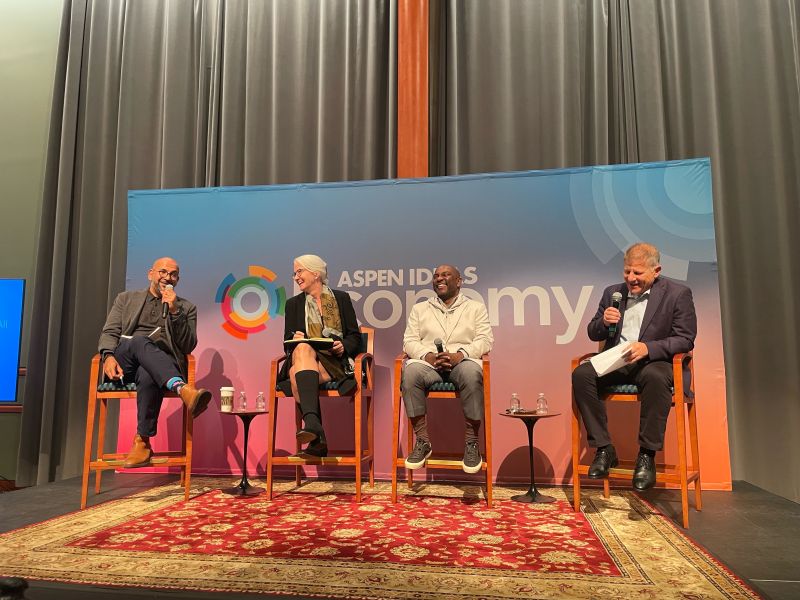
“Everything you do on your balance sheet has an impact on whether you’re extracting or putting back wealth in the community,” Gary Community Ventures’ Santhosh Ramdoss said at this week’s Aspen Ideas: Economy gathering in Newark, New Jersey. “I think we need to say, across your entire portfolio, you hold equities where you extract wealth, and in some cases, you may be putting it back. How do you share a little bit more of it?”
The palpable popular hunger for social belonging and agency, no less so than for financial security, has given rise to an “ownership movement” that is seeking to drive equitable wealth creation through home ownership, employee ownership and ownership of financial assets, such as retirement savings and even the new “Trump accounts” to be for babies born this year under the recent US tax bill.
“It is, yes, about wealth, but it’s about feeling seen. It’s about agency. It’s about feeling like you have control over your own life and your own destiny,” Matt Helmer of the Aspen Institute’s Economic Opportunities Program said at one of the many sessions on ownership strategies at the offshoot of Aspen’s well-known Ideas Festival, which take place in Colorado. Next year’s Aspen Ideas: Economy festival will be held in Tulsa, Oklahoma.
“We as a country need more of that, because we’re at this inflection point where we’re facing a choice, once again, of whether we continue this pursuit of a pluralistic, multiracial democracy, or if we’re going to abandon it to the oligarchy,” Helmer said. “I think employee ownership, but ownership more broadly, has something to say about that.”
Denver-based Gary Community Ventures has deployed approximately $50 million in an ownership portfolio that includes home ownership strategies like the Dearfield Fund and employee ownership strategies like Apis & Heritage.
“Anytime we make an ownership investment, the question we’re asking is, ‘Is there a meaningful improvement in household wealth generation,” Ramdoss said. In its first three years, the Dearfield Fund has created about $25,000 in equity for households in the fund, he said, with similar amounts accruing in employees’ ownership accounts at companies that have converted to employee ownership with financing from Apis & Heritage.
“Our minimum viable depth that we would require is, ‘Does this add $20-, $30-, $50-, $100,000 of net wealth in the household?’” he said. “I think that should be the ask. And at the same time, we want to do it at a dramatic, scalable level.”
Inclusionary investment
On a panel that I moderated, “A nation of owners,” Chicago TREND’s Lyneir Richardson shared a simple idea he has already implemented in the fund’s half-dozen or so investments in neighborhood shopping centers on commercial corridors in underinvested neighborhoods.
“Our model is, we do the financial analysis, we decide if it’s a return we can accept, and we slow down for 60 or 90 days and allow local people to invest on the same terms,” said Richardson, who has attracted nearly 400 investments averaging $2,200 from residents in the neighborhoods around the shopping centers. One recent exit netted such investors a 5X return, Richardson said.
“So when I’m doing these meetings in church basements, I’m saying, ‘Don’t you want to invest on the same terms as Penny Pritzker?” The former commerce secretary, and billionaire, is an LP in Richardson’s TREND fund. Just like many cities mandate “inclusionary housing” to drive the creation of affordable housing units, he said, so could they mandate periods of “inclusionary investing” to allow community residents to get a piece of commercial real estate development on the same terms as the big boys and girls.
Such a change would mean “everybody gets a chance to participate in the economic value that’s created,” Richardson said. And through their relationships, even more people gain exposure to the kinds of opportunities that can build financial security and generational wealth.
“They now know someone that says, ‘I have a little ownership stake there’ – my grandmother, my auntie, my church member, my fraternity brother. They know somebody with a connection to ownership.”
Ownership suite
To reach millions of people and create billions of dollars in equitable wealth, the power of the capital markets must be harnessed for strategies like Chicago TREND, Apis & Heritage and ROC-USA, which helps mobile home park residents form cooperatives to buy the land underneath their homes, said Calvert Impact’s Catherine Godschalk (see, “Financing resident-owned mobile home communities to preserve affordability”).
Rather than simply invest in Apis & Heritage’s larger, second fund, for example, Godschalk worked with the lender to create a $50 million sidecar facility to provide the senior debt in employee-led buyouts that would otherwise require time-consuming negotiations with a local bank. That lets A&H close transactions more quickly (see, “Apis & Heritage closes on $85 million and partners with Calvert Impact to finance employee-led buyouts”).
Thinking creatively, Godschalk said such loans could then be refinanced by local banks, or even rolled into a collateralized loan obligation, or CLO, a rollup of loans that would look familiar to institutional investors. That would enable such investors, by the way, to make the wealth footprint of their portfolios more inclusive and less extractive.
“The market knows how to finance mid-market and lower-middle market companies,” she said. “Why can’t we take the plain-vanilla market tools and apply it to employee owned companies and then just really scale it?”
Such financial vehicles could be part of an “ownership suite” of investment products, from fixed-income to private equity and more, that could unlock more of the $100 trillion-plus capital markets for on-the-ground solutions that enable broad-based wealth building, she said. Reversing the massive inequality of wealth would create not only a broader base for economic growth, but a less toxic political environment, she said.
“We’re in a moment because, on the negative side, this is one of the greatest risks that we hold in our society, to our economy, to our culture,” she said. “And I think we’re in a moment where we really can think about how to create deeper, more effective pathways to capital markets for some of these solutions.”