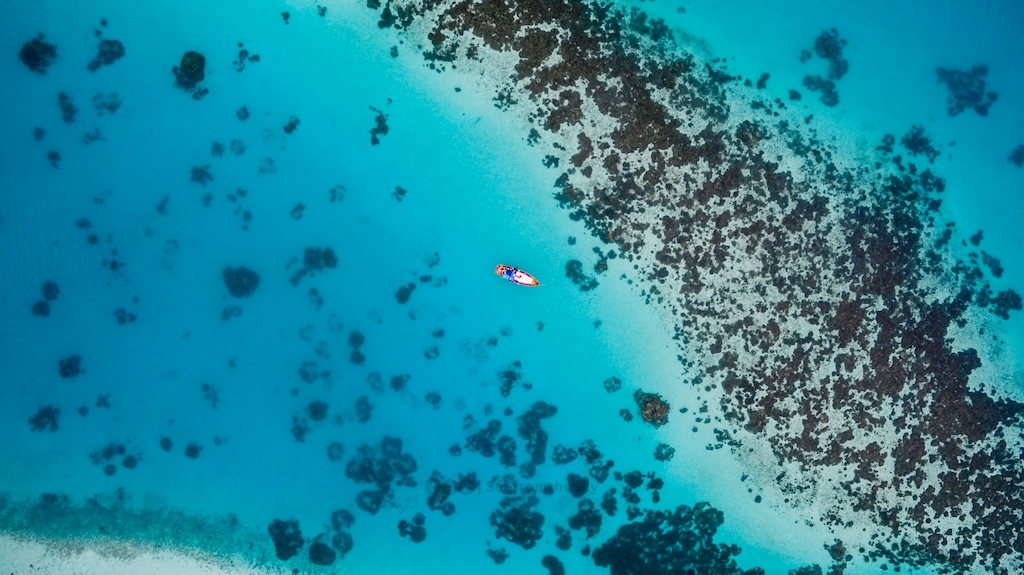
Within the ocean’s vast domain, a seemingly insignificant 2% of the seabed cradles an astonishing 25% of all marine biodiversity – coral reefs.
These vibrant communities, bursting with life, provide essential habitats and breeding grounds to thousands of species, offering shelter, breeding grounds, and food. They also benefit humans by providing economic and environmental services worth billions of dollars each year.
Global average temperatures have become nearly 1⁰C warmer since pre-industrial levels, and the UN Environment Programme forecasts a 97% chance of a temperature increase greater than 2⁰C by the end of the century under current policies, setting up an unprecedented crisis for coral reefs and coastal communities.
The ocean acts as a “carbon sink,” absorbing a significant share of the CO2 emissions released into the atmosphere. That leads to increased ocean temperatures, acidification, and a phenomenon known as coral bleaching, where corals expel the algae that give them vibrant colors and nutrients. This weakens the corals and makes them more susceptible to disease and death.
Coastal ecosystems, where coral reefs are located, are already being degraded at an alarming rate, with far-reaching consequences for marine biodiversity as well as the economic well-being of vulnerable populations who depend on coral reefs for their livelihoods. The loss of coral reefs can lead to decreased fish stocks, increased coastal erosion, biodiversity loss, absorption of wave energy, and reduced tourism revenues; jeopardizing the well-being of entire communities.
Protecting and restoring coral reefs is essential not only for the health of the ocean but also for the economic and social stability of coastal regions.

Catalytic capital gap
Despite the critical importance of coral reefs and coastal ecosystems, investment in their protection and restoration lags far behind other causes. Mainstream investors overlook ocean conservation altogether. Even among impact investors, those focused on the blue economy tend to prioritize sectors like fresh-water aquaculture and marine technology, and often perceive investments focused on restored and protected marine habitats as necessarily high-risk and low-return.
Other factors limiting the amount of capital flowing into adaptation and ocean-related initiatives mostly relate to an incorrectly perceived lack of investable solutions; a tragedy of the commons problem, since the ocean is a shared resource that makes it difficult to define ownership, responsibility and ability to monetize benefits; and and ultimately a high risk perception.
Investing in adaptation and blue economy-related sectors, especially in emerging markets where nearly all coral reefs are concentrated, is often considered riskier due to political instability, market risk, lack of infrastructure, and currency fluctuations.
The Global Fund for Coral Reefs
In 2024, the Global Fund for Coral Reefs, or GFCR, was launched as a public-private partnership driven by more than 60 member states, UN agencies, financial institutions, philanthropies, impact investors, and conservation organizations.
Its mission is to address the threat posed by climate change to the world’s most important coral reefs. The fund aims to identify reefs in geographies with the highest potential to survive rising ocean temperatures and acidification, and then direct capital to ensure their survival.
Given the inherent difficulty of investing directly in coral preservation, GFCR aims to achieve conservation outcomes through blue economy investments in target sectors whose operations and value chains depend on coral reefs, or that can reduce environmental threats by focusing on sustainable practices and transformative business models. Its focus is on established SMEs in sectors such as:
- Wild-caught fisheries management and aquaculture to reduce pressure on coral reefs and other coastal ecosystems. These include improving traceability and supply chain transparency, supporting technologies and methods that improve fishery sustainability, reducing habitat destruction, and promoting responsible oceanic aquaculture practices.
- Sustainable Tourism businesses that prioritize environmental protection and finance the restoration of reefs and coastal habitats, such as ecotourism initiatives, responsible dive operations, and accommodations that implement sustainable practices. Ecotourism sustains local communities and contributes to conservation efforts rather than harming them.
- Circular economy and pollution management through waste management systems, plastic recycling initiatives, and businesses that reduce runoff from agriculture or other land-based activities.

The Global Fund for Coral Reefs has an ambitious fundraising goal of $500 million to invest into roughly 15 established growth-stage businesses where it can either grow inherently sustainable businesses, transform the operations of existing companies by transitioning them to sustainable practices, or build greenfield/brownfield real asset projects that protect local coastal ecosystems.
As with many other catalytic capital funds, GFCR is a blended finance structure that leverages an up to $125 million fully subordinated junior equity tranche from the Green Climate Fund to de-risk capital from senior equity investors. The fund is also supported by a non-dilutive, United Nations-funded technical assistance facility, to further support the portfolio companies’ impacts and measure the impact on ocean health, coastal communities, and coral reefs.
About the catalytic investor
In 2023, the Toniic Ocean Health Working Group, driven by a growing commitment to systemic change and additionality, identified thriving marine habitat restoration as a critical, yet underfunded, investment area.
This decision, coinciding with their engagement with the Global Fund for Coral Reefs, underscored the group’s intent to direct capital towards opportunities where their support would generate uniquely impactful outcomes.
Multiple Toniic members collaborated on a shared due diligence process and ultimately a joint investment in the Global Fund for Coral Reefs through the Sea Forward Ocean Health Fund, a multi-donor advised fund at ImpactAssets with an “everblue” charitable structure for impact investors and philanthropists to contribute tax-deductible dollars.
The mission of Sea Forward is to create a meaningful difference in the health of our ocean and the billions of people who depend on it. Sea Forward invests in innovative and effective solutions in ocean health with a focus on sustainable aquaculture, science-based monitoring tools, circular economy, biodiversity, climate and regenerative nature-based solutions.
Says Laura Francis, marine biologist and founder of the Sea Forward Ocean Health Fund at ImpactAssets, and co-lead of the Toniic Ocean Health Working Group:
“Sea Forward has invested in nine ocean health funds, and we chose GFCR because of its focus on biodiversity and coastal communities in the Global South. We were particularly impressed by the large-scale coalition of partners including the United Nations and multiple European and other governments as well as financial institutions, foundations, NGOs, corporations and development banks. The GFCR investment also complements our Sea Forward grants program as we have recently funded three grants in Indonesia that support coral reef health, community education, and waste management in the coral triangle.
As most of the funds in our Sea Forward portfolio are invested in earlier-stage companies, we wanted to diversify our investments to include scalable growth stage companies that can help reduce threats to nature and promote sustainable business strategies for the ocean.”
The Sea Forward Fund was able to catalyze six investors from the Toniic Ocean Working Group, contributing about $2 million capital invested through Toniic members. Other DAF and Toniic investors can contribute in future closes.
Other investors include the Green Climate Fund, Builders Vision, the Minderoo Foundation’s Flourishing Oceans initiative and Strategic Impact Fund, and Impact Assets.
The impact
While the GFCR is still fundraising towards its final close, it has made six investments to date and has built a robust and proprietary pipeline by addressing a significant capital gap in large sectors of the blue economy. In doing so, the GFCR offers a pathway to a more resilient and healthy ocean, and the ongoing collaboration between international organizations, governments, financial institutions, and impact investors provides a powerful framework for achieving meaningful and lasting change in ocean health, while highlighting the importance of innovative financial mechanisms to protect our planet’s most vulnerable ecosystems.
Ultimately the involvement of investors like the Sea Forward Ocean Health Fund highlights the growing recognition of the importance of ocean health and the need for innovative investment strategies. By supporting GFCR, these investors contribute to a large-scale coalition of partners taking a systemic approach to protect coral reefs and promote sustainable blue economy practices.
Dario Parziale is managing director at Toniic.
The investment by Sea Forward Ocean Health Fund in the Global Fund for Coral Reefs was selected among the catalytic capital investments in the open-source Transaction Database powered by Toniic thanks to the generous support of the Catalytic Capital Consortium, or C3. The database highlights deployment trends in catalytic capital, and analyzes investment terms and investor types at the transaction level.