As the world tires of the status quo, the impact investing playbook may represent a way forward.
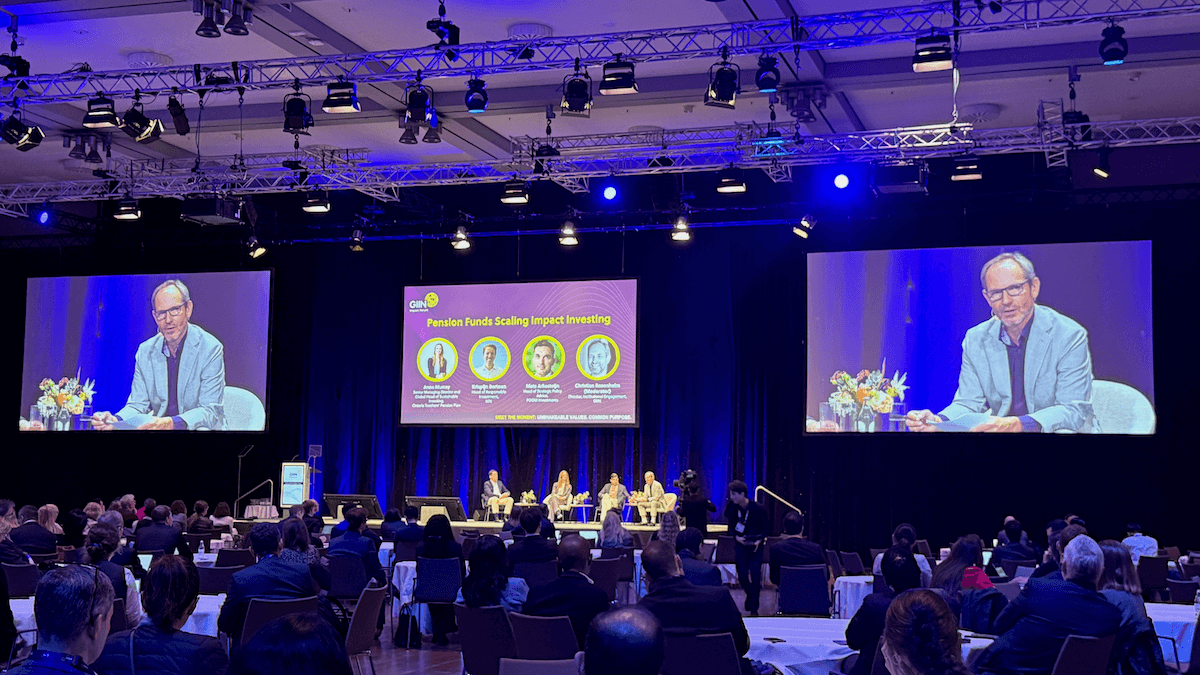
“There is uncertainty in the world, there is volatility, but there’s also clarity,” the GIIN’s Amit Bouri told the more than 1,200 attendees at the GIIN Impact Forum in Berlin last week. “The demands of people everywhere align directly with what impact investing can deliver.”
Bouri says change-elections around the world over the last year show that most people want a lower cost of living, clean air, clean water, decent jobs, a safe place to live, and confidence that things will get better, not worse.
Impact investors, he says, “have the tools, the track record and the collective power to answer.”
Long-term alignment
Being a responsible investor “is part of our DNA,” said Shahzad Memon of APG, which manages the assets of Dutch pension fund APB. APB has set a goal of deploying €30 billion ($35 billion) in impact investments by 2030. “We take our March orders from [APB], and they want us to actively go and invest in impact,” said Memon.
Memon says the strategy includes targets for biodiversity and nature-based solutions, impact private debt and real estate, and funds that align manager incentives with impact goals.
For long-term investors, impact and financial are increasingly interlinked, said Memon. “Climate-related risks are long-term risks which will affect your financial value in the future,” he said. “If you’re a long-term investor trying to create better pensions for your participants, this has to be taken into account.”
Hedging and betting
Insurance companies, including Zurich Insurance Group, Nippon Life in Japan and Allianz, are increasingly responding to climate risk exposure in their products and services with investments from their balance sheets in sustainable infrastructure and resilience solutions.
Zurich Insurance Group’s responsible investment program includes managing climate risk, including through exclusion screens, ESG integration and climate risk modeling. Increasingly, the Swiss-headquartered insurance group is focused on proactive climate solutions, such as certified-green buildings.
“That’s really where we can provide a rather direct and enabling factor to lead the green transition,” Zurich Insurance’s Danielle Brassel.
Nippon Life is making investments in steel, power, transportation in Japan, Southeast Asia and Europe to drive change in these economies from ‘brown’ to ‘green.
“It’s important to institutionalize our aim and then our process, internally and externally,” saidNippon Life’s Ayako Kageyama. “Things are moving.”
AI = Accelerating Impact
Two decades ago, Leapfrog Investments launched with what Andrew Kuper believed at the time to be a “crazy” goal: to deliver healthcare, financial services and climate solutions to 25 million low-income people in emerging markets. Today, with more than $3 billion deployed, Leapfrog portfolio companies serve more than 20x that number, providing essential services for 560 million people.
In India alone, Healthify is helping 40 million Indians eat better, lose weight, lower their cholesterol by delivering nutrition and health advice through AI agents.
“People want to be the agents of their own destiny,” Kuper said in the GIIN forum. “In that market and many others, the curve is being bent for health in a way that was inconceivable before.”
Kuper called for investors to lean into human-focused AI applications. “Now is our time as capital allocators, as business leaders, to ensure that all of humanity benefits from this dramatic revolution.”
Cultural capital
Impact investments in creative economies were on the agenda in Berlin, according to a dispatch from Upstart CoLab’s Laura Callanan.
French sovereign wealth fund BPIFrance has invested €8 billion in 16,000 French companies throughout the creative industries.
The International Finance Corp. launched its creative economy strategy in 2022 with $400 million to support creative infrastructure like film and TV soundstages intended to help bring production to the emerging markets.
Nigeria’s Ministry of Art, Culture, Tourism and Creative Economy recently stood up a $300 million Creative Economy Development Fund to create jobs and diversify its economy beyond oil.
Institutionalizing impact
Swiss impact investor BlueOrchard is seeing growing investor demand for impact investing globally, and increasingly from insurance companies.
From Scandinavia to Japan, “they’re [institutional investors] seeing that their efforts should go beyond just the very narrow interpretation of financial return,” he says. BlueOrchard’s Michael Wehrle tells ImpactAlpha.
Wehrle says BlueOrchard is designing more investment opportunities and strategies that appeal to more family offices, pension funds and insurance companies. That means integrating financial analysis, ESG and impact measurement processes, that are supported internally by governance and externally verified to ensure credibility.
Over the last 25 years, BlueOrchard has placed emphasis on “building robust processes, controls and frameworks,” says Wehrle. In Europe, all of the manager’s funds are Article nine funds, “which gives a certain stamp of validation and gives our investors comfort that when they do invest with us, that in their perspective, the risk of impact washing is mitigated with the greatest extent possible.”
Spotting hidden potential
German impact fund Roots of Impact and impact-linked financing champion, is testing out Simple Agreement for Future Impact or SAFIs, where debt issued to a company is repaid based on payments tied to a set percentage of the company’s revenues.
The firm has already issued a SAFI note to Kenyan water distributor Purefresh, via a joint water fund co-designed with the non-profit Aqua for All. (For additional background, see; Forget SAFEs. Impact investors are incentivizing growth and impact with SAFIs).
“It’s about testing an investment thesis that’s fully impact data-driven,” Bjoern Struewer of Roots of Impact tells ImpactAlpha. “We are a market builder, not exclusively, but that’s just our mission.”
The firm is teaming with impact data firm 60 Decibels to launch the Hidden Potential Fund, a new vehicle leveraging 60 Decibels’ data bank of over 1000 social enterprises globally.
The fund will identify companies which perform well against certain impact metrics, but are underperforming in some, hence the name hidden potential. This data-driven approach will help the fund offer targeted SAFI notes, rather than providing support to reach a broad array of impact metrics.