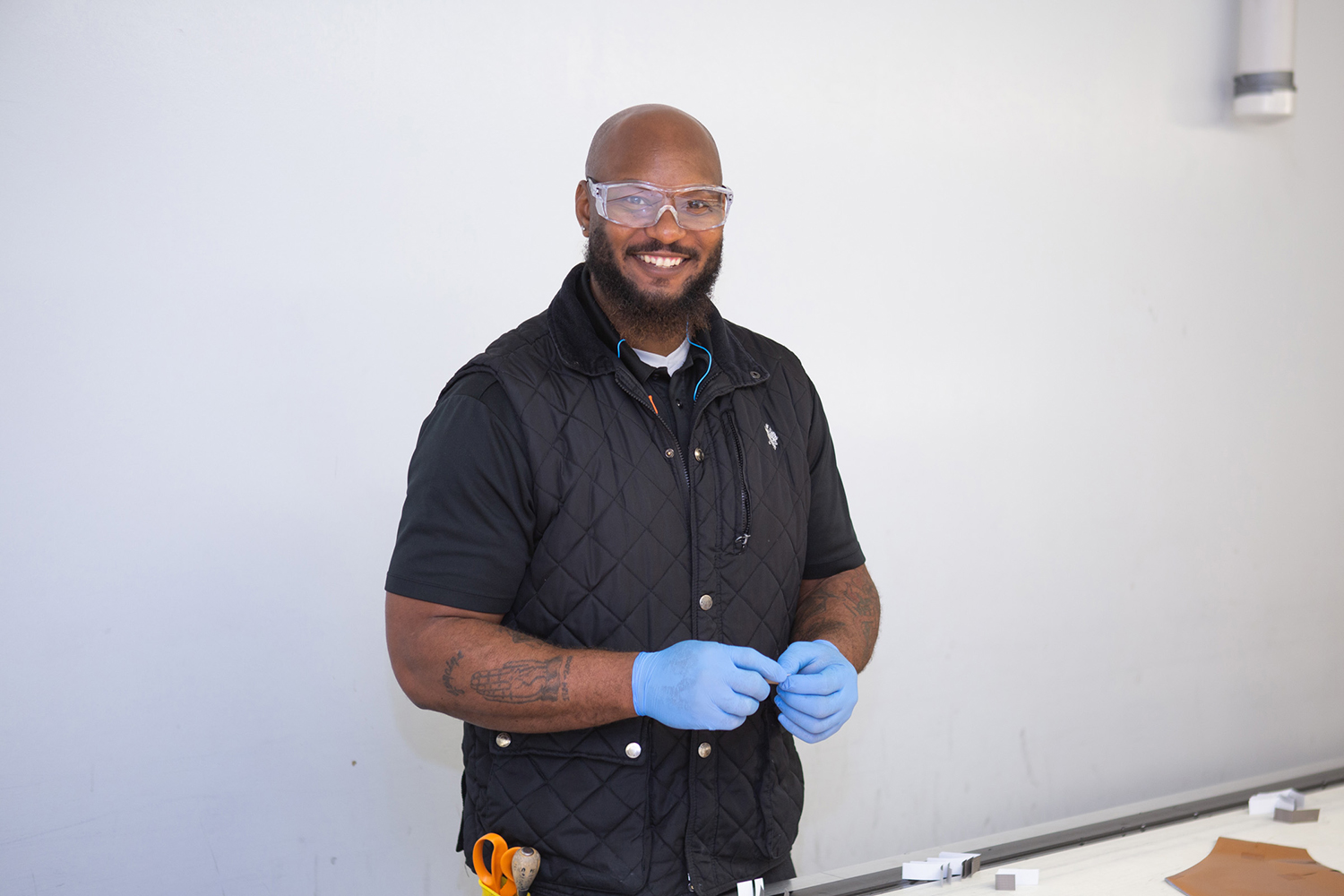
A Black single father, Kevin Sims had been out of a stable full-time job for about a year when he got hired as a technician at Web Industries. The Massachusetts-based manufacturer makes aviation and medical products using flexible materials like foams and composites.
When the company’s human resources representative told Sims that Web was 100% owned by its employees through an employee stock ownership plan, or ESOP, “I didn’t understand what that meant and I didn’t ask too many questions,” Sims reflects in a personal essay. “I was just happy to have a job.”
That was almost 10 years ago. Sims, now 52 years old, plans to exit from the ESOP in two years, when he is set to graduate from culinary school. Sim wants to use his ESOP payout to start a food-truck business that he can later pass down to his son.
“All of this ties back into the ESOP and what it has done for my life,” Sims told ImpactAlpha. “Without that, I would not have this future to look towards and I would not have this happiness and this opportunity.”
Web was founded in 1969 by Robert Fulton (known as Bob by his peers) in a rented basement near Boston. Fulton handed over a portion of the business to employees in 1985. In 2000, Web became fully employee-owned. Today, the company has more than 800 workers across eight manufacturing facilities in the US and Europe.
At last week’s Employee Ownership Ideas Forum in DC, Web’s Michael Quarrey said that as the company was expanding internationally, it created “plans that mirror the ESOP [to] include our international employees.
During the COVID-19 pandemic, Web went through a period of crisis as the world went into quarantine. Its two biggest customers for its aerospace materials, Boeing and Airbus, had scaled back their spending. “Our business dropped in that largest part of our company by about 90% and that’s obviously something that any company would find challenging,” Quarrey said during a panel discussion.
Web pivoted to making COVID rapid tests and hospital gowns, he added. Due to overwhelming demand, employees worked nights and weekends and even brought in their family members to help. Sims was one of those employees.
“I was part of that crew in Denton during COVID. We worked overtime and it kept us busy. It kept us a job,” he said. “I was so pumped that I was needed in a time like that.”
In his essay (below), “Like I had a stake in something,” Sims reflects on how becoming an employee-owner of Web Industries changed his life:
I know hard work. I was raised by a single mother of five who cleaned houses to survive. When I was 14, I got my first job tearing down houses and driving a dump truck.
For years, I worked for a moving company, hauling heavy furniture. When I lost that job, I did a few jobs on the side and worked for a buddy who had an art hanging business. I was constantly worried about how to pay my bills. I didn’t know when my next paycheck was coming or where it was coming from. I was always running. Oh my God.
I was already in my 40s, had my own son, and worried constantly about my future and his. I started applying for jobs and after about a year of trying, I got hired by a manufacturing company in Denton for an entry-level technician position. When I got the call I said, “thank you, God.”
I had little idea at the time just how thankful I’d be. Amidst all the other info, an HR rep told me my new employer, Web Industries, was 100% employee-owned. I didn’t understand what that meant. I didn’t ask too many questions. I was just happy to have a job.
Once I started, they began explaining to me that all of Web’s employees, from the workers sweeping the shop floor to the CEO to me, shared ownership of the company. They told me we have an employee stock ownership plan, or ESOP, which provides tax incentives to companies that share ownership with workers. And I was like, “WHOA!” I was so emotional about it. Tears came to my eyes. “Are you kidding me? I’m an owner of this company.”
If I’m being honest, I still didn’t really understand what ownership meant. But eight years later, it’s crystal clear and I can say with certainty that the ESOP has changed my life. When I was at the moving company, it was just business as usual, go to work, go home. I had no retirement, no say in anything. Just work. At Web, it was totally different from the start. I was taught to think like an owner, to speak up if I saw ways to do things more efficiently. I was really intrigued by that. I know I’m important, but it made me feel really important, like I was worth more, like I had a stake in something.
I came in everyday knowing I have a voice that can make change. If the company is losing money, I’m losing money. What can I do to help us?
I remember I noticed that we were wasting a lot of material because ID labels were falling off and if we didn’t have the label, we’d have to trash the entire roll. Raw materials are very expensive in our line of work so that really bothered me. I thought, “what can I do to help my team save money and get rid of this issue?” It was actually so simple. I suggested we put the labels inside the core and then reprint them on the outside. This way we could always trace it. They heard my voice, made the change and saved a lot of money–probably about $30,000 a year or more. Every time I see those tags inside of the core, I know that was my idea and feel proud.
Another time I felt proud was when COVID hit. Instead of laying people off when our main business slowed, employees moved around to both help keep us afloat and help those on the frontlines of the pandemic. Some of us switched to making COVID tests. I got assigned to making hospital gowns, thousands and thousands of them each day. We loaded them up and it felt really important to be able to provide these gowns to doctors and nurses helping to fight this deadly virus.
Of course, it’s been exciting and reassuring to see my ESOP account grow year after year and know I won’t have to work into my 70s before I can retire. But perhaps the moment when I recognized the true power of the ESOP was when I led the building of a blanket that went up into space. Engine blanket 1361, I’ll never forget that number. I got a plaque and a letter that the blanket I built went up into space. It was possible because Web invested in the growth of a technician with no experience and paved the way for me to grow my skills and, in turn, help the company grow.
I come in every day with a smile on my face. “Why are you always smiling?” My colleagues ask. I have to explain it to them, how I was blessed when I got here and I don’t see myself going anywhere else. When new employees come in, I explain that being an owner means this is my business and it’s now theirs, too. A lot of times they don’t understand it right away. But I explain it to them until I see their faces light up.
I wish more companies shared ownership with workers. In Texas, we have only 370 ESOP companies, out of more than 3 million, according to the most recent data from the National Center for Employee Ownership. Across the country, there’s only about 6,500 ESOPs, covering less than 1% of the U.S. workforce–and the number has been flat for years.
ESOPs can be particularly powerful tools for building wealth for Black workers like me, who are much less likely to own equity than our white counterparts. In 2022, two-thirds of white families owned stocks, compared with 39% of Black families, according to the Federal Reserve’s Survey of Consumer Finances (SCF). The median value of total stock holdings among White families that year was $67,800, more than four times the amount for Black families.
Broadening opportunities to participate in employee share ownership is an important strategy to help address the race and gender wealth divide, according to a report by the Aspen Institute, the Rutgers School of Management and Labor Relations and Democracy at Work. It’s one of the reasons I was excited to hear there’s a growing movement looking to expand employee ownership to every company in the country and am proud to add my voice to that effort.
I know what it’s like to work hard and not get ahead. The ESOP gave me a solid foundation. It helped me grow. It gave me a sense of ownership over my life. I want that for everyone.
—
Kevin Sims is an inspector at Web Industries, a 100% employee-owned US manufacturing company.