
Development funding is in freefall. The US has started the process of dismantling USAID. The UK has slashed overseas aid. And anti-development headwinds could prompt other countries to follow suit.
Many people in global development hope that impact investors will make up the shortfall. But that investment should not be taken for granted.
We cannot expect impact investors to fill these funding gaps without clear, concrete data on how their capital can make a difference – and, more specifically, without clear evidence-driven answers to the question of why investing in one problem over another will deliver more impact.
That’s why, today, we’re publishing a ‘hit list’ of the biggest problems facing the planet, and the most effective ways to target their root causes. It’s the result of a year-long study commissioned by VC firm güil Mobility Ventures.
Why we need an impact hit list
Having spoken with institutional investors and venture capitalists over recent years, I’ve found that one of the perennial challenges that many impact investors face is knowing where to invest to maximise impact.
To put it another way: if you’re a venture capital firm focused on, say, the mobility sector, and you care about impact, what problems should you focus on? Where should you start?
That’s not just a theoretical question. It’s exactly the conversation I had with Lionel Kaufmann, Managing Partner at güil Mobility Ventures, last year. Lionel was the first person to frame the issue so clearly to me: given our unique investment focus, what types of investments should we target to move the dial in the most impactful way?
Lionel didn’t want to measure the impact of investments after the fact. Nor did he want to run an impact analysis of ‘Investment A’ versus ‘Investment B’. Instead, he wanted to understand what types of investments to seek out in the first place.
After a discussion, we realised this would require two pieces of research: firstly, a breakdown of the biggest problems facing the planet – backed by hard data and evidence. Secondly, a research framework that could help investors know where to invest if they wanted to have the most impact on these problems.
We later realised that this research could provide a blueprint for other investors to answer these same fundamental questions, which is why we have decided to publish the results of this research publicly.
The biggest global problems
Providing a hit list of the biggest global problems facing humanity is not a simple task. How do you compare the magnitude of one problem with another? And how do you get your hands on this hard data in the first place?
Our answer to the first problem was to sort 30 of the biggest problems facing humanity across three different axes: incidents per annum, annual severe bodily harm, and annual deaths. The result is a multi-dimensional ranking of the most significant problems facing the world.
The results provide investors with a reality check on where to focus capital if they want to maximize impact. In particular:
- ‘Severe communicable diseases’ ranks the highest for incidents per annum (26.1 million incidents)
- ‘Noncommunicable diseases’ leads to the highest number of global deaths (17 million deaths)
- ‘Malnourishment’ ranks highest for annual severe harm (768 million incidents)
Equally, the research showed that many overlooked global challenges rank highly on these metrics. ‘Domestic violence against women’ ranked second for annual severe harm (103 million incidents) while ‘air pollution’ ranked second globally for causing the largest number of deaths annually (6.7 million deaths).
We all intuitively know these problems are significant causes of harm globally, but the scale of these challenges might give us pause for thought on whether our investments would be better targeted at solving them over other problems.
How to move the dial on these problems
But, more importantly, alongside this data, we’re also publishing a distinctive answer to the question of how best to move the dial on these global challenges.
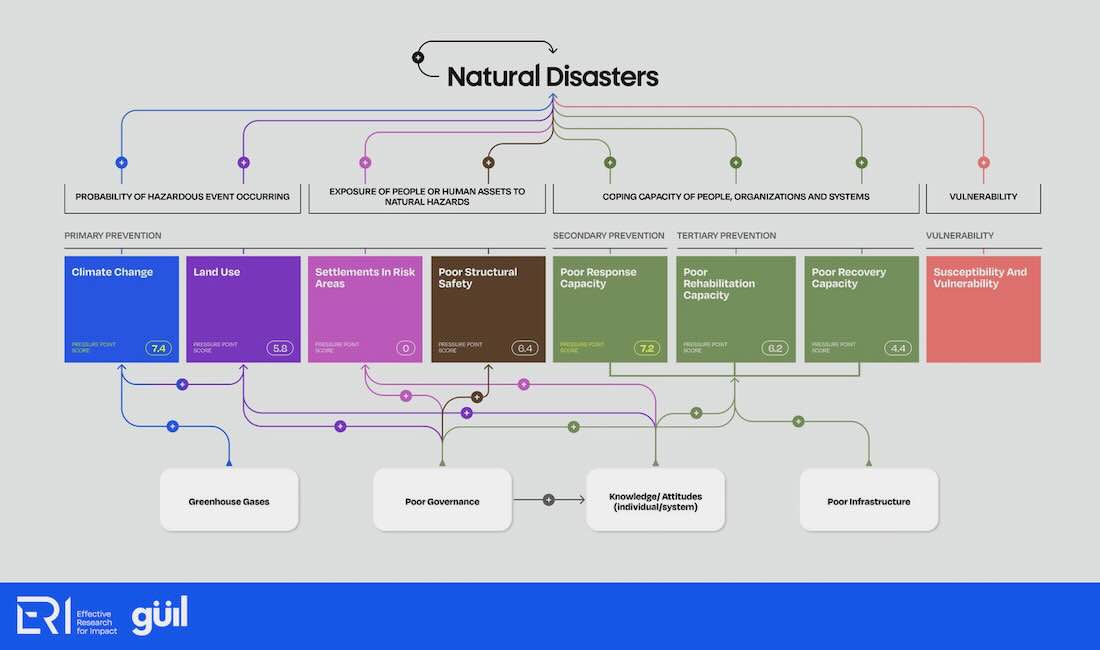
We’ve developed a unique systems-based framework that reduces each global challenge into its underlying root causes – and we’ve quantified how much each cause contributes to the problem.
In practice, this meant breaking down each global problem into a complex network of its causes. With this mapping in hand, we calculated a numerical score for each cause by integrating factors such as dominance (the cause’s impact on the problem) and centrality (the number of ways it causes the problem). This analysis is all backed up by peer-reviewed scientific research.
This meant our researchers could then identify the few underlying root causes that really matter. In our own research parlance, we say that the root causes with the highest numerical values are the problem’s ‘pressure points’.
And, if you can target your investments on these underlying drivers, you can maximize your impact:
- When it comes to reducing harm from natural disasters, focusing resources on alleviating climate change and improving disaster response capacity will have the biggest impact.
- In the case of noncommunicable diseases, focusing resources on human behaviours (exercise, adequate sleep, and a healthy diet) and reducing exposure to air pollution will have the biggest impact.
- If you’re focused on solving extreme poverty, focusing resources on tackling the problem of low wages will have the biggest impact.
While some of these results might feel like common sense, others are truly instructive. In either case, this provides impact investors with an evidence-based lens to judge where they should focus their limited time and capital.
In güil’s case, we went a step further and worked out the impact per dollar returns of any given mobility investment. This framework accounts for the importance of the affected pressure point as well as how much one dollar would affect that pressure point.
Bringing it all together
In the case of güil Mobility Ventures, the lessons write themselves. Armed with this data, they can now look at the biggest global problems they want to solve – and use the impact per dollar framework to focus on investments that tackle the most significant underlying causes.
If they want to move the dial on natural disasters (200 million incidents annually), that might mean finding investments to improve disaster response: perhaps vehicles that can better navigate disaster environments or, alternatively, help get vehicles into the right place at the right time faster.
The immediate output of this research will, hopefully, be to provide impact investors with more hard data on where to focus their energy to maximize impact, so they can better bridge the funding gap created by the collapse in government aid.
But I hope there will be a longer-term impact of this research too – to help all of us start to think in a different way. I hope it helps us ask deeper, difficult questions about how to move the dial on these social problems.
Or, to put it more bluntly, I hope it forces us to ask whether we’re genuinely focused on the right problems – and whether we’re genuinely focused on the right solutions. Resources are too scarce to waste on well-meaning efforts that don’t actually move the dial.
__________________________________________________________________________________
Gilad Tanay is Chairperson and Founder at impact research consultancy ERI Institute. The Global Challenges project was funded by güil Mobility Ventures. You can view the research and underlying data here: theglobalchallenges.com