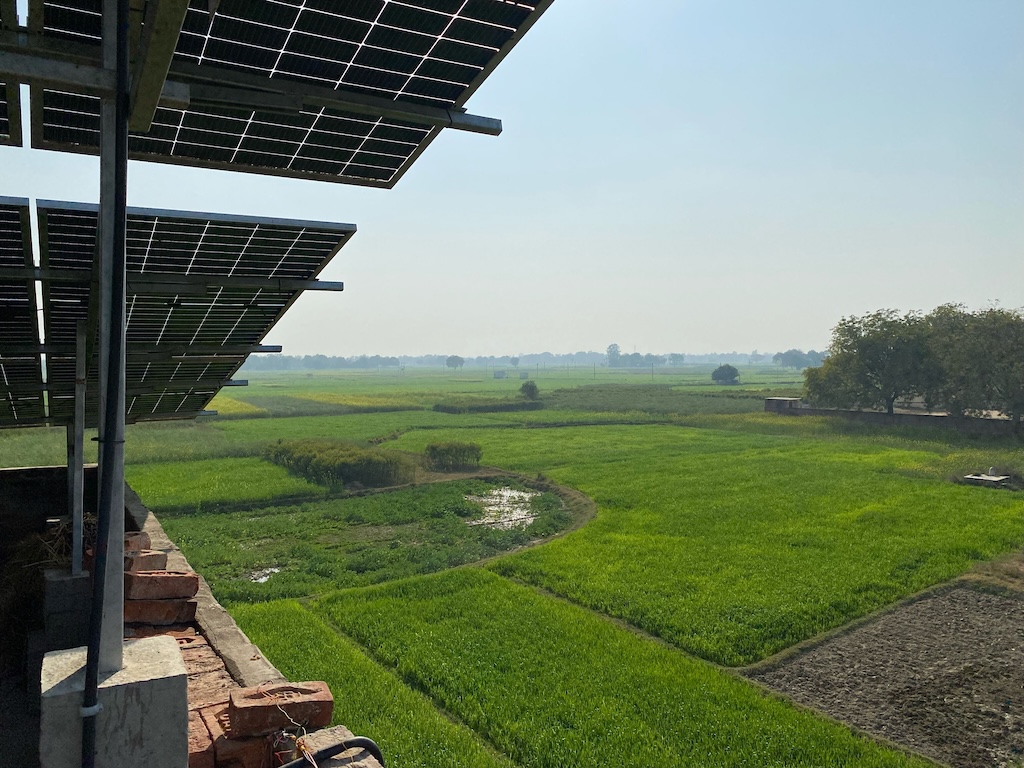

The global clean energy transition includes businesses across the emerging markets of Africa, India and elsewhere that are installing their own small-scale, local solutions to power their operations and reduce their costs.
But local lenders unfamiliar with solar projects and a still fragmented ecosystem of manufacturers, vendors and installers means that many small businesses cannot access the financing needed to realize the benefits of energy access and clean energy solutions. Multiple barriers, visible and hidden, are preventing capital from flowing where it is needed even in places where there’s no shortage of lending capital.
In India alone, these 63 million small enterprises account for 25-30% of India’s total power consumption. Serving this market could drive 15 million tons of CO2 emission reductions annually while helping smaller businesses slash their energy costs.
To stand up its strategy to unlock rooftop solar financing for micro-, small- and medium-sized enterprises in India, New York-based Encourage Capital has found that, in addition to investing, it had to build lender capabilities, help organize the fragmented solar equipment and installment landscape, develop tailored financial products and raise awareness through targeted campaigns.
Five years later, Encourage Capital’s strategy has backed lenders that have financed projects for nearly 3,400 enterprises, already exceeding its 10-year goal. Through June 30, 2025, that represents 131 megawatts of new solar capacity, halfway to Encourage Solar Finance’s 2030 goal.
The case of solar financing for small businesses in India is part of a new publication from the Catalytic Capital Consortium, “Addressing capital gaps: A guide to strategic deployment of catalytic capital.” The guide explains key aspects of the catalytic approach and showing how these elements come together to shape a catalytic capital strategy, across four key steps.
Investment and guarantees aren’t enough
When Encourage Capital, an investment firm focused on environmental and social challenges, launched its strategy five years ago to finance rooftop solar financing in India for micro-, small- and medium-sized enterprises, the opportunity looked massive: Such “MSMEs” represent an untapped $9 billion market for 15 gigawatts of installed solar capacity.
For Encourage, the natural starting point was clear: Make private equity investments in specialist non-bank lenders that already served the MSME segment and were open to new opportunities in solar.
These lenders had cracked the code on reaching underserved smaller businesses. For example, they provide tailored credit approaches based on cashflow and behavioral assessments, rather than traditional collateral requirements. They had the distribution networks, customer relationships and credit expertise needed to make solar financing work.
Encourage Capital recognized it would still run into several obstacles. These lenders were unfamiliar with rooftop solar technology and market dynamics. They were skeptical of client demand for solar products. The ecosystem of solar equipment providers and installation companies, or EPCs, was highly fragmented, with wildly variable quality, which created real performance risks. Launching this new business line would incur significant up-front costs – including product development, staff training and marketing – with an uncertain payoff.
These risks and challenges made lenders hesitant to move. To lower the barriers, Encourage Capital in 2021 worked with USAID and the US Development Finance Corp. to arrange credit guarantees covering 30-50% of losses in lending portfolios on a pari-passu basis. This partial first-loss facility would mitigate downside risk in a nascent market while ensuring lenders would maintain meaningful exposure — they’d still have substantial skin in the game.
Market dysfunction
However, it was clear to Encourage Capital that this combination of equity investment and risk-sharing wouldn’t be enough. The fundamental market dynamics remained challenging in ways that no amount of well-structured financing could fix.
On the supply side, the fragmented ecosystem of equipment providers and installers meant that even willing lenders would struggle to ensure quality installations. Poor installation quality would undermine customer savings and loan repayments, threatening the entire business model.
Lenders also lacked the specific capabilities needed for this new line of business. Their staff needed training on solar technology and new products. They needed support to develop robust systems, policies and technology tools for managing solar lending. Without these capabilities, the best intentions would be stymied by poor execution.
On the demand side, the small- and medium-size enterprises themselves had low awareness of rooftop solar solutions and the cost savings they could generate. They certainly weren’t knocking on lenders’ doors asking for such products, reinforcing lenders’ perception that no real market existed.
Even if awareness grew, MSMEs would need tailored product designs, including offerings with repayment schedules calibrated for immediate savings versus grid costs, multiple options responding to varying confidence levels, and leasing arrangements that reduced risk.
Not all barriers that cause capital gaps are rational. In this case, lenders had neither awareness of rooftop solar as an opportunity, nor familiarity with the technology and market dynamics. Without demonstrated client demand, moving into this space also felt like a leap into the unknown, with unclear upside.
Investors, like all humans, experience ambiguity-aversion (preferring familiar lending over unknown opportunities despite potential rewards) and loss-aversion (experiencing the downside of failed initiatives more intensely than the upside of successful expansion). Even where individuals within an organization are inclined to move forward, organizational inertia against making such moves can be powerful.
Matching tools to barriers
Recognizing the many barriers, Encourage Capital assembled the pieces that were needed to unlock capital flows. In addition to investment, Encourage Capital brought deep expertise and conviction about the market opportunity to these partnerships with lenders.
The combination of specialist knowledge and investment capital may have been pivotal in overcoming lenders’ otherwise entrenched mindset barriers. Encourage Capital was committing its own “skin” to the game, which was persuasive in a way that mere information-sharing could never be.
This alone wouldn’t get the market working properly. Realizing this, KfW, the German development finance institution, one of the investors in the fund, provided technical assistance grants to Encourage Capital. The TA grants supported the organization of the fragmented solar equipment and installment landscape, the development of financial products tailored to client needs, targeted awareness campaigns through local business associations, and the building of lender capabilities through systems development and staff training.
Each piece of the strategy addresses specific barriers and reinforces the others. Equity investment was necessary but not sufficient. Guarantees mitigated financial risk but did not improve market conditions. Indeed, incentivizing lenders to enter such a market would set them up for failure.
To address these real challenges, comprehensive TA stepped in to upgrade EPC quality, develop appropriate products, create awareness and build lender capabilities.
Encourage Solar Finance’s portfolio companies have already financed 3,378 MSMEs for 131 megawatts of new solar capacity through June 30, 2025, representing 103% and 50% of fund targets, with five years still to run.
The real success is starting to show in market-level shifts.
Bajaj Finance, a major lending institution in India, has called green finance one of its “Top 3 Megatrends” and announced ambitions to deliver solar finance to MSME and retail customers. The Small Industries Development Bank of India has raised $315 million specifically to scale up MSME finance solutions.
Closing capital gaps
The Encourage Capital case study highlights four principles.
Understand barriers in order to design strategies. Encourage Capital comprehensively understood what blocked capital flow, including mindset barriers and overlooked infrastructure gaps.
Assess what can actually change. Once lenders establish solar business lines, they won’t need continued technical assistance. When solar ecosystems are more developed and organized, performance risk declines. Once awareness reaches a critical mass, demand becomes self-sustaining. This suggested transient rather than structural gaps that are closable through time-limited interventions. Honest assessment matters: Not all barriers disappear (for example, higher pricing in cases of inadequate collateralization) and we should be clear when that’s the case.
Recognize that investment alone may not resolve the gap. This example required both investment and TA responses. Others might also benefit from efforts to influence other market actors, or stimulate and inform changes to market rules, such as laws and regulations. Not every investor can do everything, but being explicit allows us to formulate the right strategy and partner to fill gaps.
Build for adaptation. No plan survives contact with the enemy, and market change can never be fully predicted in advance. Track what is changing in the market — whether other actors are entering, how demand patterns are shifting, how infrastructure is developing — and refine strategy accordingly.
Roadmap for deployment
In a world facing critical financing gaps across a wide range of impact needs, catalytic capital remains a crucial yet scarce resource. We urgently need our catalytic capital to work harder than it ever has before.
“Addressing capital gaps: A guide to strategic deployment of catalytic capital,” a new publication from the Catalytic Capital Consortium, offers a roadmap to deploying catalytic capital as a strategic tool that responds to the investment barriers that lead to capital gaps, and, where possible, seeks to resolve those gaps. The guide is about making catalytic capital work as powerfully as possible.
In addition to SME rooftop solar in India, the real-world case studies include agricultural enterprises in Africa and employee ownership conversions in the United States, explaining key aspects of the catalytic approach and showing how these elements come together to shape a catalytic capital strategy, across four key steps:
Describe. Select specific investee situations and financing channels based on impact potential, and your interests and capabilities. Unpack broad categories like “SME finance.” Get specific about size, sector, geography, and other characteristics.
Analyze. At the direct investment level, identify key rationale and mindset barriers systematically. Assess which barriers could be improved versus those that are likely permanent.
Extend. Expand analysis to the indirect investment level. Understand asset allocators, and identify barriers between them and financing channels. Assess potential to improve barriers.
Respond. Develop investment parameters, identify the need for grants and technical assistance, and consider influencing and advocacy moves. Make explicit choices about which responses align with your capabilities, and consider where you could partner. Do this with an understanding of what’s already changing or being done. Deploy, learn and adapt.
Harvey Koh is a senior advisor at the Catalytic Capital Consortium (C3).
Guest posts on ImpactAlpha represent the opinions of their authors and do not necessarily reflect the views of ImpactAlpha.